In a Nutshell
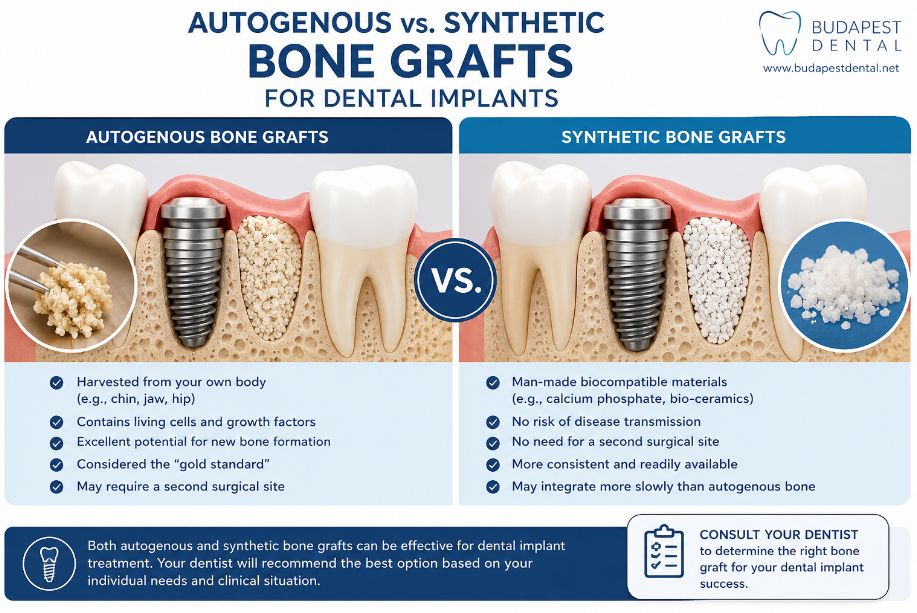
Autogenous and synthetic bone grafts can both support successful dental implant treatment when they are chosen for the right defect and placed using a well-planned surgical protocol.
-
Autogenous grafts use your own bone, usually harvested from the jaw. They provide strong biological activity and may be preferred for larger or more complex bone defects.
-
The trade-off: harvesting your own bone creates a second surgical site, which can mean more swelling, discomfort, recovery time and a small risk of altered sensation.
-
Synthetic grafts are biocompatible, man-made materials that act mainly as a scaffold for your own bone to grow into. They avoid donor-site surgery and are widely used for ridge preservation, guided bone regeneration and selected sinus-lift procedures.
-
Success rates can be similarly high: research does not show that autogenous bone is automatically superior in every situation. The defect type, surgical technique, healing, smoking status, gum health and long-term maintenance all matter.
-
The right choice is individual: autogenous bone may be recommended for major reconstruction, while synthetic grafts can be an excellent, less invasive option for smaller or moderate defects.
-
For UK and Irish patients travelling to Budapest: request a CBCT-based treatment plan, the exact graft material and technique proposed, realistic healing times, a full cost breakdown and copies of your scan and implant records.
Your Own Bone vs Man-Made Bone Grafts for Dental Implants: Safety and Success Rates
Dental implant treatment is often presented as a simple replacement for a missing tooth. In reality, an implant needs enough healthy, stable bone in the right position to support a crown, bridge or full-arch restoration over the long term. When bone volume is limited, bone augmentation may be recommended before or during implant placement.
Important: This article is for general information and should not be treated as personal dental or medical advice. The choice between using your own bone and a synthetic bone graft depends on the amount and type of jawbone loss, overall health, gum condition, smoking status, treatment goals and the clinician’s assessment. Bone grafting and implant treatment carry risks and cannot guarantee a specific result. Always obtain an in-person consultation, appropriate X-rays or CBCT scan, and a written treatment plan from a qualified implant dentist or oral surgeon before proceeding.
For UK and Irish patients considering dental implants in Budapest, Hungary one common question is whether it is safer or more successful to use your own bone or a synthetic bone graft. Neither option is automatically best in every case. Autogenous bone has unique biological advantages, while synthetic graft materials can avoid a second surgical donor site and perform predictably in many routine implant procedures.
The most important point is this: the best graft is not chosen from a price list. It is selected after a proper assessment of the defect, the implant plan, the quality of the soft tissue, the patient’s health, the desired treatment timeline and the clinician’s ability to deliver a stable, cleanable result.
What Is a Bone Graft for Dental Implants?
A bone graft is material placed to rebuild, preserve or support the jawbone where natural bone is insufficient for an implant. It may be used after tooth extraction, in a narrow ridge, beneath the sinus in the upper back jaw, around an implant placed into an extraction socket, or in larger defects caused by trauma, infection, gum disease or long-standing tooth loss.
Bone augmentation is not always required. Many patients have sufficient native bone for implants without grafting. However, when bone is too thin, too low, or positioned unfavourably, placing an implant without augmentation can compromise implant stability, aesthetics, bite function or long-term hygiene access.
A graft does not simply “turn into bone” overnight. Healing involves blood supply, cellular activity, new bone formation and gradual remodelling. The final outcome depends on surgical technique, stability of the graft, membrane use where indicated, infection control, smoking status, oral hygiene and adequate healing time.
The Main Types of Bone Graft
Several graft categories are used in implant dentistry:
This article focuses on autogenous bone and synthetic bone substitutes. In daily implant practice, clinicians may also combine materials. For example, a surgeon may use a small amount of autogenous bone with a synthetic or xenogeneic scaffold to combine handling, biological activity and volume stability.
What Is an Autogenous Bone Graft?
An autogenous graft, also called autologous bone, is bone harvested from the same person receiving the implant treatment. For smaller oral grafts, bone may be collected from areas inside the mouth, such as the mandibular ramus, chin region or implant site. Larger reconstructive cases may require bone from outside the mouth, most commonly the iliac crest of the hip.
Autogenous bone has traditionally been called the “gold standard” because it has three important properties:
- Osteogenic potential: it may contain living cells capable of contributing to bone formation.
- Osteoinductive potential: it can contain natural biological signals that encourage bone-forming activity.
- Osteoconductive potential: it creates a scaffold along which new bone can grow.
It is also biocompatible because it comes from the patient’s own body. There is no concern about immune rejection or disease transmission from donor tissue.
However, “gold standard” does not mean it is always the best or least invasive solution. The need to harvest bone creates a second surgical site, which can mean more swelling, discomfort, operating time and recovery. The amount of bone available is also limited, particularly for intraoral harvesting.
What Is a Synthetic Bone Graft?
Synthetic bone grafts are laboratory-made materials designed to support bone regeneration. Common examples include:
- Beta-tricalcium phosphate, often called β-TCP
- Hydroxyapatite
- Biphasic calcium phosphate, a blend of hydroxyapatite and β-TCP
- Calcium sulphate
- Bioactive glass
- Composite materials that combine ceramics with polymers or biological additives
Most synthetic grafts work primarily as osteoconductive scaffolds. In other words, they provide a framework that supports the patient’s own cells and new bone as healing progresses. Their structure, particle size, porosity and resorption rate vary between products.
Some synthetic materials resorb relatively quickly, while others remain visible for much longer. Neither is automatically preferable. A slowly resorbing material can help retain contour in a defect, while a faster-resorbing material may be replaced by new bone more quickly. The clinician needs to match the biomaterial to the anatomy and the implant-restoration plan.
Synthetic grafts are widely used in implant dentistry because they are readily available, avoid a second surgical harvest site and can be highly predictable for suitable procedures such as socket preservation, minor contour grafting, guided bone regeneration and selected sinus lifts.
Autogenous vs. Synthetic Bone: The Clinical Difference
The most useful comparison is not “natural versus artificial.” It is whether the material and technique can create enough stable, vascularised bone for the planned implant, while keeping surgical risk proportionate to the size of the defect.
A skilled implant surgeon does not choose between autogenous and synthetic grafts based only on the material label. The decision also depends on whether the defect is horizontal or vertical, how much bone is missing, whether the site is infected, whether immediate implant placement is possible, what soft tissue is available and how much time the patient can allow for healing.
Safety of Autogenous Bone Grafts
Autogenous bone is generally biologically safe because it comes from the patient. It does not introduce donor tissue, and it does not carry disease-transmission concerns associated with human or animal-derived grafts.
The safety trade-off is surgical morbidity at the donor site. If bone is collected from inside the mouth, the patient has an additional wound and may experience swelling, bruising, discomfort, limited mouth opening or temporary altered sensation. The exact risk depends on the donor area, surgical technique and the amount of bone required.
The chin and mandibular ramus are common intraoral donor sites. A systematic review comparing these areas found a higher prevalence and severity of donor-site morbidity after chin harvesting than harvesting from the mandibular ramus. The chin region was associated with greater risks of pain, altered sensation, loss of tooth vitality and neurosensory disturbance in the included studies.
For major reconstructive cases requiring bone from the hip, the treatment burden is greater. A systematic review and meta-analysis found lower implant survival in jaws augmented with iliac crest grafts compared with intraoral bone grafts at several follow-up periods. Iliac crest harvesting was also frequently associated with pain or discomfort, gait disturbance and sensory disturbance.
This does not mean hip grafts are unsafe or inappropriate. They can be valuable in severe reconstructive cases, particularly where the jaw has lost a large amount of bone. It means that the extent of surgery should be justified by the defect and the alternative options should be explained clearly.
Safety of Synthetic Bone Grafts
Synthetic grafts avoid donor-site complications because no bone is harvested from the patient. This is a major practical advantage for patients who need limited to moderate augmentation and want to avoid a second operative area.
Modern calcium phosphate-based materials are designed to be biocompatible and are widely used in oral and maxillofacial surgery. However, “synthetic” does not mean risk-free. Every grafting procedure carries potential risks, including infection, wound opening, membrane exposure, incomplete graft integration, graft loss, sinus complications in upper-jaw procedures, delayed healing and failure to achieve enough bone for the original implant plan.
The material’s resorption behaviour also matters. A graft that resorbs too rapidly may lose volume before enough native bone develops. A graft that remains too stable may leave a greater proportion of residual material at the time of implant placement. These are not inherently failures; they are clinical variables that should be planned for.
A systematic evaluation of β-TCP in implant dentistry found no meaningful difference in implant survival or other measured clinical and radiographic outcomes when compared with other graft types, blood-clot healing or native bone in the available studies. The authors concluded that β-TCP appears to be a promising material for implant-related regeneration.
The appropriate question is not “Is synthetic graft material safe?” It is “Which specific material is being proposed, what is its intended role in my case, and what evidence supports its use for that type of defect?”
Success Rates: What the Research Actually Shows
Patients understandably want a single percentage. Unfortunately, a simple “autogenous graft success rate” versus “synthetic graft success rate” can be misleading.
Published outcomes differ because studies involve different defects, jaw locations, grafting techniques, healing times, implant systems, patient risk factors and definitions of success. Some report graft survival, while others report implant survival. Implant survival means the implant remains in place; implant success can include stricter criteria such as bone levels, absence of pain, lack of infection and stable function.
The available evidence does not support a blanket statement that autogenous bone is always more successful than synthetic substitutes for every implant case.
A systematic review and meta-analysis of posterior mandibular augmentation found no statistically significant difference between biomaterials and autogenous bone in bone gain, complication rates or implant survival. The authors concluded that both biomaterials and autogenous bone can be indicated for reconstruction of the atrophic posterior mandible without reducing implant survival.
A review comparing autogenous bone blocks with guided bone regeneration reported overall implant survival of 97.9% in autogenous block-grafted sites and 98.5% in guided bone regeneration sites. The authors found no meaningful difference in implant survival between these approaches.
Research on sinus-floor augmentation has similarly challenged the assumption that autogenous bone is automatically superior. A Cochrane review concluded that bone substitutes may replace autogenous bone in sinus-lift procedures for severely atrophic sinuses, although evidence quality and clinical context remain important.
These figures should be interpreted carefully. They do not guarantee a 98% outcome for an individual patient. They show that, in properly selected cases and under appropriate protocols, both approaches can support high implant survival.
When Autogenous Bone May Be Preferred
Autogenous bone can be particularly useful where the defect is extensive, where significant three-dimensional reconstruction is needed, or where a rigid block graft is required to rebuild a severely narrow or deficient ridge.
A clinician may consider autogenous bone when:
- The patient has substantial horizontal or vertical bone loss.
- A large block graft is needed to reconstruct the ridge.
- The defect requires strong biological activity and rapid vascularisation.
- A small amount of locally harvested bone can be combined with another material.
- The patient is already undergoing another surgical procedure where suitable bone is available.
- Previous grafting has failed and a more biologically active approach is needed.
- The clinician believes the recipient site and treatment plan favour autogenous tissue.
Autogenous bone is also often used in combination rather than alone. For example, small bone chips collected during implant-site preparation may be mixed with another graft material to enhance handling and biological activity.
However, a patient should not be told that autogenous bone is the only “real” graft option without a clear explanation of why less invasive alternatives are unsuitable.
When a Synthetic Bone Graft May Be Preferred
Synthetic grafts are often attractive when the bone deficiency is limited or moderate, when the desired procedure is a socket-preservation graft, minor guided bone regeneration, contour augmentation or selected sinus grafting.
A clinician may recommend a synthetic material when:
- The defect does not require a large structural bone block.
- The patient wants to avoid a second surgical site.
- The treatment plan involves particulate grafting under a membrane.
- A graft with controlled resorption and volume maintenance is desired.
- The site is suitable for simultaneous implant placement and minor grafting.
- The patient has medical or practical reasons to minimise surgical trauma.
- The surgeon has extensive experience with a particular evidence-supported biomaterial protocol.
For many patients travelling from Ireland or the UK to Budapest, avoiding an extra donor-site operation can simplify recovery and travel logistics. That said, the decision should never be driven only by the number of days available abroad. If a larger graft and longer healing period are clinically needed, compressing treatment into a short trip can create avoidable risk.
Common Procedures and Material Choices
Socket Preservation After Extraction
When a tooth is removed, the surrounding ridge naturally remodels. Socket preservation uses graft material, often with a membrane, to reduce the loss of ridge volume and improve future implant options.
Both synthetic and autogenous materials may be used. For a single extraction socket, a synthetic graft can be a sensible choice because it avoids a separate harvest procedure and can provide a stable scaffold for healing. The final choice depends on the socket walls, infection status, soft tissues and whether an implant is planned immediately or after healing.
Guided Bone Regeneration
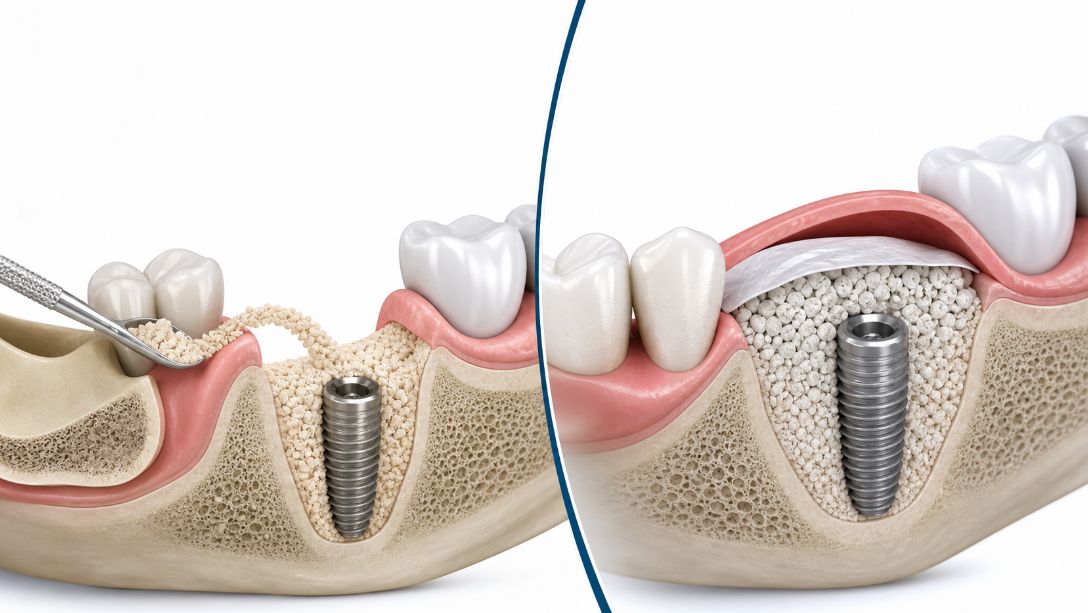
Guided bone regeneration, often called GBR, typically uses particulate graft material and a barrier membrane to rebuild a localised deficiency around an implant or future implant site.
Synthetic grafts, autogenous particles or mixed grafts can all be used. The membrane helps exclude soft tissue cells from the space while bone regenerates. Stable graft containment and tension-free wound closure often matter more than the marketing description of the granules.
Sinus Lift Surgery
In the upper back jaw, the maxillary sinus may limit available bone height. A sinus lift raises the sinus membrane and places graft material beneath it to create space for bone formation.
Both autogenous and synthetic materials can be used in suitable cases. Evidence does not establish that autogenous bone is universally superior for sinus augmentation. The surgeon should explain whether implants can be placed at the same time, how long healing may take and what happens if the sinus membrane is perforated.
Large Ridge Reconstruction
Where bone loss is severe, autogenous block grafting may be considered because it can provide structural volume and biological activity. This is where the trade-off between additional surgery and the reconstruction required becomes most relevant.
In some cases, the best answer may not be a graft at all. Short implants, tilted implants, zygomatic implants, or a different restorative design can occasionally reduce or avoid the need for extensive augmentation. These options require specialist planning and are not appropriate for every patient.
What Matters More Than the Graft Label
The graft material is one part of success. Several other factors may have as much or more influence on the final result:
- Accurate 3D diagnosis and implant planning
- Control of gum disease and infection before surgery
- Sufficient blood supply at the recipient site
- Stable graft fixation and membrane management
- Tension-free soft-tissue closure
- Appropriate healing time before loading the implant
- Patient smoking or nicotine exposure
- Diabetes control and overall medical health
- The clinician’s experience with the chosen technique
- Cleanable crown or bridge design
- Long-term maintenance after the final restoration is fitted
For patients with active periodontitis, implant surgery should usually be delayed until inflammation is stabilised. Bone grafting is not a solution to uncontrolled gum disease. The graft and implant need a healthy biological environment to heal predictably.
Questions to Ask Your Implant Clinic in Budapest
A transparent clinic should explain why a graft is recommended and discuss alternatives without pressure. Before committing to treatment, consider asking:
- Do I need a graft, and what does my CBCT scan show?
- Is my bone deficiency horizontal, vertical or both?
- Why are you recommending autogenous bone, a synthetic graft or a combination?
- What specific graft product will be used?
- Is it synthetic, human donor-derived, animal-derived or my own bone?
- If my own bone is recommended, where will it be taken from?
- What additional pain, swelling, numbness or recovery should I expect from harvesting?
- Will I need a membrane, fixation screws or a staged procedure?
- Can the implant be placed at the same appointment, or must it heal first?
- What is the realistic healing timeline before my final crown or bridge?
- What are the alternatives if I decline grafting?
- What costs are included for graft material, membrane, surgery, scans and follow-up?
- Will I receive copies of my CBCT scan, graft details and implant passport?
-
What aftercare can be provided when I return to the UK or Ireland?
Patients travelling for implant dentistry should not be promised a fixed treatment timeline before the clinical assessment confirms that it is safe. A responsible Budapest clinic will build travel planning around biology, not the other way around.
Frequently Asked Questions
Is using my own bone safer than a synthetic bone graft?
Autogenous bone avoids concerns associated with donor materials and has unique biological properties. However, it requires bone harvesting, which creates donor-site discomfort and potential complications. Synthetic grafts avoid that second surgical site and can be highly predictable for appropriate defects. The safest option depends on the anatomy and treatment required.
Is synthetic bone graft material rejected by the body?
Modern synthetic grafts used in dentistry are designed to be biocompatible. True immune rejection is not the usual concern. Risks relate more to infection, graft instability, wound healing, resorption behaviour and whether the material is appropriate for the defect.
Does a bone graft guarantee that I can have implants?
No. A graft can improve the amount and shape of available bone, but it cannot guarantee implant placement or long-term implant success. Healing must be reviewed before the implant plan proceeds.
How long does a bone graft take to heal?
Healing time varies by procedure. Minor socket preservation or small GBR procedures may be reviewed after a few months, while larger grafts and complex reconstruction can require longer. Your dentist should give a personalised schedule based on imaging and surgical findings.
Is bone grafting painful?
The procedure is usually carried out with local anaesthetic, with sedation available in some cases. Post-operative discomfort, swelling and bruising are common. Autogenous grafts may involve more discomfort because there is also a donor area to heal.
Can smokers have bone grafts and dental implants?
Smoking and nicotine exposure can impair healing and increase the risk of complications. Patients should discuss this honestly with their implant team and follow any cessation recommendations before and after surgery.
Are success rates lower with synthetic grafts?
Not necessarily. Evidence from selected implant-grafting procedures shows comparable implant survival with biomaterials and autogenous bone. Outcomes depend on the procedure, defect, surgeon, patient risk factors and maintenance—not only on the graft category.
Final Clinical Perspective
Autogenous bone remains an important and highly effective option in implant dentistry, especially for demanding reconstruction. Its biological properties can be valuable when large or complex bone defects must be rebuilt. The price for that advantage is additional surgery and donor-site morbidity, which should be justified by the clinical need.
Synthetic bone grafts are not a second-best compromise. In the right situation, they can provide a predictable scaffold for regeneration while avoiding a second surgical site. For routine localised augmentation, guided bone regeneration, ridge preservation and selected sinus procedures, they may offer an excellent balance between treatment effectiveness and patient comfort.
The most trustworthy implant plan is one that explains the defect, compares the available options honestly, gives realistic timelines and does not promise an identical solution for every patient. For UK and Irish patients considering treatment in Budapest, Hungary, insist on a detailed consultation, appropriate 3D imaging, transparent graft information, a written treatment plan and complete clinical records for future maintenance.
Sources
- Cochrane Review: Efficacy of Bone Augmentation Procedures for Dental Implants
- Systematic Review and Meta-Analysis: Autogenous Bone Versus Biomaterial for Posterior Mandibular Augmentation
- Review: Implant Survival in Autogenous Bone Block Grafts Versus Guided Bone Regeneration
- Systematic Evaluation: Beta-Tricalcium Phosphate in Implant Dentistry
- Systematic Review and Meta-Analysis: Autogenous Bone Donor Site and Dental Implant Survival
- Systematic Review: Mandibular Ramus Versus Chin Donor-Site Morbidity
- Systematic Review: Biomaterial Selection for Bone Augmentation in Implant Dentistry
- Review: Bone Grafts and Synthetic Substitutes in Dentistry