Root canal treatment has a reputation for being something to fear, but in modern dentistry it is one of the most effective ways to keep a badly damaged tooth in your mouth and working comfortably. It is almost always a “tooth‑saving” procedure, not a failure of dentistry. Understanding how to avoid needing it in the first place, and why it is still a very good option when required, helps you make clear, confident decisions about your care.
What root canal treatment actually is
Inside every tooth there is a small space containing the dental pulp – a soft tissue made of nerves, blood vessels and connective tissue. When decay, trauma or deep cracks reach this area, the pulp becomes inflamed or infected. At that point, you may experience severe pain, lingering sensitivity, swelling or a dental abscess.
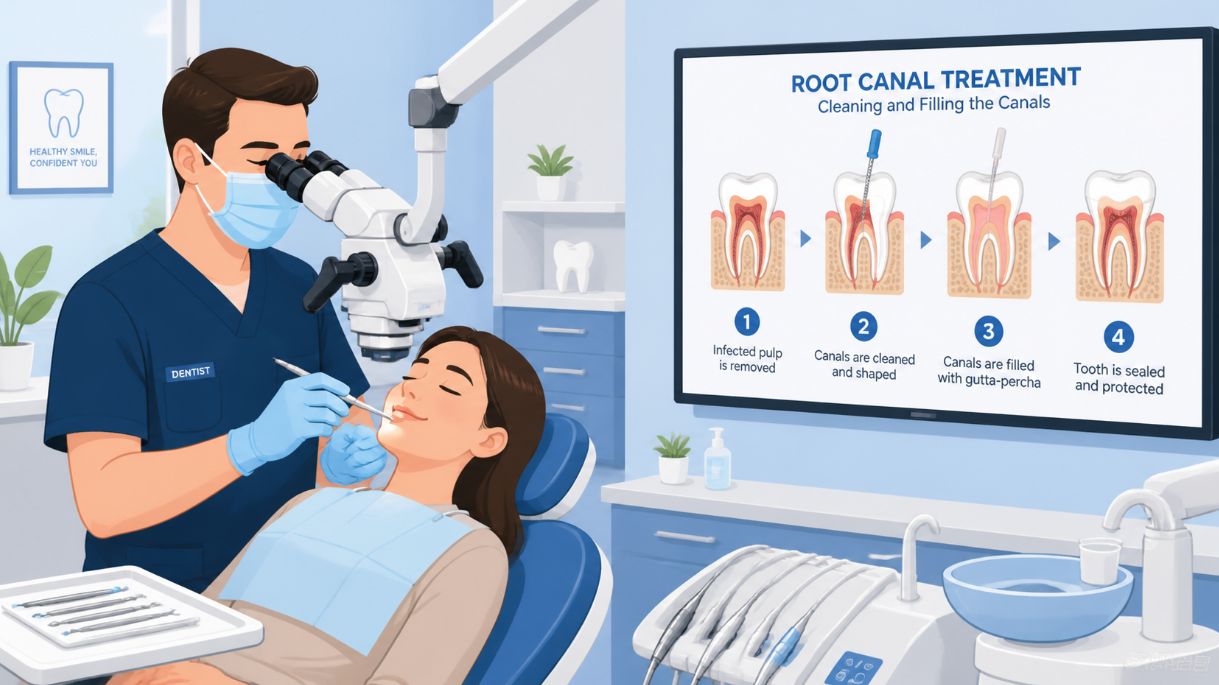
Root canal treatment (endodontic therapy) removes the diseased pulp from inside the tooth, disinfects the root canals, and seals them with a biocompatible material. The outer shell of the tooth – the enamel and dentine – is preserved and then strengthened with a filling or, more often, a crown. This means you keep your natural tooth in the jaw, rather than losing it and needing a bridge, denture or implant to fill the gap.
In practical terms, root canal therapy is a carefully controlled cleaning and sealing procedure carried out under local anaesthetic. Most patients describe it as similar to having a long, detailed filling rather than something dramatically worse.
Why you might need a root canal
Several common problems can lead to damage of the pulp:
-
Deep tooth decay that has reached or is very close to the nerve
-
A cracked or broken tooth exposing the inner dentine and pulp
-
A heavy blow to a tooth, even if there is no obvious chip
-
Repeated dental work on the same tooth over many years
-
Long‑standing leakage around old fillings or crowns
At early stages, a filling or onlay may be enough. But once bacteria enter the pulp chamber, the tissue cannot recover fully on its own. Left untreated, the infection can travel down the root, cause an abscess, damage surrounding bone and eventually lead to tooth loss.
Root canal treatment removes this source of infection and pain while preserving the tooth itself. That is why dentists often describe it as the last step before extraction – the last major effort to save a tooth that would otherwise be lost.
How to avoid needing root canal treatment
Although root canal therapy is highly successful, it is still far better not to need it at all. The good news is that many of the factors that lead to it are under your control.
1. Control decay early
Tooth decay is the most common reason for root canal. You can dramatically reduce your risk by:
-
Brushing twice daily with a fluoride toothpaste
-
Cleaning between teeth daily with floss or interdental brushes
-
Limiting how often you have sugary foods and drinks, especially between meals
-
Using additional fluoride products if your dentist recommends them
Regular check‑ups allow your dentist to spot small cavities before they reach the nerve. Treated early with a simple filling, these teeth often never need root canal.
2. Protect against cracks and wear
Cracks and fractures can open a direct pathway to the pulp. To reduce this risk:
-
Avoid chewing very hard foods (ice, unpopped popcorn kernels, hard sweets)
-
Do not use your teeth as tools to open packaging
-
If you clench or grind, consider a night guard to protect teeth
-
Replace large, old fillings with onlays or crowns before they fail catastrophically
Timely reinforcement of a heavily filled tooth is a proactive way to prevent it splitting and exposing the nerve.
3. Look after your gums
Advanced gum disease does not usually cause root canal problems on its own, but it can expose roots and make teeth more vulnerable. Good periodontal health supports teeth structurally and reduces complex combined gum/pulp problems.
4. See your dentist promptly when something feels wrong
Lingering sensitivity to hot or cold, pain when biting, a pimple‑like swelling on the gum, or dull aching that comes and goes are all early warning signs. Getting these symptoms checked quickly often means:
-
Smaller cavities can be treated before they reach the pulp
-
Cracks can be identified and protected
-
Early pulp inflammation might be managed more conservatively in some cases
Delaying until pain becomes severe usually narrows your options and makes root canal or extraction more likely.
Why root canal is still a very good option
If you do find yourself needing a root canal, it is important to know that this is not a second‑best choice. In many situations, it is the most sensible, conservative and cost‑effective way to treat the problem.
1. You keep your natural tooth
No artificial replacement matches a healthy, well‑restored natural tooth in terms of how it feels when you bite, how it supports neighbouring teeth and how it maintains your jawbone. Root canal allows you to:
-
Keep the tooth in place
-
Maintain your natural bite and chewing pattern
-
Avoid gaps that cause drifting or over‑eruption of opposing teeth
Even a high‑quality implant or bridge involves more intervention to your mouth than saving a tooth that can still function.
2. Long‑term success can be excellent
When done well and followed by a proper restoration (often a crown), root canal‑treated teeth can last many years or even decades. Success rates are high, particularly when:
-
The tooth is not too structurally compromised
-
Infection is cleaned thoroughly
-
The final restoration seals the tooth well and protects it from fracture
Many people live happily with root‑treated teeth and forget which ones they were.
3. Often kinder overall than extraction plus replacement
At first glance, extraction can seem quicker and cheaper. But if you want to replace the missing tooth properly – with a bridge or implant – the overall treatment time, complexity and cost often exceed those of root canal plus a crown.
Root canal also avoids:
-
A period living with a gap
-
Additional work on neighbouring teeth (as with some bridges)
-
Surgery and bone grafting that can be necessary for implants
For many patients, staying with their own tooth produces the best balance of comfort, cost and long‑term function.
4. Modern techniques make it much more comfortable
Advances in anaesthetic techniques, rotary instruments, irrigation systems and magnification mean root canal is usually no more uncomfortable than other dental work. The discomfort you feel beforehand from infection is often worse than anything you experience during treatment.
Most patients report feeling pressure and vibration rather than sharp pain once the area is properly numbed. Afterwards, tenderness is usually manageable with standard pain relief and settles as inflammation resolves.
Step‑by‑step: what to expect during treatment
While every case is unique, a typical root canal on a back tooth is carried out over one or two appointments through a series of steps:
-
Assessment and planning – Your Budapest dentist discusses symptoms, checks the tooth, and takes X‑rays (and sometimes 3D scans) to understand the problem and anatomy.
-
Local anaesthetic – The tooth and surrounding area are thoroughly numbed.
-
Isolation – A rubber dam is placed to keep the tooth clean and stop instruments or irrigants from reaching your throat.
-
Access – A small opening is made in the top of the tooth to reach the pulp chamber.
-
Cleaning – The canals are negotiated, shaped and repeatedly rinsed with disinfectant solutions to remove infected tissue and bacteria.
-
Filling the canals – Once clean and dry, the canals are filled and sealed with a specially designed material.
-
Temporary or permanent restoration – The access cavity is sealed. Many teeth then need a crown at a later visit for strength.
Understanding this process usually helps reduce anxiety – it is a logical sequence aimed at turning an infected, painful tooth into a sealed, stable one.
Microscopic root canal: what it adds and why it matters
You may have heard of “microscope‑assisted” or “microscopic” root canal treatments, especially with specialist endodontists. This refers to the use of a high‑powered dental operating microscope during the procedure.
What microscopic treatment involves
A dental microscope provides:
-
Strong magnification of the tooth and root canal system
-
Bright, focused illumination deep inside the tooth
-
The ability to see fine details that are invisible to the naked eye or simple loupes
With this enhanced view, the clinician can:
-
Locate tiny or hidden canals that might otherwise be missed
-
Identify fine cracks in the tooth structure
-
Clean and shape canals more precisely
-
Work more conservatively, removing less healthy tooth tissue
Why this can improve outcomes
Root canal systems are often complex, with extra branches, curved canals and unusual anatomy. Missed canals or insufficient cleaning are key reasons treatments sometimes fail.
Microscope‑assisted endodontics reduces these risks by making it easier to:
-
Find all canals, including those that are unusually narrow or curved
-
Remove old posts, broken instruments or existing root fillings during retreatment
-
Identify and seal perforations or unusual communications inside the tooth
For difficult teeth – such as molars with complex roots or teeth that have already had root treatment once before – microscopic techniques can significantly increase the chances of saving the tooth.
Is microscopic treatment always necessary?
Not every tooth needs a microscope; many straightforward cases are successfully treated with conventional magnification. However, there are clear situations where being referred to an endodontist who uses a microscope is wise, such as:
-
Very curved or narrow roots
-
Previous failed root canal where standard retreatment is challenging
-
Suspicion of cracks that need careful evaluation
-
Unusual anatomy visible on X‑rays or 3D scans
In these cases, the extra precision of microscopic care can be the difference between keeping the tooth and losing it.
When root canal may not be the best option
Even though root canal is highly valuable, there are times when it is not the right choice. Examples include:
-
A tooth that is cracked vertically down the root
-
Extensive decay or fracture below the gum line, leaving too little tooth to restore
-
Very advanced gum disease with severe bone loss around the tooth
-
Situations where access to the root canals is impossible or extremely limited
In such cases, attempting root canal may only delay the inevitable and add cost and discomfort along the way. A good clinician will explain when the prognosis is poor and talk you through alternatives, including extraction and replacement options.
The key is that “saving the tooth at all costs” is not always in your best interests – but when the chances of success are reasonable, root canal is usually worth strong consideration.
How to talk with your dentist about root canal
If you have been told you may need root canal treatment, it is perfectly appropriate to ask for a clear explanation. Helpful questions include:
-
What has happened to the tooth, and why is root canal being recommended?
-
Are there any alternatives that would still save the tooth, or is this the only realistic option?
-
What are the chances of success in my case, and how long might the tooth last?
-
Will I need a crown afterwards, and what will that involve?
-
Would I benefit from seeing a specialist who uses microscopic techniques?
-
If we decide not to do root canal, what would extraction and replacement look like instead?
This conversation gives you a full picture of your options so you can weigh short‑term cost and convenience against long‑term health and function.
Root canal in context: a practical way to protect your smile
Viewed calmly, root canal treatment is not a punishment, but a tool that modern dentistry uses to give damaged teeth a second chance. You can reduce your chances of needing it by taking care of your teeth, acting early on small problems and protecting heavily filled teeth from cracking.
When it is necessary, though, it is often the most conservative, comfortable and cost‑effective way to remove infection, relieve pain and keep your natural tooth in place. Microscopic techniques add another layer of precision and predictability, especially for complex or previously treated teeth.