Key Takeaways
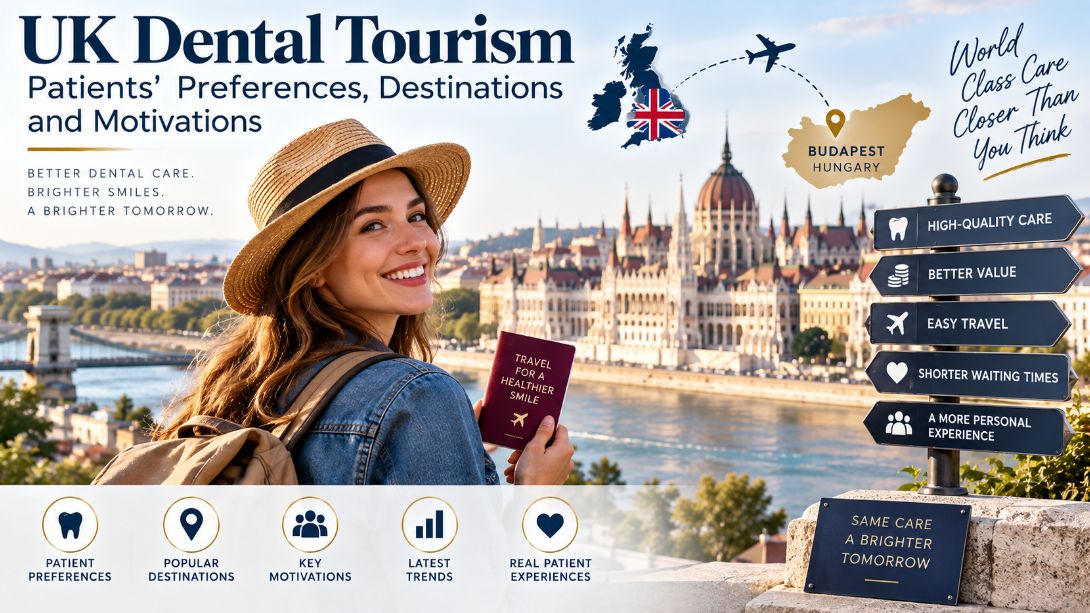
- UK dental tourism is growing because many patients face limited NHS access, long waits and high private dentistry costs at home.
- Younger adults, especially those aged 18–34, are most interested in cosmetic treatments such as veneers, teeth whitening, composite bonding and smile makeovers.
- Adults aged 45–70 are the highest-value patient group, commonly travelling for dental implants, crowns, bridges, All-on-4 and full-mouth rehabilitation.
- Women are often more active in researching cosmetic dentistry and aesthetic smile transformations, while men are strongly represented in implant and functional restorative cases.
- Cost savings remain the biggest driver, but UK patients also value speed, fixed pricing, treatment packages and the option to combine care with a city break or holiday.
- Turkey is the best-known destination for UK dental tourists, particularly for price-led veneers, crowns, implant packages and resort-based treatment trips.
- Hungary, especially Budapest, remains a trusted choice for complex implantology, crown-and-bridge work and full-mouth restorative dentistry.
- Poland is becoming increasingly popular with UK patients seeking modern EU-based clinics, convenient flights and competitive prices for implants and crowns.
- The safest dental tourism decisions are based on clinical suitability, written treatment plans, qualified clinicians, transparent prices and a clear aftercare strategy—not social-media promotions alone.
- Patients should compare the complete cost of treatment, including flights, hotel stays, return visits, possible complications and long-term maintenance.
From Turkey to Hungary: Where UK Dental Tourists Go for Treatment
UK dental tourism has shifted from a niche “treatment holiday” into a mainstream consumer-healthcare decision. For many British patients, the attraction is not simply cheaper dentistry: it is the combination of faster access, a fixed package price, visible cosmetic results and the ability to complete treatment abroad when NHS access or UK private fees feel out of reach.
The market is diverse. Younger patients are often drawn to cosmetic smile makeovers, while older adults tend to travel for implants, crowns, bridges and full-mouth rehabilitation. Turkey remains the volume leader for price-led cosmetic and implant cases, while Hungary and Poland continue to appeal to UK patients who prioritise shorter travel, EU-based care pathways and complex restorative treatment planning.
The UK dental tourism market
Dental tourism means travelling internationally to receive dental treatment, usually on a self-funded basis. For UK residents, the decision is increasingly shaped by three domestic pressures:
- Difficulty accessing routine NHS dentistry in some areas
- Long waits for consultations or specialist treatment
- The high out-of-pocket price of private implants, crowns, veneers and full-mouth rehabilitation
For patients facing a multi-thousand-pound treatment plan, an overseas clinic may appear to offer a financially realistic route to restoring function or improving appearance. However, dental tourism should not be viewed as a shortcut or a low-risk commodity purchase. Treatment plans must be clinically appropriate, properly diagnosed and supported by a clear aftercare pathway.
The British Dental Association says 95% of dentists surveyed had examined patients who had travelled overseas for dental treatment, and 86% had treated cases that subsequently developed complications. The BDA also notes that repair costs can be substantial: two-thirds of dentists reported remedial costs of at least £500, while more than half reported costs above £1,000.
This does not mean treatment abroad is inherently poor. It means UK patients need to distinguish between a properly planned clinical journey and a heavily marketed, speed-first package with limited diagnosis, aggressive sales tactics or uncertain support after returning home.
Patient age groups
The UK outbound dental market is broadly split into two major patient segments. Their motivations, treatment needs, financial position and preferred destinations can be very different.
Younger adults: cosmetic and social-media-led demand
Patients aged 18 to 34 are the most visible dental tourism demographic online. Their interest is commonly linked to veneers, smile design, whitening, composite bonding and “Hollywood smile” makeovers.
This audience is highly digital. They compare before-and-after images on Instagram, TikTok, YouTube and clinic websites; message patient coordinators through WhatsApp; and often expect quotations quickly. They are also more likely to see dental treatment as part of a wider identity, lifestyle or confidence decision rather than solely a clinical necessity.
Turkey has performed particularly well with this segment because many clinics package treatment with airport transfers, hotel arrangements, English-speaking coordinators and visually compelling social-media marketing. Antalya and Istanbul are especially prominent because they combine large dental-clinic networks with direct flights, accommodation options and holiday infrastructure.
The risk for younger cosmetic patients is that the desired outcome may be communicated as a product—“a new smile in one week”—rather than as irreversible biological treatment. Veneers and crowns often require tooth preparation, and not every patient is suitable for aggressive cosmetic work. A conservative option such as orthodontics, whitening, limited bonding or minimally invasive veneers may sometimes be more appropriate than full crowns on healthy teeth.
Middle-aged patients: affordability and practical treatment needs
The 35–49 age group often sits between cosmetic demand and functional necessity. These patients may have older crowns, missing teeth, heavily restored dentition, dental anxiety or delayed treatment caused by cost pressures.
They usually assess dental tourism in practical terms:
- Can I save enough to justify the trip?
- Can the clinic complete treatment around work and family responsibilities?
- Is there a fixed price rather than an open-ended UK treatment estimate?
- Can several procedures be completed during one trip?
- What happens if a crown, implant or bridge needs attention after I return?
This group is more likely than younger travellers to compare clinics in Turkey, Hungary and Poland rather than choosing purely on influencer content. They often seek a blend of visible improvement, functional rehabilitation and a manageable all-in cost.
Older adults and retirees: the high-value restorative segment
Adults aged roughly 45 to 70 represent the most commercially significant group in dental tourism because they tend to require higher-value treatment. Their priority is rarely a short-lived aesthetic trend. It is more commonly the restoration of chewing ability, speech, comfort and confidence after tooth loss, failing crowns, gum disease or long-term dental neglect.
Common treatments include:
- Single dental implants with crowns
- Implant-supported bridges
- Full-mouth crowns and bridges
- All-on-4 and All-on-6 full-arch restorations
- Bone grafting and sinus lift procedures
- Denture stabilisation with implants
- Replacement of old or failing dental work
This segment generally does more research before committing. They may request panoramic X-rays or CBCT scans, ask about implant brands, enquire about a dentist’s surgical experience and want clarity on how many visits will be required.
Hungary—especially Budapest—has historically appealed strongly to this market. Its reputation is based less on social-media glamour and more on established cross-border dentistry, restorative expertise, English-speaking teams and proximity to the UK. Poland is also attractive, especially for patients in Northern England and Scotland who can access convenient routes to Kraków or Warsaw.
Gender patterns and decision-making
Gender should not be treated as a clinical predictor, but consumer behaviour patterns do appear across cosmetic and restorative enquiries.
Women are often slightly more active in researching cosmetic dentistry, aesthetic alignment and smile transformation. They may place more emphasis on natural appearance, shade matching, facial harmony, patient reviews, photographic outcomes and the experience of travelling with a friend or partner.
Men are strongly represented in implant, extraction-and-replacement and full-mouth restoration cases. In many instances, the decision is driven by a practical financial comparison: accepting removable dentures or extraction in the UK versus paying for fixed implant-supported teeth abroad.
In reality, the decision-maker is often not the patient alone. Spouses, adult children, friends and online peer groups can influence destination choice, clinic trust and treatment timing. A patient may initially request “Turkey teeth” but, after discussion with a family member or UK dentist, move towards a more conservative restorative plan in Hungary or Poland.
For dental tourism providers, this means the patient journey must address both emotional and practical concerns:
- Appearance and confidence
- Pain and dental anxiety
- Cost certainty
- Safety and qualification checks
- Travel logistics
- Aftercare at home
- Long-term maintenance costs
Treatments UK patients seek abroad
The most popular overseas treatments can be grouped into cosmetic dentistry and restorative dentistry. The distinction matters because the ideal clinic, destination, timeframe and risk profile can be very different.
Veneers and cosmetic makeovers
Veneers remain one of the most searched dental-tourism treatments among UK consumers. However, “veneers” is frequently used online as a broad term that can conceal important differences between composite bonding, porcelain veneers, lithium disilicate restorations and full crowns.
A responsible patient should ask exactly what is being proposed. If teeth are extensively filed down for crowns when a less invasive alternative may be possible, the long-term maintenance burden can be significant. Crowns and veneers may eventually require replacement, and future repairs can become more complex if records, materials and bite information are unavailable.
Dental implants
Implants are a major driver of UK dental tourism because UK private prices can be difficult to absorb when multiple teeth are missing. The appeal is especially strong for patients quoted for several implants, implant bridges or a complete arch.
But implants are not a one-size-fits-all product. A safe plan requires assessment of bone volume, gum health, bite forces, smoking status, medical history and the condition of the surrounding teeth. Treatment may require more than one visit, and the final bridge or crown should not be rushed before appropriate healing and integration.
The General Dental Council advises patients considering dental care overseas to ask who will carry out treatment, what qualifications they hold, how often they perform the procedure, their complication and infection rates, their insurance arrangements, the warranty offered and how aftercare will work.
All-on-4 and full-mouth rehabilitation
All-on-4 and All-on-6 treatments are among the highest-value dental tourism procedures. They appeal to patients who have multiple failing teeth, loose dentures, severe tooth wear or extensive decay and want a fixed full-arch solution.
These treatments should be approached with particular care because they involve surgery, prosthetic planning, bite reconstruction and long-term maintenance. The lowest quote is not necessarily the best value. Patients should understand whether the advertised package includes:
- Extractions and immediate temporary teeth
- Implant brand and component system
- Sedation or anaesthesia, if needed
- Bone grafting or sinus lifting, if required
- Temporary and final bridges
- CBCT imaging and diagnostic work-up
- Number of visits and likely healing period
- Management of complications
- Warranty terms and exclusions
- Return flights or hotel stays if remedial work is necessary
What UK patients prefer
UK patients increasingly expect a consumer-friendly, transparent and coordinated service. The best dental tourism providers are not simply selling a low price; they are reducing uncertainty across the entire treatment journey.
All-inclusive but transparent pricing
Packages are popular because patients want to understand the complete cost before leaving the UK. Transfers, accommodation support, local transport and English-speaking coordinators can make a complex trip feel manageable.
However, a package should be transparent rather than merely attractive. Patients should receive a written breakdown showing what is included, what is excluded and what could generate additional cost. “From” prices can become misleading if they exclude bone grafting, temporary prosthetics, additional implants, final restorations or return-visit costs.
Fast treatment, without rushed care
Speed matters. Patients often want to use annual leave efficiently and avoid months of appointments. A 7–10-day trip may be suitable for certain cosmetic cases or preliminary implant surgery, but it is not automatically appropriate for every full-mouth restoration.
The NHS advises people to ensure that aftercare is coordinated, to allow an appropriate recovery period before travelling home and to factor in the possibility of extended stays or return trips. It also states that dental treatment is not reimbursable under its treatment-abroad reimbursement route.
English-speaking communication
English-language communication remains a key conversion factor for UK patients. They want to understand treatment options, consent documents, medication instructions, implant passports, guarantees and aftercare guidance.
For high-value cases, written communication matters just as much as a friendly coordinator. Patients should receive copies of:
- The treatment plan and itemised quotation
- X-rays and CBCT images where relevant
- Implant brand, size and batch information
- Laboratory and restoration details
- Consent forms
- Medication instructions
- Emergency contact details
- Post-treatment care instructions
- Warranty and complaints policy
Trust, regulation and clinical reputation
UK patients frequently look for signs of familiar standards: EU regulation, international accreditation, recognised implant systems, digital dentistry, modern sterilisation protocols and clinicians with postgraduate training.
Hungary and Poland benefit from a perception of European clinical governance and easier legal or travel access. Turkey benefits from scale, lower prices and mature health-tourism infrastructure, but clinics vary widely. The country itself is not a quality guarantee or a quality warning; the individual clinic, clinicians, diagnosis and aftercare plan determine the real value.
Purchasing power and value perception
The typical UK dental tourist is not necessarily affluent. Many are middle-income consumers who can fund travel and treatment but cannot comfortably pay UK private prices for a major restorative plan.
This is a form of healthcare arbitrage: the patient uses savings from lower labour, operating and facility costs abroad to access treatment that feels financially impossible at home. The value proposition is strongest when several procedures are needed.
A single filling may not justify travel. A patient who needs six crowns, four implants or a full-arch restoration may see a very different calculation, even after flights and accommodation are included.
Still, the correct comparison is not simply “UK quote versus overseas quote.” A genuine value calculation should include:
- Consultation and diagnostics in the UK
- Flights, accommodation and airport transfers
- Companion travel, if required
- Additional nights for recovery
- Return visits for final restorations
- Travel insurance that covers planned treatment
- Emergency care and possible remedial work
- Maintenance costs over the life of implants, crowns or bridges
- Exchange-rate changes
- Lost income or annual leave
The NHS specifically warns patients to account for exchange-rate changes, extended stays and the cost of possible return trips when treatment abroad is chosen primarily to save money.
Favourite destinations for UK patients
Turkey: strongest for volume, packages and cosmetic demand
Turkey is the leading destination in public awareness for UK dental tourism. Istanbul and Antalya are the best-known hubs, with Izmir also attracting international patients.
Turkey’s strengths include highly competitive prices, large clinic choice, direct UK flights, strong hospitality infrastructure and polished all-inclusive packages. It is especially popular for veneers, crowns, multiple implants, full smile makeovers and full-arch implant treatments.
The downside is variation. The market includes excellent clinicians and advanced clinics, but also aggressive advertising, pressure-selling and treatment recommendations that may not be sufficiently conservative. Patients should not book because a hotel package looks luxurious or because a social-media influencer has posted dramatic before-and-after images.
Turkey is best suited to UK patients who want a broad choice of clinics, significant potential savings and a streamlined treatment-trip experience—but only after independent due diligence.
Hungary: established choice for complex restorative dentistry
Budapest has long been recognised as one of Europe’s major dental tourism centres. It is particularly appealing to patients seeking implants, crown-and-bridge work, full-mouth rehabilitation and treatment plans requiring careful restorative coordination.
For UK patients, Hungary offers several advantages:
- Relatively short flight times from the UK
- EU-based regulatory environment
- A longstanding international patient market
- Strong reputation in restorative dentistry and implantology
- English-speaking clinics accustomed to UK and Irish patients
- A city-break setting rather than a resort-only model
Hungary may not always be the absolute cheapest option, but it often appeals to patients who value clinical planning, established providers and a European treatment pathway. It is a particularly strong choice for older adults, retirees and patients with more complex needs.
Poland: growing appeal for accessibility and EU reassurance
Poland, especially Kraków and Warsaw, is increasingly attractive to UK patients. Its combination of EU membership, relatively short flights, modern clinics and competitive treatment prices creates a strong alternative to Turkey.
Poland can be especially convenient for patients in Northern England, Scotland and the Midlands, depending on local airport routes. It appeals to people who prefer an EU destination but still want meaningful savings on crowns, implants, bridges and full-mouth restorations.
Polish clinics often market digital workflows, intraoral scanning, CAD/CAM restorations and internationally recognised implant systems. The main patient appeal is a balance of affordability, convenience and perceived regulatory familiarity.
Albania: an emerging price-led alternative
Tirana is a growing name in dental tourism marketing, particularly for patients looking for lower costs on veneers, implants and full-mouth treatment. Albania can be attractive for price-sensitive consumers, but it is a newer consideration for many UK patients compared with Turkey, Hungary or Poland.
As with any destination, patients should assess the clinic—not just the country. This includes clinician registration, diagnostic standards, materials, sterilisation, patient references, warranty terms and realistic follow-up arrangements.
Choosing safely
The central lesson for UK dental tourists is simple: buy a treatment plan, not a holiday package.
Before booking, patients should obtain a full written treatment plan and ask their UK dentist for an independent opinion where possible. A clinic should never pressure someone to commit during a hotel consultation, social-media call or time-limited discount campaign.
The NHS lists hard selling, pressure for a quick decision, missing information about complications and the absence of aftercare discussion as warning signs when considering treatment overseas.
A strong due-diligence checklist should include:
- Confirm the dentist’s identity, registration and relevant qualifications
- Ask who performs each part of the treatment, including surgery and laboratory work
- Request a written diagnosis, treatment plan and itemised quote
- Confirm whether the proposed treatment is conservative and clinically necessary
- Ask for the implant system, prosthetic material and laboratory details
- Understand how complications, repairs and return visits are handled
- Obtain a copy of the warranty, complaints procedure and insurance arrangements
- Ask for medical records, radiographs and implant documentation before returning to the UK
- Build a realistic budget that includes travel, aftercare and possible remedial work
Final assessment
The UK dental tourism market is driven by a powerful mix of unmet demand, cost pressure and consumer desire for faster access to visible results. Younger adults fuel the cosmetic segment, while older adults and retirees account for much of the high-value implant and full-mouth rehabilitation demand.
Turkey remains the most prominent destination for price-sensitive cosmetic and package-led dental travel. Hungary is a mature, trusted option for UK patients seeking implants, crowns, bridges and complex restorative work in Budapest. Poland is increasingly attractive for patients who want EU-based care, short travel times and competitive pricing.
For clinics and publishers serving UK audiences, the most credible message is not “cheapest dental treatment abroad.” It is transparent, clinically led care: proper diagnosis, realistic timelines, recognised materials, qualified clinicians, written consent, complete records and a workable plan for aftercare in the UK.
Frequently Asked Questions
Which age group is most likely to travel abroad for dental treatment?
UK dental tourists generally fall into two main groups. Younger adults, typically aged 18–34, are more likely to research veneers, whitening, composite bonding and cosmetic smile makeovers. Adults aged 45–70 are often the highest-value group because they travel for more complex treatment, including dental implants, crowns, bridges, full-mouth rehabilitation and fixed full-arch teeth.
Why do UK patients choose dental treatment abroad?
Cost savings are a major reason, particularly for implants, crowns, bridges and full-mouth restoration. However, UK patients also choose overseas clinics because they may offer shorter waiting times, fixed-price packages, English-speaking patient coordinators, accommodation assistance, airport transfers and faster treatment schedules.
What dental treatments do UK patients most commonly get abroad?
The most commonly researched treatments include dental veneers, smile makeovers, crowns, single dental implants, implant bridges, All-on-4, All-on-6 and full-mouth rehabilitation. Cosmetic procedures are especially popular with younger patients, while restorative and implant treatment is more common among older adults and patients with multiple missing or failing teeth.
Is Turkey the most popular destination for UK dental tourists?
Turkey is one of the most visible and widely marketed destinations for UK dental tourists. Cities such as Antalya, Istanbul and Izmir are especially popular for veneers, crowns, dental implants and package-based smile makeover trips. Patients are often attracted by lower prices, direct flights, resort infrastructure and clinics that organise transfers and accommodation support.
Why do UK patients choose Hungary for dental treatment?
Hungary, particularly Budapest, is a long-established dental tourism destination for UK patients. It is often chosen for dental implants, crown-and-bridge treatment, oral surgery and full-mouth restoration. Many patients value Hungary’s experienced international clinics, European location, English-speaking teams and reputation for complex restorative dentistry.
Is Poland a good option for UK dental patients?
Poland is becoming increasingly attractive for UK patients who want competitive prices while remaining within an EU-based healthcare environment. Kraków and Warsaw are popular for dental implants, crowns, bridges and digital dentistry. Convenient flights, modern clinics and relatively short travel times make Poland a practical alternative to Turkey or Hungary for many UK travellers.
Are women more likely than men to travel for cosmetic dentistry?
Women are often more active in researching cosmetic dental options, including veneers, smile makeovers and teeth whitening. Reviews, natural-looking results, before-and-after photography and peer recommendations can strongly influence their decision-making. Men are also active dental tourists, particularly for functional treatments such as implants, full-mouth reconstruction and fixed teeth to replace failing or missing teeth.
What should a dental tourism package include?
A clear dental tourism package should state exactly what is included and excluded. Patients should look for an itemised treatment plan covering consultations, X-rays or CBCT scans, the planned procedures, implant brand where relevant, temporary and final restorations, medication, transfers, accommodation arrangements and return-visit requirements. It should also explain what happens if additional treatment, bone grafting or repairs become necessary.
How can UK patients choose a safe dental clinic abroad?
Patients should choose a clinic based on clinical suitability rather than social-media popularity or the lowest price. Ask who will provide the treatment, check professional qualifications and registration, request a written treatment plan, confirm the materials and implant system used, review the warranty, and understand how aftercare will work after returning to the UK. An independent opinion from a UK dentist can also help patients assess whether the proposed treatment is necessary and appropriately conservative.
What extra costs should UK dental tourists consider?
The true cost is more than the initial clinic quote. UK patients should budget for flights, accommodation, transfers, food, travel insurance, companion travel, additional nights if recovery takes longer than expected, second visits for final restorations and possible future repairs. Long-term maintenance also matters: implants, crowns, bridges and veneers may need hygiene appointments, repairs or replacement over time.
Sources
- General Dental Council: Going abroad for dental treatment — Patient questions on qualifications, regulation, insurance, guarantees, complications and aftercare.
- NHS: Treatment abroad checklist — Guidance on second opinions, warning signs, costs, recovery, insurance and NHS reimbursement limitations for dental care.
- British Dental Association: Dental tourism — Evidence and professional concerns related to complications, continuity of care and repair costs after overseas treatment.