In a Nutshell
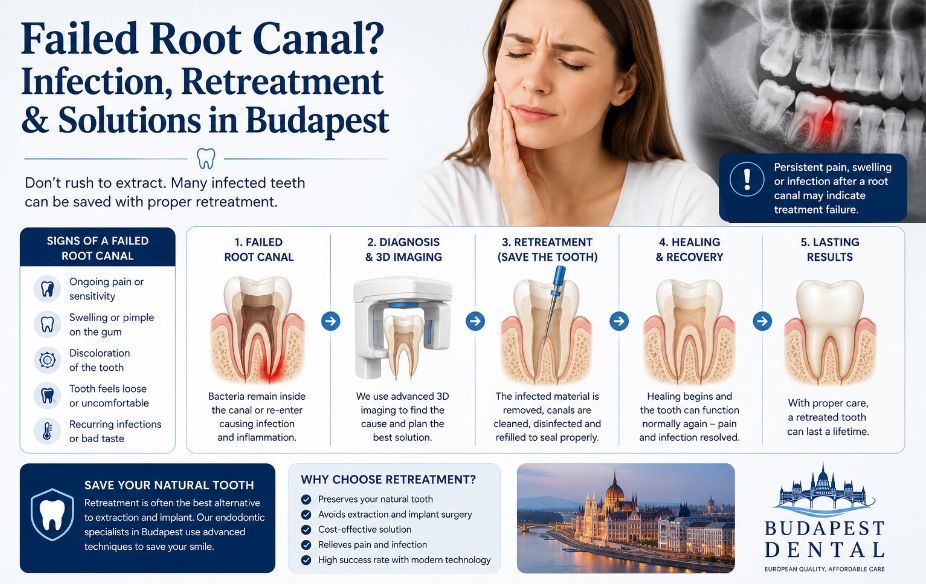
A failed root canal does not always mean your tooth needs to be extracted. Persistent infection around the root tip—known as chronic apical periodontitis—can often be treated with specialist root canal retreatment.
-
A CBCT scan may identify missed canals, hidden infection, cracks, root resorption or previous treatment complications that a standard X-ray cannot show clearly.
-
Non-surgical root canal retreatment is usually the first option when the tooth can be restored and the original source of infection can be addressed.
-
Endodontic microsurgery (apicectomy) may be considered when conventional retreatment is not possible or has already failed.
-
Extraction and implant treatment may be the better choice if there is a vertical root fracture, severe decay, inadequate tooth structure or a poor long-term prognosis.
-
For complex treatment in Budapest, choose a clinic that uses rubber dam isolation, microscope-assisted endodontics, CBCT when clinically justified and provides written records for follow-up after you return home.
Failed Root Canal Infection: Can the Tooth Be Saved?
A root canal treatment is designed to remove infection from inside a tooth, seal the root canal system and allow the bone around the root tip to heal. In many cases, it is highly successful. However, a previously root-treated tooth can become infected again months or even years later.
A “failed root canal” does not automatically mean the tooth must be extracted. In Budapest, patients can access specialist endodontic care, including microscope-assisted root canal retreatment, cone-beam CT (CBCT) diagnosis and endodontic microsurgery. The best approach depends on why the original treatment has not healed, whether the tooth is restorable and whether the root structure is still sound.
This guide explains chronic root-tip inflammation, CBCT imaging, non-surgical retreatment, apical surgery and when extraction may be the more predictable option.
Important: Persistent pain, swelling, pus, fever or facial swelling after root canal treatment needs professional assessment. This article is general information and does not replace a diagnosis from a dentist or endodontist.
What Is a Failed Root Canal?
A root canal can fail when bacteria remain inside the root canal system, re-enter the tooth after treatment or persist around the root tip. The medical term for inflammation around the root end is apical periodontitis.
Apical periodontitis develops when bacteria and their by-products irritate the tissues beyond the root tip. The body responds with inflammation, and the surrounding bone may gradually be resorbed. On an X-ray, this often appears as a darker area around the end of the root, called a periapical radiolucency.
Not every root-filled tooth with a dark area is actively worsening, and not every symptom comes from the root canal. A proper diagnosis requires clinical examination, dental tests and appropriate imaging.
Common signs of failed root canal treatment include:
- Persistent or recurrent pain when biting
- Tenderness when tapping or chewing
- Gum swelling near the root
- A pimple-like swelling on the gum, sometimes called a sinus tract
- Pus, bad taste or unpleasant smell
- Facial swelling
- A darkened tooth
- Recurrent decay or a loose crown
- A lesion around the root tip visible on an X-ray
- No symptoms at all, with the issue found during a routine check-up
Chronic apical periodontitis is often painless. This is why a root-treated tooth may feel normal while a low-grade infection continues around the root tip.
Why Does Root Canal Treatment Fail?
Root canal treatment can fail for several reasons. The cause matters because it affects whether non-surgical retreatment, apical surgery or extraction is most appropriate.
Missed or Untreated Canals
Teeth do not always have a simple, predictable canal system. Upper molars, for example, often have an additional canal in the mesiobuccal root. If a canal was not found, cleaned and sealed during the original treatment, bacteria can remain inside it.
A microscope and CBCT scan can be particularly useful in complex molars, teeth with unusual anatomy or root-filled teeth that continue to show signs of inflammation.
Inadequate Cleaning or Root Filling
The original root filling may be too short, too long, poorly condensed or may not seal the complex internal anatomy effectively. This can leave space for bacteria to survive.
The aim of retreatment is not simply to replace old filling material. It is to identify the reason for the original failure, disinfect the canal system as thoroughly as possible and create a durable seal.
Leakage From a Crown, Filling or Crack
A successful root filling needs a good seal at the top of the tooth as well as at the root tip. If a filling or crown leaks, fractures or develops decay around its edge, bacteria can enter the root canal system again.
This is why a well-made final restoration is a critical part of root canal success. Re-treating the canals without correcting a leaking crown or filling may not provide a long-term result.
Cracked Teeth or Vertical Root Fracture
A crack can allow bacteria to enter the tooth repeatedly. A vertical root fracture is particularly challenging because it may extend down the root and compromise the tooth’s long-term prognosis.
Symptoms may include pain on biting, a narrow deep gum pocket beside one root, recurrent swelling or persistent infection despite apparently adequate treatment. A crack is not always visible on a standard X-ray, and even CBCT cannot reliably detect every fine fracture.
Root Perforation or Previous Treatment Complications
During original treatment, an instrument may create an unwanted pathway through the root wall, known as a perforation. Other complications include separated instruments, ledges, blocked canals, posts that obstruct access or extruded filling materials.
Some of these issues can be managed by an experienced endodontist. Others may make extraction the more predictable long-term option.
New Decay or Trauma
A tooth may become reinfected because of new decay, a fractured restoration, trauma or loss of a protective crown. Root-treated teeth can be more brittle, particularly if they have lost a lot of natural tooth structure.
What Is Chronic Apical Periodontitis?
Apical periodontitis is inflammation in the tissues surrounding the root tip. It is usually caused by infection within the root canal system.
The condition may be acute or chronic:
-
Acute apical periodontitis can cause severe pain, tenderness, swelling or a dental abscess.
-
Chronic apical periodontitis may cause little or no pain. It is often identified by an X-ray showing bone loss around the root tip or by a recurring gum swelling.
The body may form a drainage pathway from the infected root to the gum surface. This may appear as a small pimple or bump that occasionally releases fluid. The swelling may reduce after drainage, but this does not mean the source of infection has gone away.
Root canal retreatment aims to remove or reduce the bacterial cause inside the root canal. Antibiotics alone do not resolve a persistent root-canal infection because they cannot reliably eliminate bacteria living inside the sealed canal system. Local dental treatment is usually necessary.
Why a CBCT Scan Can Be Important
A conventional dental X-ray is two-dimensional. It is useful and involves a low radiation dose, but structures can overlap and hide important details.
A cone-beam computed tomography (CBCT) scan provides a three-dimensional view of the tooth, roots, jawbone and surrounding anatomy. In endodontics, it may help assess:
- The number, position and shape of root canals
- Missed canals
- Curved or calcified canals
- The size and location of apical lesions
- Root resorption
- Root perforations
- Previous treatment complications
- Bone loss patterns
- Proximity to the maxillary sinus or lower jaw nerve
- Planning for apical surgery
- Possible fractures in selected cases
CBCT can influence treatment planning. In one study, clinicians changed their retreatment strategy after viewing CBCT images in almost half of cases.
However, a CBCT scan is not required for every root canal problem. It exposes patients to more radiation than a standard dental X-ray, and metal posts or root-filling material can create image artefacts. The scan should be justified because it is likely to provide information that changes diagnosis or treatment.onlinelibrary.
European endodontic guidance supports CBCT as an additional tool in medium- to high-complexity cases, where conventional imaging and clinical findings do not provide enough information.
The Specialist Endodontic Assessment
If you are seeking complex root canal retreatment in Budapest, a quality consultation should go beyond “Can this tooth be retreated?”
An endodontist or dentist with advanced endodontic experience may assess:
- Your pain history and symptoms
- Previous X-rays and treatment records
- Tooth mobility and gum health
- Tooth restorability: how much healthy tooth remains
- Bite forces and signs of clenching or grinding
- Existing crown, post, filling or bridgework
- Presence of decay around the restoration
- Root length, shape and number
- Possible crack or root fracture
- Apical lesion size and bone condition
- Need for CBCT imaging
- Whether the tooth can receive a durable final crown or restoration
- The alternative of extraction and dental implant treatment
The central question is not simply whether retreatment is technically possible. It is whether saving the tooth offers a good long-term prognosis compared with extraction and replacement.
Non-Surgical Root Canal Retreatment
Non-surgical retreatment is usually the first option when the dentist believes the infection is caused by inadequately treated or reinfected canals and the tooth remains structurally restorable.
The treatment is completed through the crown of the tooth rather than through surgery in the gum.
Step 1: Access and Isolation
The dentist usually places a rubber dam around the tooth. This is a protective sheet that keeps saliva and bacteria out of the treatment area and protects the patient during the procedure.
The old filling, crown or restoration may need to be removed. If a post is present, it may also need to be removed carefully to access the canals.
Step 2: Removal of Previous Root Filling Material
Old root-filling material, usually gutta-percha, is removed using specialist instruments, solvents where appropriate and magnification. This can be technically demanding, especially in narrow, curved or calcified canals.
The clinician then looks for untreated anatomy, including missed canals, fins, isthmuses or accessory canals.
Step 3: Cleaning and Disinfection
The canals are shaped, irrigated and disinfected. Modern endodontic retreatment commonly uses antimicrobial irrigants and activation techniques to improve cleaning of complex spaces.
The objective is to reduce the bacterial load as much as possible. No root canal procedure can guarantee complete removal of every microorganism from every microscopic canal branch, which is why careful sealing and a good restoration are also essential.
In some complex or infected cases, treatment may take more than one visit. A temporary medication may be placed inside the tooth between appointments.
Step 4: Root Filling and Coronal Seal
Once the canals are considered clean and dry, they are filled and sealed. The dentist then places a strong temporary or permanent restoration.
A final crown, onlay or other protective restoration may be recommended if the tooth has lost substantial structure. This protects against fracture and helps prevent coronal leakage.
Expected Outcomes
Contemporary non-surgical retreatment can have favourable outcomes, but no responsible clinician should promise a guaranteed success rate.
A 2024 systematic review reported pooled periapical healing and success rates of approximately 78% using strict outcome criteria and around 86% to 88% using looser criteria. Outcomes were more favourable where pre-treatment lesions were absent or smaller, root filling was adequate and follow-up was longer.
A poorer prognosis may be associated with:
- Large apical lesions
- Significant pre-existing bone loss
- Untreated canals that are difficult to access
- Root fractures
- Severe root resorption
- Perforations
- Complex molar anatomy
- A tooth that cannot receive a good final restoration
- Persistent leakage from a crown or filling
Endodontic Microsurgery: Apicectomy and Root-End Treatment
If non-surgical retreatment is not possible, has already failed, or cannot access the cause of infection, endodontic microsurgery may be considered.
This is often called an apicectomy, though modern endodontic microsurgery involves more than simply removing the root tip.
The procedure may include:
- Lifting the gum near the affected root.
- Accessing the small area of bone around the root tip.
- Removing inflamed tissue and a small section of the root end.
- Cleaning and preparing the root end under magnification.
- Placing a root-end filling to seal the canal from the tip.
- Suturing the gum and allowing the area to heal.
Microsurgery can be particularly useful when a root canal is blocked by a post, a crown cannot reasonably be removed, or anatomy makes conventional retreatment difficult.
It is not automatically better than non-surgical retreatment. The choice depends on the specific tooth. A systematic review comparing non-surgical treatment or retreatment with apical surgery found no clearly superior option overall, partly because the available studies were heterogeneous.
A skilled endodontist will explain the advantages, limitations and expected prognosis for both approaches.
Intentional Replantation
In selected unusual cases, a tooth may be carefully extracted, treated outside the mouth and replanted immediately. This is known as intentional replantation.
It is generally considered only when conventional retreatment and apical surgery are not feasible, for example because the root tip is inaccessible or close to vital anatomy. It is a specialised procedure with risks, including root resorption, fracture and loss of the tooth.
It is not routinely the first choice for a failed root canal.
When Extraction May Be the Better Option
Saving a natural tooth is often desirable, but retreatment should not be undertaken if the long-term outlook is poor.
Extraction may be recommended when there is:
- A confirmed vertical root fracture
- Insufficient remaining tooth structure for a reliable restoration
- Severe decay extending too far below the gumline
- Advanced gum disease and tooth mobility
- Untreatable root perforation
- Severe resorption
- Repeated failed endodontic treatment with poor prognosis
- A root shape or anatomy that makes predictable treatment impossible
- Cost, time or personal factors that favour replacement
If extraction is needed, replacement options may include a dental implant, bridge or removable denture. In Budapest, patients considering an implant should ask about socket preservation, healing time, bone grafting needs, gum condition and the full timeline to the final crown.
An extraction should not be viewed as the default answer simply because a root canal has failed. Equally, retreatment should not be pursued if it has little realistic chance of providing a durable tooth.
What to Expect During Recovery
After Non-Surgical Retreatment
Most patients can return to normal daily activities the same day. The tooth may feel tender to bite on for a few days because the tissues around the root tip are inflamed.
Avoid chewing hard foods on the tooth until it has been permanently restored. Contact the clinic if you develop increasing swelling, severe pain, fever, a rash, persistent numbness or a lost temporary filling.
After Apical Surgery
Following endodontic surgery, mild swelling, bruising, tenderness and gum soreness can occur. These symptoms often peak in the first two to three days and then improve.
You may need stitches removed after around one week, depending on the type used. Your clinician may arrange follow-up X-rays over months or years to monitor bone healing around the root tip.
The European Society of Endodontology recommends a minimum one-year follow-up when assessing treatment effectiveness for apical periodontitis, although full radiographic healing can continue beyond that period.
How to Choose an Endodontist in Budapest
Budapest is widely known for dental tourism, but complex retreatment should be selected on clinical quality—not price alone.
Look for a clinic that can provide:
- A detailed consultation before treatment
- Clear explanation of all options, including extraction
- Digital periapical X-rays and CBCT where clinically justified
- Rubber dam isolation as standard
- Dental microscope or high-quality magnification
- Specialist endodontic instruments and modern irrigation protocols
- Written treatment plan and itemised costs
- Transparent explanation of prognosis
- A final restoration plan, not just the root canal stage
- Copies of X-rays, CBCT report and treatment records
- A structured follow-up plan after you return home
For UK patients travelling to Budapest, ask how the clinic will manage follow-up care if symptoms occur after you return. Request digital copies of treatment notes and imaging so your home dentist can continue monitoring the tooth if needed.
Questions to Ask Before Retreatment
Before consenting to treatment, consider asking:
- Why did my original root canal fail?
- Is the tooth cracked or structurally restorable?
- Do I need a CBCT scan, and what will it change?
- Is non-surgical retreatment possible?
- Would apical microsurgery provide a better prognosis?
- Do I need a new crown, onlay or filling after treatment?
- What is the estimated chance of success in my specific case?
- What happens if retreatment does not heal?
- How many visits will I need in Budapest?
- What aftercare and follow-up are included?
- Can I receive my X-rays, CBCT images and written treatment report?
- If extraction becomes necessary, what replacement options and timelines should I consider?
When to Seek Urgent Dental Care
Contact a dentist urgently if you develop:
- Rapidly increasing facial swelling
- Fever, chills or feeling seriously unwell
- Difficulty swallowing or breathing
- Severe pain not controlled by recommended pain relief
- Pus or a spreading gum swelling
- A loose temporary restoration exposing the tooth
- Trauma to the treated tooth
In the UK, contact your dentist or NHS 111 if urgent dental care is needed and you cannot access your own practice. Breathing difficulty, rapidly spreading neck swelling or severe systemic illness requires emergency care.
Final Advice
A failed root canal infection can often be managed without removing the tooth. Chronic apical periodontitis frequently results from missed anatomy, leaking restorations, incomplete disinfection, cracks or previous treatment complications.
For complex cases, CBCT imaging and specialist endodontic assessment can help identify the cause of failure and guide treatment. Non-surgical retreatment is commonly the first option when the tooth is restorable. Endodontic microsurgery may be appropriate when conventional access is not possible or has already failed.
For patients considering treatment in Budapest, choose a clinic that prioritises diagnosis, rubber dam isolation, magnification, appropriate use of CBCT, clear prognosis and long-term follow-up—not just rapid treatment or a low headline price.
Failed Root Canal Retreatment FAQs
What does a failed root canal mean?
A failed root canal means that infection or inflammation has persisted or returned after previous root canal treatment. It may be caused by missed canals, incomplete cleaning, a leaking crown or filling, new decay, a crack, root fracture or a complication from earlier treatment.
Can a failed root canal be treated without extracting the tooth?
Often, yes. If the tooth is structurally restorable and the cause can be addressed, non-surgical root canal retreatment may save it. When retreatment is not possible or has a poor prognosis, endodontic microsurgery or extraction may be considered.
What is chronic apical periodontitis?
Chronic apical periodontitis is long-standing inflammation around the tip of a tooth root, usually caused by bacteria remaining inside or re-entering a root canal system. It may appear as a dark area around the root tip on an X-ray and can be painless for a long time.
Can a root canal infection return years later?
Yes. A root-treated tooth can become reinfected years later if bacteria enter through a leaking crown, fractured filling, new decay, crack or failed seal. This is why the final restoration and regular dental checks are important after root canal treatment.
What are the symptoms of a failed root canal?
Possible symptoms include pain on biting, tenderness, swelling, a gum abscess or pimple, pus, bad taste, recurrent facial swelling or a dark area on an X-ray. However, some failed root canals cause no symptoms and are detected during routine dental examinations.
Why do I need a CBCT scan for root canal retreatment?
A CBCT scan provides a three-dimensional image of the tooth, roots and surrounding bone. It may help identify missed canals, complex anatomy, root resorption, perforations, lesion size, root-end problems and surgical planning issues that may not be visible on a standard two-dimensional dental X-ray.
Does every failed root canal need a CBCT scan?
No. A standard dental X-ray is often sufficient for straightforward cases. CBCT is generally used when the diagnosis is uncertain, the anatomy is complex, surgery is being considered or the scan is likely to change the treatment plan.
How is root canal retreatment carried out?
The dentist reopens the tooth, removes the old filling materials, locates all canals, disinfects the root canal system and seals it again. A rubber dam is normally used to isolate the tooth, and magnification or a dental microscope can help manage complex anatomy. The tooth may then need a new filling, onlay or crown.
Is root canal retreatment painful?
Retreatment is normally completed under local anaesthetic, so you should not feel pain during the procedure. The tooth may feel tender when biting for a few days afterwards, particularly if there was inflammation around the root tip before treatment.
How successful is root canal retreatment?
Success depends on the tooth, original cause of failure, root anatomy, size of any lesion, quality of the final restoration and whether the tooth is cracked. A recent systematic review reported pooled healing rates of around 79% using strict criteria and approximately 88% using looser outcome criteria.
What is an apicectomy?
An apicectomy, more accurately called endodontic microsurgery, is a procedure where the surgeon accesses the root tip through the gum, removes inflamed tissue and the end of the root, then seals the canal from the root end. It may be considered where conventional retreatment is not feasible or has failed.
Is an apicectomy better than root canal retreatment?
Not necessarily. Non-surgical retreatment is often preferred when the canals can be accessed and the cause of failure can be corrected. Apical surgery may be a better option where posts, crowns, blocked canals or anatomical issues prevent conventional retreatment. The most suitable approach depends on the individual tooth.
Can antibiotics cure a failed root canal infection?
Antibiotics may be needed for spreading infection, facial swelling, fever or systemic illness, but they do not remove bacteria inside a root canal system. Most persistent root canal infections require dental treatment such as retreatment, drainage, surgery or extraction.
When is extraction the better option?
Extraction may be more predictable when there is a vertical root fracture, severe decay below the gumline, insufficient tooth structure for a reliable restoration, advanced gum disease, severe resorption, an untreatable perforation or repeatedly failed treatment with a poor prognosis.
What happens if my tooth must be extracted?
Replacement options may include a dental implant, bridge or removable denture. If you are considering an implant, ask about bone socket preservation at the extraction appointment, as this may reduce jawbone shrinkage while the site heals.
How many visits will root canal retreatment take in Budapest?
It varies. Some uncomplicated retreatments can be completed in one extended visit, while complex cases—especially those with infection, posts, calcified canals or multiple roots—may require two or more appointments. Ask the clinic to explain the expected timetable and whether follow-up is included.
What should I ask a Budapest endodontic clinic before treatment?
Ask whether CBCT is needed, whether a dental microscope and rubber dam will be used, why the original root canal failed, whether the tooth is cracked and restorable, whether retreatment or apicectomy is recommended, what final restoration is required, and how follow-up will work once you return home.
When should I seek urgent care?
Seek urgent dental help for rapidly increasing facial swelling, fever, difficulty swallowing or breathing, severe uncontrolled pain, spreading gum swelling or pus. In the UK, contact your dentist or NHS 111 if you cannot access urgent dental care; breathing difficulty or rapidly spreading neck swelling requires emergency care.
Sources
- Systematic review: Outcomes of contemporary non-surgical endodontic retreatment
- European Society of Endodontology: Position statement on CBCT in endodontics
- CBCT in endodontics: Indications and limitations for clinical practice
- Study: CBCT influence on endodontic retreatment strategies
- Dental Update: CBCT use in endodontic retreatment
- Systematic review: Non-surgical retreatment versus apical surgery
- European Society of Endodontology: Guideline for pulpal and apical disease treatment