For most UK patients, tooth extraction is a last resort. The good news is that modern dentistry offers several reliable ways to save a tooth before it reaches that point, from simple fillings to advanced root canal treatments and protective crowns. Each option has its place, and knowing how they work helps you talk confidently with your dentist instead of feeling pushed into a quick decision.
Why saving a tooth usually comes first
Your natural teeth are finely tuned for biting, chewing and speaking. Even the best replacement – an implant, bridge or denture – is still an imitation of what your own tooth can do. Removing a tooth changes how your teeth meet, can lead to drifting and gaps, and often means more treatment later to fill the space.
Because of this, most dentists will explore every reasonable option to keep a tooth functioning comfortably in your mouth. The earlier a problem is identified, the simpler and more conservative the solution is likely to be. Left too long, a small cavity that could have been fixed with a simple filling may progress to needing a root canal or even extraction.
Think of saving a tooth as a ladder. At the lower rungs you have the least invasive treatments, and the higher you climb, the more complex the work becomes. The aim is to act early enough that you can stay on the lower rungs.
Early intervention: fillings and inlays
When a filling can save a tooth
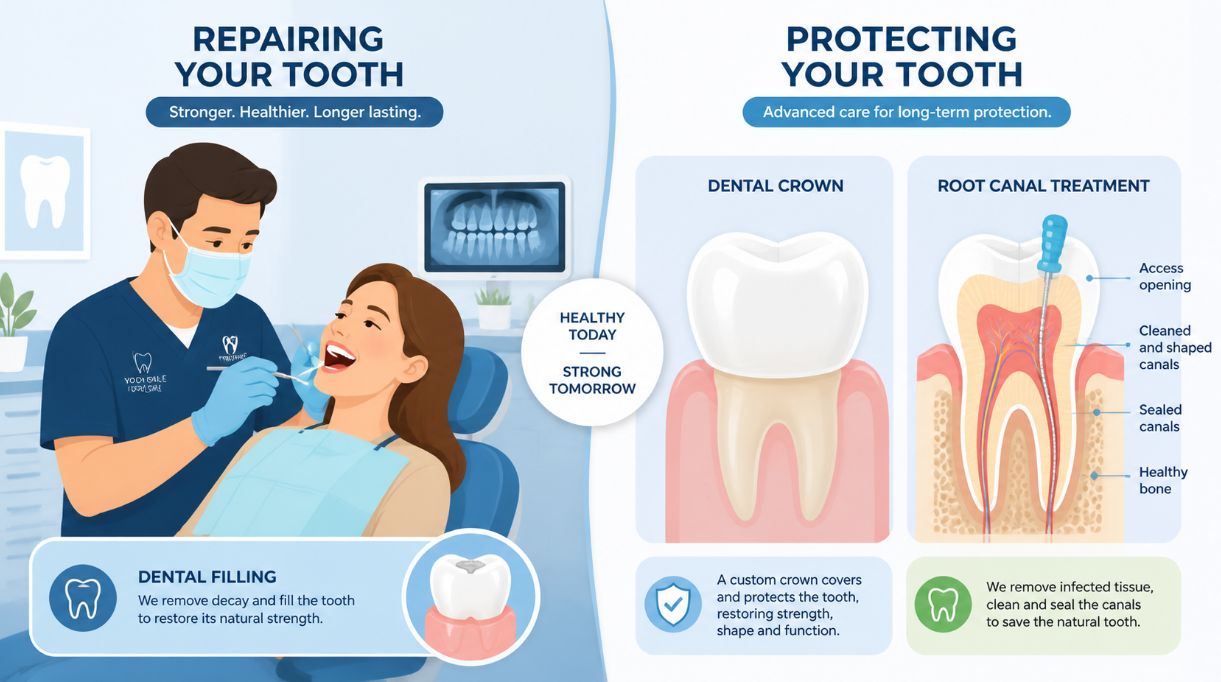
A filling is often the first line of defence against extraction. It is used when decay, wear or minor fractures have damaged part of the tooth, but the underlying nerve (pulp) is still healthy or only mildly irritated.
The process is straightforward:
-
The dentist numbs the tooth and removes the decayed or weakened tissue.
-
The cleaned cavity is shaped so a restoration can bond securely.
-
A filling material – usually tooth‑coloured composite – is placed in layers and hardened with a curing light.
-
The restoration is shaped and polished so your bite feels normal.
By sealing the tooth, a filling stops bacteria going deeper and protects the remaining structure from further damage. In many cases, this is enough to keep the tooth healthy for many years.
When fillings are not enough
If a cavity is very large, or if there are cracks running through the tooth, a simple filling might not provide enough strength. Under heavy chewing forces, a heavily filled tooth can fracture, sometimes in a way that makes it impossible to repair.
In these cases, your dentist may recommend:
-
A larger onlay or inlay, which is a custom‑made piece that fits into or over the tooth.
-
A full crown to cover and protect the remaining tooth structure.
These options are more involved than a filling, but they can dramatically reduce the risk of the tooth cracking beyond repair.
Crowns: reinforcing a weakened tooth
Crowns are like a protective helmet for a damaged tooth. They are commonly used to save teeth that have:
-
Very large fillings
-
Cracks or fractures
-
Been weakened by root canal treatment
-
Extensive wear from grinding or acid erosion
How a crown helps
During crown preparation, the dentist reshapes the tooth so a custom‑made cap fits snugly over the top and around the sides. The crown is usually made from ceramic, metal, or a combination, and is cemented permanently in place.
By encasing the tooth, a crown:
-
Holds cracked or weakened tooth structure together
-
Distributes biting forces more evenly
-
Protects the underlying tooth from further decay if you keep cleaning well
For teeth that would otherwise be at high risk of splitting, a crown can be the key to keeping them in service rather than losing them.
Root canal treatment: saving the tooth when the nerve is in trouble
When decay, trauma or repeated dental work has reached the nerve, you may develop intense toothache, lingering sensitivity, swelling or an abscess. At this stage, a filling alone is no longer enough because the pulp inside the tooth is infected or dying.
If the outside of the tooth is still strong enough, root canal treatment (endodontic therapy) can remove the infection while preserving the tooth itself.
What root canal actually involves
Root canal treatment is often misunderstood, but in skilled hands it is a controlled, methodical process:
-
Diagnosis and imaging – The dentist or endodontist examines the tooth, checks your symptoms and reviews X‑rays or 3D images to understand the root anatomy and any infection in the surrounding bone.
-
Anaesthesia and isolation – The tooth is numbed thoroughly. A rubber sheet (rubber dam) is placed around it to keep it clean and dry.
-
Access to the canals – A small opening is made in the biting surface or back of the tooth to reach the pulp chamber.
-
Cleaning the root canals – Fine instruments and disinfecting solutions are used to remove infected tissue and bacteria from inside each root.
-
Filling the canals – Once cleaned and shaped, the canals are filled with a biocompatible material and sealed to prevent re‑infection.
-
Restoring the tooth – The opening is sealed with a filling, and in most cases a crown is recommended afterwards to protect the now‑brittle tooth from breaking.
The aim is to remove pain and infection while keeping the tooth anchored in the jaw, so you can chew and smile with it as normal.
When root canal is a strong option
Root canal is usually the best way to save a tooth when:
-
There is deep decay reaching the nerve, but the remaining tooth is rebuildable.
-
You have toothache or an abscess at the tip of the root, but the roots themselves are intact.
-
A tooth has suffered trauma, and the nerve has died but the structure is still sound.
-
A previous root canal has minor issues that can be addressed with retreatment.
In these situations, extracting the tooth would remove the problem, but at the cost of losing something that could potentially function well for many years if treated properly.
Other ways dentists try to rescue teeth
Pulp capping and stepwise caries removal
When decay is very close to the nerve but may not yet have fully infected it, your dentist might consider less aggressive treatments designed to encourage the pulp to heal.
Examples include:
-
Indirect pulp capping – The dentist removes most of the decay but deliberately leaves a thin layer over the pulp to avoid exposing it, then seals it with a special material and a restoration.
-
Direct pulp capping – If there is a tiny pinpoint exposure in a healthy pulp (often in younger patients), a protective dressing is placed directly over it to encourage repair.
These approaches are case‑dependent and tend to work best in younger, otherwise healthy teeth. When successful, they can prevent or delay the need for root canal treatment.
Periodontal treatment for loose teeth
Sometimes the threat to a tooth is not decay but gum disease. When advanced gum disease has destroyed supporting bone, teeth become loose and at risk of being lost.
Non‑surgical deep cleaning, improved home care and, in some cases, gum surgery can stabilise the supporting tissues. If the tooth has not lost too much support, this can be enough to keep it functioning rather than extracting it.
In selected cases, splinting a loose tooth to its neighbours can also buy time as the underlying gum health improves.
Splints and occlusal guards
Cracks and fractures often develop in teeth that are overloaded, either because of clenching, grinding or an uneven bite. As part of saving a compromised tooth, your dentist may:
-
Adjust your bite very slightly to spread forces more evenly.
-
Provide a night guard to reduce stress from grinding.
Reducing mechanical stress gives fillings, crowns and root canal treatments a better chance of long‑term success.
When extraction becomes the sensible choice
Even with all these tools, there are times when a tooth is too far gone to justify rescue. Responsible dentists will explain when treatment is unlikely to succeed or would involve excessive cost and complexity for poor long‑term prospects.
Common reasons extraction becomes the better option include:
-
A vertical crack running down the root.
-
Decay so deep below the gum that there is too little healthy tooth to support a restoration.
-
Very advanced gum disease with severe bone loss around the tooth.
-
Multiple failed attempts at root canal or retreatment with continuing infection.
In these cases, removing the tooth can eliminate chronic infection and pain, and allow you to move on to a stable solution such as an implant, bridge or well‑designed denture.
The key point is that extraction should be a considered decision, taken with a clear understanding of what has been tried, what could be tried, and what replacement options are available.
How to improve your chances of keeping teeth
Many teeth end up needing extraction not because dentistry failed, but because problems were allowed to progress silently until they were too advanced. There is a lot you can do to tilt the balance in favour of saving teeth.
-
Keep regular check‑ups and hygiene visits – Early decay, cracks and gum problems are far easier to manage conservatively.
-
Treat toothache promptly – Do not wait for pain to “go away on its own”; it often means the nerve is under pressure or infection is building.
-
Prioritise protective restorations – If your dentist advises a crown or onlay to reinforce a heavily filled tooth, see it as an investment in keeping the tooth, not an optional upgrade.
-
Manage grinding and clenching – A night guard or bite adjustment can be the difference between a tooth surviving or splitting.
-
Look after your gums – Thorough brushing, interdental cleaning and professional care reduce the risk of mobility and loss through periodontal disease.
By acting early and following through with recommended treatments, you keep tooth‑saving options like fillings and root canal firmly on the table.
Asking the right questions at the dentist
When you are told a tooth is in trouble, it is reasonable to ask your dentist to walk you through the alternatives. Useful questions include:
-
Can this tooth be saved with a filling, onlay, crown or root canal?
-
If we try to save it, what are the realistic chances of success and how long might it last?
-
What happens if we extract it now – how will we replace it, and what will that involve?
-
Are there ways to reduce the risk of similar problems in my other teeth?
A good dentist will be happy to explain the pros and cons of each route and help you choose a plan that balances comfort, cost, long‑term function and your own priorities.