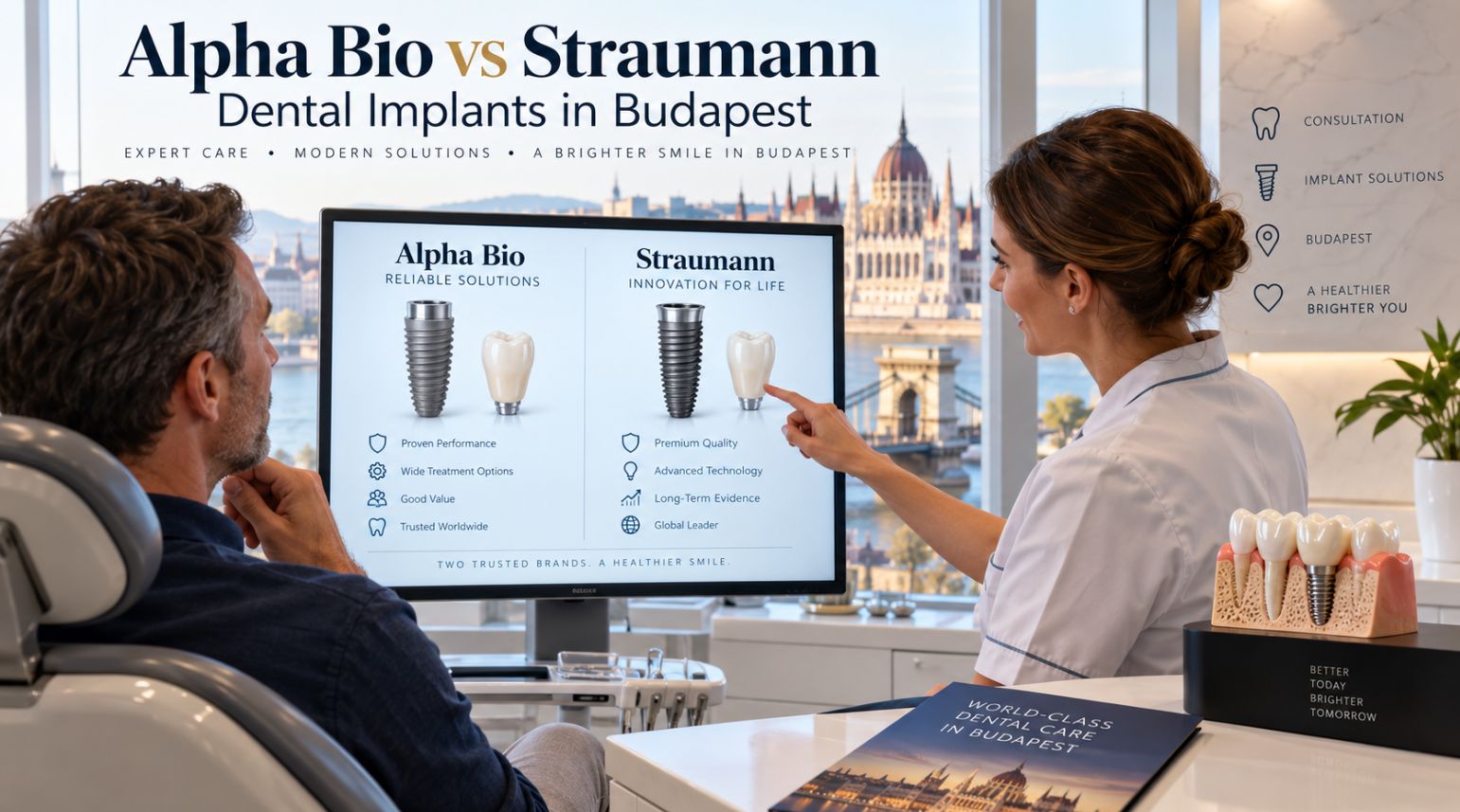
Key Highlights
- Alpha-Bio Tec and Straumann are both established, internationally distributed dental implant systems used by implant clinics in Budapest and worldwide.
- For UK, Irish, and US patients, the right implant brand should be chosen according to bone quality, implant location, gum health, bite forces, missing-tooth site, aesthetic demands, healing risks, and the clinician’s experience—not only the headline price.
- Budapest implant treatment can often cost substantially less than comparable treatment in London, Dublin, or the US because of local operating and laboratory costs. However, compare written treatment plans carefully: low quotes may exclude CBCT scans, bone grafting, abutments, temporary teeth, final crowns, follow-up, and travel costs.
- Straumann is a Swiss premium implant brand with broad international recognition and a strong presence among implant clinicians and dental laboratories.
- Straumann’s Roxolid is a titanium-zirconium alloy designed for higher mechanical strength than conventional Grade 4 titanium. It may provide useful options in selected narrow spaces or sites with limited bone—when the clinical assessment supports its use.
- Straumann’s SLActive is a hydrophilic implant surface intended to support early osseointegration. In suitable cases with good bone quality and adequate implant dimensions, Straumann guidance describes an initial healing phase of at least 3–4 weeks for SLActive versus at least 6 weeks for standard SLA surface protocols. Healing still depends on your individual anatomy, surgical stability, health, and restorative plan.
- Straumann may be particularly attractive for complex cases involving reduced bone volume, narrow implant sites, demanding front-tooth aesthetics, selected immediate-placement or immediate-load protocols, full-arch treatment, or high functional demands.
- Alpha-Bio Tec is generally positioned as a strong high-value implant option, often suited to standard cases with healthy gums, adequate bone density, sufficient bone volume, and a conventional healing plan.
- Alpha-Bio Tec’s SPIRAL implant design is intended to support primary stability across a range of bone conditions. The exact implant type, surface, connection, and suitability should be confirmed in your written treatment plan.
- A standard implant case does not mean lower-quality care. A correctly placed Alpha-Bio implant with a precise crown, healthy gums, balanced bite, and consistent maintenance can provide an excellent long-term outcome.
- Straumann is usually the premium price tier, while Alpha-Bio Tec is generally lower-to-mid tier. The final treatment cost also depends on surgery, grafting, abutments, temporary restorations, crown material, diagnostics, and follow-up—not the implant fixture alone.
- Both brands have international distribution. Still, ask for an implant passport listing the exact system, implant line, diameter, length, connection, surface, batch information, abutment details, and restoration material. This makes future maintenance in the UK, US, or Ireland much easier.
- Dental implants are not maintenance-free. Whether you choose Alpha-Bio or Straumann, success depends on daily cleaning, healthy gums, regular hygiene and implant reviews, bite management, and avoiding or reducing risk factors such as smoking.
- The best value is not the cheapest implant quote. It is a transparent, clinically appropriate plan with a reputable implant system, experienced clinician, clear inclusion list, documented components, and realistic aftercare.
- Before choosing a brand in Budapest, send a recent panoramic X-ray or CBCT scan for review and ask: Which implant system fits my bone structure, aesthetic goals, treatment complexity, and budget—and why?
Straumann vs. Alpha-Bio in Budapest: Premium and High-Value Implant Options
Both Alpha-Bio Tec and Straumann are legitimate, internationally distributed implant systems used in modern implant dentistry. For patients travelling to Budapest from the UK, US, or Ireland, the right choice is not simply “premium versus budget”: it depends on bone quality, implant site, whether grafting or immediate loading is planned, bite forces, aesthetic demands, restorative design, and the treating team’s experience with the system.
A high-quality Budapest clinic can use the same internationally recognised implant brands and modern digital workflows found in London, Dublin, or New York. Lower treatment costs in Hungary are commonly linked to local operating costs, laboratory structures, and overheads rather than an automatic reduction in clinical standards—but patients should still insist on transparent documentation of the exact implant system, components, final crown, diagnostics, and aftercare included in their quote. Published market guides commonly report substantial—but variable—Hungary-to-UK/US price differences, often in the 40–70% range for comparable treatment pathways.
The first rule: choose the clinical plan, not the logo
Patients understandably ask, “Which implant brand is better?” But a clinically responsible answer starts with a different question:
Which implant system and treatment design are best suited to my anatomy, restoration, health risks, and long-term maintenance needs?
The brand matters. It influences component availability, surface technology, implant materials, connection design, surgical workflow, long-term documentation, and the laboratory’s ability to create an accurate restoration. Yet a brand alone cannot compensate for poor diagnosis, inadequate bone, untreated gum disease, uncontrolled diabetes, smoking, poor hygiene, excessive grinding, inaccurate implant placement, or an ill-fitting crown.
A high-quality implant result depends on:
- A comprehensive clinical examination.
- Appropriate X-rays and, where needed, CBCT imaging.
- Assessment of gum health and bone volume.
- A prosthetically driven plan—designing the final crown or bridge before deciding where the implant goes.
- A clinician trained and experienced with the proposed system.
- Accurate surgical placement.
- A well-designed abutment and crown.
- Good bite management, particularly for clenchers and grinders.
- Daily cleaning and regular professional maintenance.
- Clear documentation of the implant brand, line, diameter, length, connection, and restoration components.
The British Society of Periodontology describes implants as long-term rehabilitation for lost teeth, but emphasises the importance of ongoing maintenance and monitoring.
Straumann: Swiss premium implant engineering
Straumann is a Swiss-headquartered implant company with a long-standing global presence in premium implant dentistry. It is widely recognised by clinicians, dental laboratories, and implant-maintenance providers in Europe, North America, and many other markets.
For international patients, its widespread use can provide reassurance that implant components, replacement screws, restorative parts, and professional support are more likely to be available if future care is needed in the UK, Ireland, or the US. However, patients should still retain their implant passport and treatment records because “Straumann” is a broad brand family with different implant lines, connections, components, and restorative options.
Roxolid: titanium-zirconium alloy
One of Straumann’s best-known innovations is Roxolid, a titanium-zirconium alloy. It is designed to offer greater mechanical strength than conventional commercially pure titanium while maintaining suitability for dental implant use.
Straumann states that Roxolid has approximately 20% higher tensile strength than its cold-worked titanium and around 80% higher strength than standard Grade 4 titanium. The company positions this strength as useful when clinicians want to consider smaller-diameter implants or work in situations with limited anatomical space, subject to appropriate case selection.
For patients, the practical benefit is not that a smaller implant is automatically better. It is that a stronger implant material may give the surgeon more restorative and anatomical options in selected situations, including narrow spaces, limited bone width, or sites where preserving bone may be desirable.
SLActive: a hydrophilic implant surface
Straumann’s SLActive is a chemically modified, hydrophilic implant surface designed to support early bone healing and osseointegration—the biological process in which bone forms a stable attachment to the implant surface.
Straumann describes SLActive as a high-performance surface with accelerated osseointegration potential. Its technical documentation states that the surface may reduce initial healing time to approximately three to four weeks in selected protocols, while treatment decisions remain dependent on surgical stability, bone quality, restoration type, patient health, and clinician judgement.
This needs a careful interpretation. A surface technology does not guarantee that every patient can receive an immediate crown or shortened healing period. Immediate placement and immediate loading are clinical protocols, not marketing add-ons. They require sufficient primary stability, favourable bite conditions, good infection control, appropriate bone and gum conditions, and a patient who can follow aftercare advice.
When Straumann may be a strong fit
Straumann may be especially attractive for patients with:
- Reduced bone volume or narrow implant sites.
- Complex upper-front-tooth aesthetic cases.
- A need for a smaller-diameter implant where clinically appropriate.
- A history of more challenging healing factors.
- Full-arch rehabilitation or immediate-load planning.
- Higher bite forces, bruxism, or demanding restorative requirements.
- A preference for a premium system with broad international recognition.
- A clinician whose surgical and restorative workflow is strongly built around Straumann components.
Straumann’s Bone Level Tapered and BLX product information presents Roxolid and SLActive options as designed to support primary and secondary stability, including use in more challenging anatomical and immediate-placement or immediate-loading protocols when clinically appropriate.
That said, an implant brand should never be selected solely because a patient has diabetes, smokes, has limited bone, or wants treatment completed quickly. These factors increase the need for careful risk assessment and may require treatment of gum disease, smoking cessation, grafting, staged loading, or a different restoration design.
Alpha-Bio Tec: a high-value, established global system
Alpha-Bio Tec is an established implant manufacturer with a broad international distribution network. Its portfolio includes implant designs such as the SPIRAL range and other implant solutions intended to support a variety of clinical indications. Alpha-Bio states that it operates through a global distributor network serving clinicians in many countries and regions.
In Budapest, Alpha-Bio Tec is often positioned as a dependable, high-value system for suitable standard implant cases. It can be an attractive choice for patients who want a recognised implant brand, durable titanium implant design, and transparent restorative planning without paying the premium associated with certain top-tier brand lines.
Spiral design and primary stability
Alpha-Bio Tec’s SPIRAL implant family is known for a tapered, threaded design intended to support stability in a range of bone situations. Implant macrodesign—its shape, threads, taper, and connection—can affect insertion behaviour and primary stability, but the best choice depends on the patient’s actual bone quality, implant site, surgical technique, and final restoration.
It is important not to confuse “spiral” or “aggressive-thread” design with universal superiority. A design that is advantageous in soft bone may not be the best solution for every dense-bone, front-tooth, grafted, or narrow-space case. The clinician needs to select implant diameter, length, connection, and position based on diagnostic imaging and the desired final crown.
Why Alpha-Bio may suit standard cases
Alpha-Bio Tec can be a sensible high-value option for patients with:
- Good bone density and sufficient bone volume.
- A straightforward single-tooth replacement.
- A non-complex posterior tooth replacement.
- Stable gum health and good oral hygiene.
- No major aesthetic or anatomical complications.
- A conventional healing and loading plan.
- A clear desire to balance quality, traceability, and budget.
“Standard case” does not mean low-quality dentistry. It means the anatomy and treatment requirements do not necessarily demand the additional material or surface features associated with a premium tier. A properly planned Alpha-Bio implant, placed in healthy bone and restored with a precise crown, can deliver an excellent result.
Alpha-Bio vs. Straumann: side-by-side comparison
The table is a practical guide, not a substitute for diagnosis. Individual Alpha-Bio and Straumann implant lines have different designs, materials, surfaces, connections, indications, and compatible restorative components. Your treatment plan should name the exact implant line, not only the brand.
Healing time: why there is no universal timetable
Patients often compare implant brands by asking, “Which one heals faster?” It is a reasonable question, but the answer is never just the brand name.
Osseointegration is affected by:
- Implant surface and design.
- Bone density and bone volume.
- Implant stability at placement.
- Whether the implant is placed immediately after extraction.
- Whether bone grafting is required.
- The implant’s location in the upper or lower jaw.
- Gum and bone health.
- Smoking and vaping.
- Diabetes control and other medical factors.
- Infection history.
- Bite forces and grinding.
- Whether the implant is supporting a single crown, bridge, denture, or full arch.
- Whether immediate loading is planned.
Straumann’s SLActive technical information supports its role in accelerated early osseointegration, and company materials cite shortened initial healing protocols in selected cases. Yet no ethical clinic should promise every patient a fixed “four-week implant” based on the brand alone.
A conventional staged approach may be the safest plan for many patients, particularly after bone grafting, with active infection history, limited bone, complex bite forces, or a high-risk medical profile. Faster treatment is not automatically better if it compromises stability.
What “FDA-cleared” and “CE-marked” really mean
UK, US, and Irish patients often want assurance that materials used in Budapest meet recognised regulatory standards.
-
In the United States, many dental implants enter the market through the FDA’s 510(k) clearance pathway, which assesses substantial equivalence to a legally marketed device.
-
In Europe, medical devices are placed on the market under the applicable European regulatory framework and conformity-assessment processes, commonly associated with CE marking.
Straumann implant documentation available through the FDA’s database includes a titanium-zirconium implant design with the SLActive surface. However, regulatory status can vary by specific product, implant line, indication, market, and date. A clinic should not merely say “FDA approved” or “CE certified” in general terms.
Ask to see or receive:
- The exact implant brand and product line.
- Implant diameter and length.
- Material and surface designation.
- Lot or batch number.
- Implant passport or patient identification card.
- Abutment brand and type.
- Final crown material.
- Warranty conditions.
- Copies of X-rays, scans, treatment notes, and laboratory documentation.
This level of transparency is valuable whether you choose Alpha-Bio Tec, Straumann, or another recognised implant system.
Are both brands easy to maintain at home?
Both systems have international reach, but there is an important distinction between global recognition and guaranteed local availability.
Straumann has an especially large international footprint and is familiar to many implant dentists and laboratories in the UK, Ireland, and US. Alpha-Bio Tec also has an international distributor network.
However, future care depends on the exact implant connection and restorative components—not just the logo. If a crown screw loosens, a crown fractures, or a replacement restoration is needed years later, a local clinician may need precise component information.
Before travelling home, request:
- An implant passport for every implant.
- Brand, system, line, connection, diameter, and length.
- Batch or lot information where available.
- Implant placement date and site.
- Abutment details.
- The final crown or bridge material.
- Pre-operative and post-operative X-rays.
- Digital scans or STL files if available.
- A written summary in English.
- The clinic’s emergency and warranty contact details.
Keep digital copies in cloud storage and share them with your home dentist. This makes future maintenance simpler and reduces the risk of uncertainty if a restoration needs repair years later.
Budapest costs: value requires transparency
Budapest has a long history as a dental-travel destination for UK and Irish patients, and it increasingly attracts US patients seeking lower overall costs for implant and restorative work. Cost comparisons should be approached carefully because quotes differ greatly in what they include.
Published 2026 market guides cite broad ranges such as:
-
Approximately €880–€1,300 for a single implant, abutment, and crown in Hungary in one guide, compared with reported UK ranges of £2,500–£4,500 and US ranges of $3,500–$5,500.
-
Around £800 for a single implant including abutment and crown in one Budapest-focused guide, compared with a cited UK private range of £1,800–£3,500. Potential savings in the 40–70% range in comparisons of comparable Hungary, UK, and US treatment pathways.
These are market estimates, not guaranteed prices. A lower headline figure may exclude critical items such as consultations, CBCT scans, extraction, bone grafting, sinus lift, temporary tooth replacement, healing caps, abutments, final crowns, sedation, hygiene treatment, warranty support, or accommodation and flights.
For a meaningful comparison, ask every clinic to provide a line-by-line plan including:
The best value is not necessarily the lowest quote. It is the treatment plan that is clinically appropriate, fully documented, and financially transparent from diagnostics to maintenance.
Which brand is right for you?
Straumann may be worth considering if you have:
- Limited bone width or more challenging anatomy.
- A demanding front-tooth aesthetic case.
- A plan involving immediate placement or immediate loading.
- A need for a smaller-diameter implant where clinically justified.
- A complex full-arch reconstruction.
- Higher functional demands from clenching or grinding.
- A preference for the premium tier and broader global familiarity.
- A clinical team that recommends a specific Straumann system based on your scan and restoration plan.
Alpha-Bio Tec may be a strong choice if you have:
- Healthy gums and stable oral hygiene.
- Good-quality bone with adequate available volume.
- A straightforward single missing tooth or conventional multi-tooth replacement.
- No major space, root-position, or bite complications.
- A conventional healing timeline.
- A preference for a transparent, recognised, cost-conscious implant solution.
- A clinician who uses the system routinely and can provide complete records and component details.
Either system can be appropriate when:
- The site is properly diagnosed and planned.
- The clinician is experienced with the exact implant line.
- The implant is placed in the correct 3D position.
- The crown or bridge is designed around the bite and gums.
- The patient maintains excellent daily cleaning.
- Professional review is continued long term.
A stronger brand name does not automatically mean a better outcome for a simple, healthy implant site. Likewise, choosing a value-oriented system should not mean accepting vague materials, missing documentation, or shortcuts in surgery and restoration.
Final recommendation
Alpha-Bio Tec and Straumann can both form part of high-quality implant treatment in Budapest. The most appropriate choice should come after a proper assessment of your bone structure, gum health, missing-tooth site, bite, aesthetic expectations, medical risk factors, travel timetable, and budget.
Straumann is commonly favoured where the clinical situation is more demanding, where Roxolid alloy and SLActive surface options may add useful flexibility, or where a patient wants a premium system with broad global familiarity. Alpha-Bio Tec is often an excellent high-value choice for well-planned, standard implant cases with healthy gums and adequate bone.
Do not choose solely from an online price list. Send a current panoramic X-ray or, ideally where available, a CBCT scan and recent clinical photographs for an expert assessment. Ask for a written treatment plan that identifies the exact implant system, explains why it suits your anatomy, itemises every treatment stage, and sets out realistic aftercare for when you return to the UK, US, or Ireland.
Top FAQs: Alpha-Bio vs. Straumann Dental Implants
Is Straumann better than Alpha-Bio Tec?
Neither brand is automatically “better” for every patient. Straumann is commonly positioned as a premium implant system with proprietary Roxolid titanium-zirconium alloy and SLActive surface options, while Alpha-Bio Tec is widely used as a recognised high-value system with versatile implant designs, including its SPIRAL range.
The best choice depends on your bone volume and density, implant site, gum health, bite forces, need for grafting, aesthetic requirements, medical history, treatment timeline, and the experience of the implant team with the exact system.
Is Alpha-Bio Tec a good implant brand?
Yes. Alpha-Bio Tec is an established implant manufacturer with international distribution and a range of implant designs. Its SPIRAL system includes conical and internal-connection options intended for different clinical needs.
For a patient with healthy gums, sufficient bone, a straightforward missing-tooth site, and a conventional treatment plan, Alpha-Bio can be a sensible and cost-conscious option when used by an experienced clinician and restored with high-quality components.
Is Straumann a premium dental implant brand?
Yes. Straumann is widely considered a premium-tier implant brand, particularly because of its long global history, broad clinician and laboratory recognition, and proprietary technologies such as Roxolid and SLActive.
Premium does not mean that every patient needs Straumann. A premium system may be more relevant where the anatomy is challenging, bone is limited, the implant site is highly visible, or the treatment plan involves immediate loading or advanced full-mouth reconstruction.
What is Straumann Roxolid?
Roxolid is Straumann’s titanium-zirconium alloy, composed of approximately 85% titanium and 15% zirconium. Straumann developed the material to provide higher mechanical strength than conventional Grade 4 titanium.
In practical terms, Roxolid may give clinicians useful options in selected narrow spaces or areas with limited bone, including situations where a smaller-diameter implant may be considered. It does not mean that every patient should receive a narrow implant or that grafting can always be avoided.
What is Straumann SLActive?
SLActive is a hydrophilic, chemically modified implant surface used on selected Straumann implants. It is based on the sandblasted, large-grit, acid-etched surface concept, with modified surface chemistry intended to support early healing and osseointegration.
Straumann positions SLActive as a surface with accelerated early osseointegration potential. The actual healing and loading timeline still depends on the implant site, bone quality, initial stability, grafting, infection history, general health, smoking, bite forces, and the type of restoration being fitted.
Does SLActive mean I can get a tooth immediately?
Not necessarily. Immediate loading means placing a temporary or fixed tooth on an implant shortly after surgery. It is a clinical protocol—not an automatic benefit of a particular implant surface.
Even with Straumann SLActive, immediate loading must be justified by strong initial implant stability, adequate bone, controlled bite forces, good gum health, a suitable restoration design, and appropriate patient risk factors. Some patients will benefit from a conventional staged healing approach instead.
What is the Alpha-Bio SPIRAL implant?
The Alpha-Bio SPIRAL implant is a threaded implant system with a conical design. Alpha-Bio describes versions with Conical Standard, Conical Narrow, and Internal Hex connection configurations.
Its thread and body design are intended to support surgical handling and primary stability. Your clinician should select the precise implant type, length, diameter, and connection based on your bone structure, the missing tooth’s position, and the final crown or bridge design.
Which implant brand is better for limited bone?
Straumann may be considered in certain limited-bone or narrow-space cases because Roxolid is a higher-strength titanium-zirconium alloy, and the system has options designed for demanding anatomical situations.
However, brand selection alone cannot solve inadequate bone. Some patients still need bone grafting, sinus augmentation, soft-tissue management, a smaller restoration design, or another treatment approach. The correct decision requires clinical examination and CBCT imaging where appropriate.
Which implant is better for a front tooth?
A front-tooth implant requires precise planning regardless of brand. The most important factors are the three-dimensional implant position, bone level, gum thickness, gum contours, tooth-root spacing, crown design, smile line, shade matching, and the clinician’s aesthetic experience.
Straumann is often selected for high-aesthetic or complex cases, but a well-planned Alpha-Bio implant can also be appropriate. The implant brand matters less than whether the overall treatment is prosthetically driven—planned from the final crown and smile backwards.
Which implant brand is best for a back tooth?
Both Alpha-Bio and Straumann can be suitable for a posterior tooth, such as a missing molar. In a straightforward site with stable gums, good bone density, sufficient space, and a conventional bite, Alpha-Bio may offer strong value.
Straumann may be preferred where there is reduced bone, demanding bite forces, a complex bridge plan, immediate loading considerations, or a clinician-specific reason based on the scan and surgical protocol.
Are Alpha-Bio and Straumann implants FDA-cleared and CE-marked?
Regulatory status applies to specific products, markets, and indications—not simply to a brand name. Straumann products include implant systems listed in US device records, including Roxolid and SLActive configurations.
Before treatment in Budapest, ask the clinic for the exact implant brand, product line, material, surface, diameter, length, lot number, and available documentation. A transparent clinic should be able to provide an implant passport or patient identification record after placement.
Can I get Alpha-Bio or Straumann parts in the UK, Ireland, or US?
Both systems have international availability, but do not assume that every dental practice will stock every component. Future restorations depend on the exact implant line, connection type, abutment, screw, and crown design.
Straumann has particularly broad international recognition. Alpha-Bio also operates through an international distribution network. Before travelling home, obtain a complete implant passport and digital treatment records so a local dentist can identify the exact system and source compatible components if needed.
What is an implant passport, and why do I need one?
An implant passport is a patient record that identifies the implant you received. It should include the implant brand, system or line, diameter, length, connection type, placement site, date of surgery, and ideally lot or batch information.
You should also ask for details of the abutment and crown material, as well as pre- and post-operative X-rays. This information can help your UK, US, or Irish dentist provide maintenance, manage a loose screw, replace a crown, or source compatible components in the future.
How long do Alpha-Bio and Straumann implants last?
No implant brand can be responsibly guaranteed to last forever. Implant longevity depends on the quality of placement, gum health, bone support, crown design, bite forces, smoking, diabetes control, grinding, daily cleaning, and professional maintenance.
The crown or bridge on top of an implant may need repair or replacement before the implant fixture itself. Regular check-ups help identify early signs of loose components, gum inflammation, excess cement, bite overload, or bone changes.
How often should I have an implant checked?
Implants should be checked regularly, generally at least once a year, with more frequent reviews for people with risk factors such as smoking, diabetes that is not well controlled, a previous history of gum disease, complex bridges, or difficulty cleaning around restorations.
At maintenance visits, the dental team may assess plaque control, gum inflammation, bleeding, implant probing depths, bite contacts, the condition of the crown or bridge, and bone levels where clinically indicated.
Do implants need special cleaning?
Yes. Implant crowns and bridges need daily cleaning around the gum line and between teeth. Your dentist or hygienist may recommend a soft toothbrush, interdental brushes, implant floss, super floss, water flosser, or another technique suited to your restoration.
Implant disease may not always cause pain early on. Regular professional monitoring and consistent cleaning are essential for both Alpha-Bio and Straumann implants.
Why are dental implants cheaper in Budapest?
Lower Budapest treatment prices can reflect lower local overheads, staffing costs, laboratory costs, property costs, and the high volume of private dental clinics serving international patients. Lower cost should not automatically be interpreted as lower-quality materials or clinical care.
However, every quote must be compared carefully. Check whether it includes diagnostics, CBCT imaging, extraction, bone grafting, implant surgery, healing caps, abutments, temporary teeth, final crowns, follow-up appointments, warranties, and travel costs.
Is the cheapest implant option always the best value?
No. The cheapest quote may exclude essential treatment stages or use unclear materials. The best value is a complete, itemised treatment plan that identifies the implant brand and line, includes realistic surgical and restorative stages, explains risks, and provides documentation for future care.
A well-planned Alpha-Bio implant may be better value than an incompletely planned premium implant. Equally, a Straumann implant may be worth the additional cost in a complex or high-risk case where its system features and the clinician’s experience offer a clear advantage.
Can I choose the implant brand myself?
You can express a preference and ask why one system is recommended over another. However, the final choice should be made with your implant clinician after reviewing your X-rays or CBCT scan, gum condition, available bone, bite, health history, and desired restoration.
A reputable clinic will explain the clinical rationale, provide alternatives where suitable, disclose the price difference, and document the selected implant system in writing.
What should I send for an online implant opinion?
For a useful initial opinion, send:
- A recent panoramic X-ray.
- A CBCT scan if you already have one.
- Clear photographs of your teeth and smile.
- Details of missing teeth, old bridges, dentures, or existing implants.
- Your medical history, medications, smoking status, and history of gum disease.
- Any information about grinding, clenching, jaw pain, or previous implant treatment.
- Your desired timeline, budget range, and whether you will travel from the UK, Ireland, or US.
An online review can be useful for preliminary planning, but the final implant decision requires an in-person examination and appropriate diagnostic imaging.
Sources
- Straumann – Dental Implant System Technical Information: Roxolid and SLActive
- Straumann – SLActive Implant Surface
- Straumann – Bone Level Tapered Implant Information
- Alpha-Bio Tec – Company and Implant Portfolio Overview
- Alpha-Bio Tec – Global Distribution Network
- British Society of Periodontology – Dental Implant Patient FAQs
- U.S. FDA – Straumann Titanium-Zirconium Implant 510(k) Documentation
- Budapest Implant Cost Guide: Hungary and UK Comparison
- Dental Implants in Hungary: 2026 Cost Guide
This article is for general education and does not replace a full dental examination, periodontal assessment, CBCT review where appropriate, or personalised surgical and restorative treatment planning. Implant treatment carries risks and requires lifelong oral-hygiene and professional maintenance.