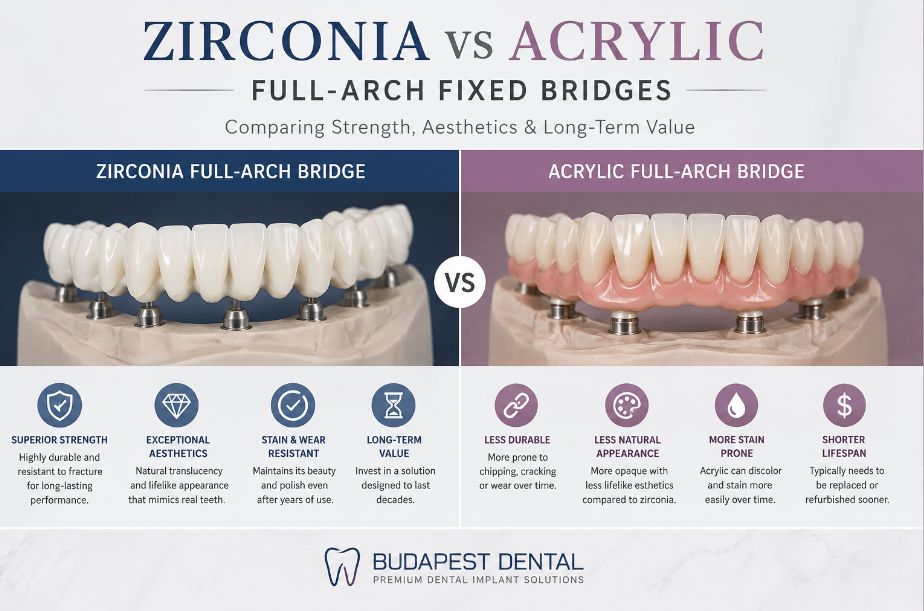
In a Nutshell
- Zirconia bridges: Premium long-term choice with excellent durability, stain resistance and colour stability.
- Acrylic/PMMA bridges: Lighter, usually more affordable and easier to repair or modify.
- Best use for PMMA: Often ideal as a provisional full-arch bridge while implants heal and the bite, smile and speech are tested.
- Best use for zirconia: Often the preferred final bridge once healing is complete and the bite is stable.
- Maintenance matters: Neither material is maintenance-free; daily cleaning, implant hygiene visits and regular bite checks are essential.
- Choosing the right material: Your bite force, teeth grinding, available space, gum support needs, aesthetic priorities and budget should guide the decision.
Zirconia vs Acrylic Full-Arch Fixed Bridges: Longevity, Aesthetics and Maintenance
Choosing the final bridge material is one of the most important decisions in full-arch dental implant treatment. After implants have been placed and integrated, the fixed bridge is the part you see, bite with, clean around and rely on every day. For UK patients considering full-mouth implant treatment in Budapest, the most common comparison is between a zirconia full-arch bridge and an acrylic-based fixed bridge, often described as PMMA, PMMA hybrid, acrylic-on-titanium or metal-acrylic.
Both options can restore function, confidence and appearance. Neither is automatically the “best” for every patient. Zirconia generally offers superior wear resistance, colour stability and a more premium long-term finish, while acrylic or PMMA bridges are lighter, easier to repair and often better suited to provisional stages or patients whose bite and aesthetics still need to be tested.
The right decision depends on more than price. It should consider implant positions, available space, bite force, grinding, smile line, gum support, cleaning access, material thickness, opposing teeth, budget and the clinical team’s ability to maintain the bridge over time.
What Is a Full-Arch Fixed Bridge?
A full-arch fixed bridge replaces all teeth in the upper or lower jaw. It is secured to several dental implants and can restore a complete smile without the need to remove the bridge at home.
Depending on the case, a full-arch bridge may replace:
- Teeth only, where the patient has minimal gum and bone loss.
- Teeth plus a pink gum section, where volume has been lost and lip support is needed.
- A complete upper or lower dental arch after removal of failing teeth.
- A previous loose denture with a fixed implant-supported alternative.
The bridge may be screw-retained, cement-retained or use a combination of components. For full-arch rehabilitation, screw retention is often preferred because it gives the dentist access for maintenance, repairs and periodic review without destroying the restoration.
A successful bridge is not defined only by the material. It requires correct implant placement, passive fit, stable bite, sufficient material thickness, a hygienic design and a patient who can clean around it consistently.
Zirconia and Acrylic: The Basic Difference
Zirconia full-arch bridges
Zirconia is a high-strength ceramic used in modern dentistry for crowns, bridges and full-arch implant restorations. In full-arch cases, it is commonly milled as a single framework or monolithic bridge and bonded to titanium bases or a titanium bar that connects to the implants.
Monolithic zirconia means the chewing surfaces are made largely from one solid ceramic material. It may have surface staining for natural shade variation and, in some designs, limited facial porcelain or pink ceramic for gum aesthetics.
Zirconia is known for:
- High strength and resistance to wear.
- Good colour stability.
- A smooth, polished surface that can be hygienic when well designed.
- Natural translucency and excellent shade potential in selected cases.
- Resistance to staining from tea, coffee, wine and smoking compared with acrylic.
- A more premium appearance for many patients.
Its limitations include greater cost, the need for adequate thickness and careful design, and more complex repairs if a bridge fractures or requires major alteration.
Acrylic or PMMA full-arch bridges
Acrylic full-arch bridges usually consist of acrylic teeth and pink acrylic gum material supported by a titanium, cobalt-chromium or other metal framework. PMMA stands for polymethyl methacrylate, a durable dental resin often used in provisional implant bridges and, in some cases, as part of a longer-term hybrid restoration.
The term “acrylic bridge” can describe different products. Some are temporary PMMA bridges used during healing. Others are definitive metal-acrylic hybrid bridges designed for longer-term use. Patients should ask exactly what is included in their treatment plan, because a provisional PMMA bridge and a final metal-acrylic bridge are not the same product.
Acrylic or PMMA bridges are valued for:
- Lower initial cost than zirconia in many cases.
- Easier chairside repair if a tooth chips or fractures.
- Lower weight, which some patients find comfortable.
- Flexible aesthetics during the provisional stage.
- Ability to replace individual acrylic teeth or add material when clinically appropriate.
- Useful shock absorption in some restorative designs.
Their limitations include surface wear, staining, plaque retention if the surface becomes rough, potential loosening or fracture of acrylic teeth, and a higher likelihood of maintenance over time.
Zirconia vs Acrylic: Practical Comparison
Longevity: Which Material Lasts Longer?
Patients often ask whether zirconia lasts longer than acrylic. The practical answer is that zirconia is generally more resistant to surface wear, staining and everyday cosmetic deterioration. However, bridge longevity is not dictated by material alone.
A high-quality zirconia bridge can still fail if it is too thin, poorly supported, inaccurately fitted, subjected to uncontrolled grinding or designed with excessive cantilevers. An acrylic bridge can perform well for years if it is properly reinforced, maintained and repaired promptly when needed.
A retrospective study comparing full-arch zirconia and metal-acrylic restorations found that zirconia had higher prosthetic survival at five years: 93.7% for zirconia compared with 83.0% for metal-acrylic. The zirconia group also had fewer delayed complications, although initial fabrication costs were higher.
A 2026 umbrella review of systematic reviews found long-term prosthetic survival ranging from 89.5% to 96.8% over five to 15 years for implant-supported complete-arch prostheses. Implant survival ranged from 95.2% to 99.2%. It also found that monolithic zirconia had fewer technical complications than veneered zirconia, while screw-retained frameworks were associated with lower technical complication rates.
These outcomes are encouraging, but they do not guarantee a particular lifespan for an individual patient. Full-arch bridges exist in a high-load environment. Bite forces, implant number, jaw anatomy, material thickness, cleaning, recall attendance and smoking all influence outcomes.
Why Monolithic Zirconia Matters
Not all zirconia bridges are constructed the same way.
Older or more aesthetic zirconia designs may use a zirconia framework covered with porcelain. This can look beautiful, but porcelain is more likely to chip than solid zirconia. In full-arch work, the chewing forces are considerable, particularly for patients who grind their teeth.
Monolithic zirconia means the main tooth structure is a single solid piece of zirconia rather than a zirconia framework with porcelain covering all visible teeth. Limited porcelain may still be used in non-load-bearing facial or gum areas where aesthetics need refinement.
A systematic review found that full-arch zirconia bridges had a low short-term failure rate, but that most minor complications involved chipping of veneering porcelain. It concluded that monolithic zirconia, or zirconia with porcelain restricted to non-functional areas, may reduce this specific risk.
For a patient who has a strong bite, clenches or grinds, the bridge design and material thickness can be just as important as choosing zirconia itself. A night guard may also be recommended after the final bridge is fitted.
Aesthetics: Which Looks More Natural?
Both zirconia and acrylic can look attractive when designed by a skilled clinical and laboratory team. The best result is not necessarily the brightest or whitest bridge. It is one that fits the patient’s face, skin tone, age, lip movement and desired level of tooth visibility.
Zirconia aesthetics
Zirconia can offer:
- Stable shade and surface gloss.
- Fine control over tooth shape and texture.
- Natural-looking variation in translucency and colour.
- Less long-term discolouration.
- A smooth, highly polished finish.
It is particularly attractive for patients who want a final bridge with a refined ceramic appearance. However, if a patient has lost substantial gum and bone volume, the bridge may need pink ceramic or a specific shape to restore facial and lip support. This requires careful smile design, not just a premium material.
Acrylic aesthetics
Acrylic bridges can also deliver pleasing results, especially as a provisional phase. They allow the clinician to test tooth shape, smile line, bite position, lip support and speech before committing to the final bridge.
This can be valuable in complex full-mouth cases. A patient may wear a provisional PMMA bridge for several months while implants integrate and the clinician assesses comfort, function and aesthetics. Changes can be made more easily before transferring the approved design into zirconia.
The longer-term limitation is that acrylic can lose polish, pick up stains and show wear. It may look less crisp and glossy after years of chewing, smoking, tea, coffee or coloured foods.
Maintenance: The Most Overlooked Issue
No full-arch bridge is maintenance-free. Whether it is zirconia or acrylic, it must be cleaned every day and reviewed professionally.
Plaque can build up at the bridge-gum junction and around the implant openings. If inflammation is ignored, peri-implant mucositis or peri-implantitis can develop, potentially leading to bone loss around implants.
A maintenance routine often includes:
- Brushing twice daily with a soft manual or electric toothbrush.
- Cleaning beneath the bridge with super floss, implant floss or purpose-designed floss.
- Using interdental brushes where the bridge design allows.
- Using an oral irrigator as an adjunct, not a replacement for mechanical cleaning.
- Attending hygienist or implant-maintenance appointments at the interval advised by the clinical team.
- Having the bridge, screws, bite and soft tissues assessed regularly.
- Wearing a protective night guard if prescribed.
Zirconia maintenance
Zirconia is resistant to staining and can maintain a smooth surface for a long time. This may reduce the tendency for deposits to adhere compared with a roughened or worn resin surface. Nevertheless, zirconia can still accumulate plaque if cleaning is inadequate.
Maintenance may include polishing, checking screw access, reviewing the bite, monitoring the gums and taking radiographs where clinically appropriate. Repairs are less common for surface wear, but if a major fracture or bonding problem occurs, the repair can be more complex.
Acrylic maintenance
Acrylic often needs more frequent attention. Over time, it may require:
- Polishing to refresh the surface.
- Repair of a chipped or fractured tooth.
- Replacement of an acrylic tooth.
- Repair of pink acrylic gum material.
- Adjustment if bite surfaces wear.
- Review of the metal framework and screw joints.
This does not make acrylic an inferior choice. It makes it a material that should be chosen with an honest expectation of planned maintenance.
Prosthetic Complications: What Can Actually Go Wrong?
Patients should receive a realistic explanation of maintenance and complications before treatment begins. The following issues can occur with either material:
- Screw loosening or screw fracture.
- Changes in bite or wear of opposing teeth.
- Implant-related inflammation or bone loss.
- Fracture or loss of an implant.
- Damage from clenching or grinding.
- Food trapping due to bridge shape.
- Difficulty cleaning under the bridge.
- Need to remove the bridge for professional maintenance.
Some complications are material-specific.
Common acrylic or PMMA complications
- Chipping or fracture of individual teeth.
- Wear and flattening of chewing surfaces.
- Cracking or fracture of pink acrylic.
- Staining and surface roughness.
- Debonding of acrylic teeth from the framework.
- Framework fracture in a major overload situation.
Common zirconia complications
- Chipping of porcelain if the bridge is veneered.
- Fracture of zirconia if it is too thin, poorly designed or overloaded.
- Debonding of titanium bases or cylinders.
- Screw loosening or fracture.
- Damage to opposing natural teeth or restorations if the bite is not adjusted properly.
A study of monolithic and minimally layered zirconia full-arch bridges observed at least one complication in 30% of prostheses during follow-up, although no prostheses were lost. The median event-free survival time was 5.8 years, and a regular recall schedule was associated with fewer complications.
This is a useful reminder that “zirconia” does not mean “fit it and forget it.” Regular review matters.
Is Acrylic Better for a Temporary Bridge?
In many full-arch implant cases, yes.
A PMMA provisional bridge is often the sensible choice during the healing and testing phase. It allows the team to evaluate:
- Smile shape and tooth length.
- Lip support.
- Speech.
- Bite height.
- Chewing comfort.
- Cleaning access.
- Soft-tissue healing.
- Whether the patient wants aesthetic changes before the final bridge is made.
A provisional bridge also protects implants during healing when designed appropriately. If a minor fracture or adjustment is required, PMMA is usually easier to alter than zirconia.
A clinician should explain whether the quoted acrylic bridge is:
- A provisional bridge intended for use during healing, or
- A definitive metal-acrylic hybrid bridge intended for longer-term function.
This distinction affects material expectations, warranty terms, future cost and the timeline for a final zirconia bridge.
When Zirconia Is Often the Better Choice
Zirconia may be the strongest long-term choice where:
- The implants are stable and fully integrated.
- The bite has been tested and adjusted.
- There is enough restorative space for proper zirconia thickness.
- The bridge can be designed with good hygiene access.
- The patient wants excellent stain resistance and long-term appearance.
- The patient accepts a higher initial cost.
- A provisional bridge has already established the ideal tooth shape and bite.
- The patient is willing to maintain scheduled hygiene and review appointments.
For many patients, the most sensible pathway is not acrylic or zirconia. It is acrylic then zirconia: a well-designed provisional PMMA bridge during healing, followed by a definitive monolithic zirconia bridge once the implant and bite conditions are stable.
When Acrylic or PMMA May Be the Better Choice
Acrylic or PMMA may be suitable where:
- A temporary bridge is needed during implant integration.
- The final bite, facial support or tooth design is still being refined.
- Budget is a major limitation.
- A lighter restoration is preferred.
- The patient wants easier repairability.
- There is significant gum replacement and the bridge design benefits from acrylic pink tissue.
- The patient understands that maintenance and eventual repair or replacement may be part of the long-term plan.
A definitive acrylic hybrid can still be an acceptable choice for selected patients. It should be treated as a legitimate prosthetic tier, not as a misleading imitation of zirconia. The key is a clear discussion of likely maintenance.
Bite, Bruxism and Implant Number
Material selection should never be separated from biomechanics.
Patients who clench or grind their teeth can generate high forces that place stress on implants, screws and the bridge framework. A bite assessment may identify wear, muscle tenderness, jaw-joint symptoms or fractured previous restorations. These findings influence material, bridge thickness, implant distribution and the need for a night guard.
Implant number alone does not guarantee success. A 2026 umbrella review found no significant difference in implant or prosthesis survival between full-arch designs supported by four versus six implants, but this does not mean the same design fits every patient.
The surgeon and restorative dentist need to consider bone quality, implant positions, cantilever length, opposing dentition, jaw shape, parafunction and the final material. A zirconia bridge on a poorly planned four-implant layout is not automatically better than a well-designed acrylic bridge on an appropriate framework.
Questions to Ask Your Clinic in Budapest
If you are travelling from the UK for full-arch treatment, ask for direct answers to the following:
- Is the quoted acrylic bridge provisional or definitive?
- Is the zirconia bridge monolithic, layered or veneered?
- Will there be a titanium bar, titanium bases or another reinforcement system?
- How much material thickness is available in my bite?
- How will you assess grinding or clenching?
- Is a night guard included or recommended?
- Is the bridge screw-retained for retrievability?
- How will I clean beneath it every day?
- Does the quote include provisionals, final bridge, screw-retained components and fitting appointments?
- What happens if a PMMA tooth chips during healing?
- What happens if the zirconia bridge needs adjustment or repair after I return to the UK?
- Will I receive my implant passport, bridge material information, radiographs and treatment records?
- How often should I see a hygienist and implant dentist once I am home?
Avoid choosing solely on phrases such as “premium zirconia” or “permanent teeth.” Ask about the design, thickness, support, material brand, laboratory process, maintenance and aftercare.
Frequently Asked Questions
Is zirconia better than acrylic for All-on-4 bridges?
Zirconia often offers better long-term wear resistance, colour stability and surface polish. Acrylic can be easier to repair and is commonly used as a temporary bridge while healing and bite testing take place. The better choice depends on your anatomy, implant plan, bite and budget.
Can acrylic full-arch bridges be permanent?
Yes, a metal-acrylic hybrid can be used as a definitive restoration in selected cases. It should not be confused with a short-term PMMA provisional. It may require more maintenance and repair over time than zirconia.
Does zirconia chip?
Monolithic zirconia is highly resistant to chipping. Chipping is more commonly associated with porcelain layered over zirconia. That is why many full-arch designs use monolithic zirconia in load-bearing areas.
Which bridge is easier to repair?
Acrylic is generally easier and less costly to repair, polish or modify. Zirconia repairs can be more technically complex, particularly if there is a fracture or major structural issue.
Does zirconia damage opposing teeth?
A highly polished and properly adjusted zirconia bridge is generally compatible with opposing teeth. However, any bridge with an incorrect bite, rough surface or excessive grinding forces can damage natural teeth or restorations. Regular bite checks are important.
How often does a full-arch bridge need maintenance?
The interval is individual. Many patients need professional implant maintenance at least every three to six months, particularly if they have a history of gum disease, smoking, diabetes, previous peri-implant inflammation or a complex full-arch bridge.
Clinical Bottom Line
Zirconia and acrylic full-arch bridges can both provide effective fixed teeth on implants. Zirconia is generally the premium definitive option for patients seeking excellent aesthetics, colour stability and resistance to wear, provided the bridge has adequate thickness, sound implant support and a carefully managed bite.
Acrylic or PMMA remains essential in implant dentistry. It is often the right provisional material during healing and can be a valid definitive option for patients who value lower initial cost, reduced weight and simpler repairability.
For many UK patients travelling to Budapest, the safest long-term plan is a staged one: a well-designed PMMA provisional bridge first, followed by a definitive monolithic zirconia bridge once healing, bite, aesthetics and hygiene access have been confirmed. The material should follow the clinical plan—not dictate it.
Sources
- Umbrella Review: Prosthetic Complications of Implant-Supported Complete-Arch Restorations
- Long-Term Clinical Outcomes and Cost-Effectiveness of Zirconia-Based Versus Metal-Acrylic Full-Arch Prostheses
- Systematic Review: Clinical Outcomes of Full-Arch Fixed Implant-Supported Zirconia Prostheses
- Review: Zirconia for Implant-Supported Fixed Complete Dental Prostheses
- Retrospective Cohort: Event-Free Survival and Complications of Full-Arch Zirconia Prostheses
- Systematic Review: Framework Materials for Full-Arch Implant-Supported Rehabilitations