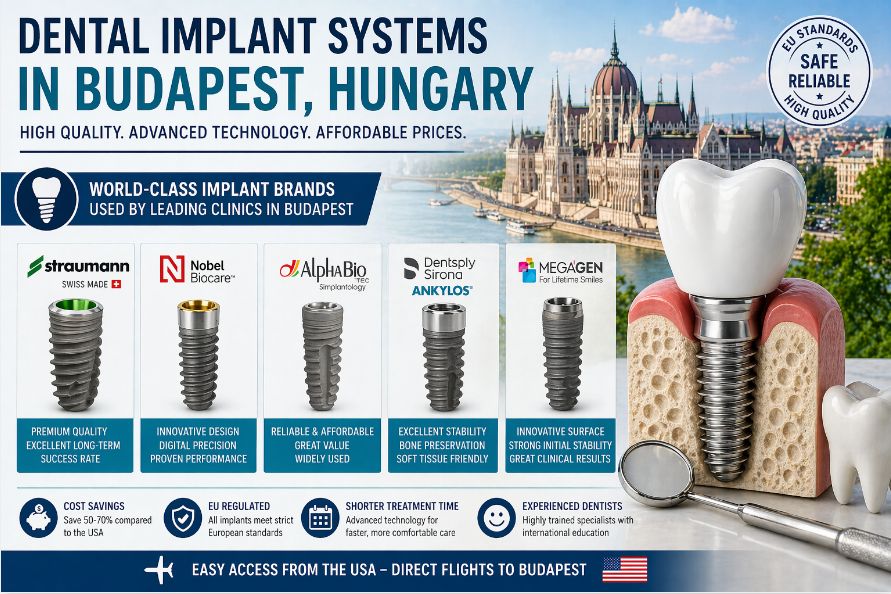
Budapest has earned its reputation as one of Europe’s leading dental tourism destinations, particularly for advanced implant dentistry. Patients from the United States increasingly travel to Hungary not only for cost savings, but also for access to high-quality implant systems that match or exceed the standards found at home. Understanding which implant brands and technologies are used in Budapest is essential for making an informed decision, especially for patients considering full-mouth restorations or complex cases.
This review provides a detailed and practical overview of the most commonly used dental implant systems in Budapest, how they compare, and what U.S. patients can realistically expect in terms of quality, durability, and long-term outcomes.
Why Implant System Choice Matters
Dental implants are not generic products. Each system differs in design, materials, surface technology, and long-term clinical research. These differences influence how well the implant integrates with bone, how stable it remains over time, and how easily it can be restored or repaired.
In the United States, reputable dentists typically use globally recognized implant systems backed by decades of clinical data. The same is true in Budapest. Leading Hungarian clinics do not rely on unknown or low-cost alternatives; instead, they primarily use premium European and international implant brands that are widely respected in the dental community.
For patients, this means that treatment received in Budapest is not a compromise in quality, but rather a strategic financial and logistical decision.
Straumann: The Gold Standard in Implant Dentistry
Straumann is widely regarded as one of the most advanced and reliable implant systems in the world. Headquartered in Switzerland, Straumann has built a reputation for innovation, precision engineering, and long-term clinical success.
In Budapest, many top-tier clinics offer Straumann implants as their premium option. These implants are known for their high success rates, even in challenging cases involving bone loss or compromised oral health.
One of Straumann’s key advantages is its proprietary SLActive surface technology, which accelerates osseointegration. This can reduce healing time and improve implant stability. For patients traveling internationally, shorter treatment timelines are particularly valuable.
Straumann implants are also highly versatile, supporting a wide range of restorative solutions, from single crowns to full-arch prosthetics. While they are typically more expensive than other systems used in Hungary, they remain significantly more affordable than in the United States.
Nobel Biocare: Innovation and Digital Precision
Nobel Biocare is another globally recognized leader in implant dentistry. Originally developed through research associated with osseointegration pioneer Per-Ingvar Brånemark, Nobel Biocare has been at the forefront of implant innovation for decades.
Budapest clinics frequently use Nobel Biocare systems for complex and full-mouth rehabilitation cases. One of their standout features is integration with digital planning tools and guided surgery techniques. This allows for highly precise implant placement, improving both functional and aesthetic outcomes.
Nobel Biocare implants are also known for their strong prosthetic compatibility. This means that restorations such as crowns, bridges, and implant-supported dentures can be designed with exceptional accuracy.
For U.S. patients, the familiarity of the Nobel Biocare brand provides reassurance. Many American dentists are trained on these systems, which can simplify follow-up care if needed after returning home.
Alpha-Bio Tec: Cost-Effective Reliability
Alpha-Bio Tec is an Israeli implant manufacturer that has gained significant popularity in Budapest due to its balance of affordability and reliability.
Alpha-Bio implants are widely used in mid-range clinics and are often recommended for patients seeking a more budget-conscious solution without sacrificing essential quality. These implants are supported by solid clinical research and are designed for straightforward cases.
While they may not offer the same level of advanced surface technology as premium brands like Straumann, Alpha-Bio implants still achieve high success rates when placed by experienced professionals.
For patients undergoing multiple implants or full-mouth restorations, choosing a system like Alpha-Bio can result in substantial cost savings while maintaining dependable outcomes.
Ankylos and Dentsply Sirona: Engineering Precision
Dentsply Sirona produces the Ankylos implant system, which is also commonly used in Budapest clinics. Ankylos implants are known for their unique connection design, which minimizes micro-movement and helps preserve bone around the implant.
This system is particularly valued for its long-term stability and aesthetic results. The connection between the implant and abutment is engineered to reduce gaps where bacteria could accumulate, which contributes to healthier surrounding tissue.
Clinics that specialize in high-end restorative dentistry often offer Ankylos implants as an alternative to Straumann or Nobel Biocare. For patients concerned about longevity and soft tissue aesthetics, this system is a strong contender.
Megagen and Other Emerging Systems
MegaGen Implant is a rapidly growing brand that has gained traction in Budapest. Known for its innovative designs and competitive pricing, MegaGen implants are often used in clinics that adopt newer technologies.
These systems can be particularly useful in cases requiring immediate loading, where a temporary tooth is placed on the implant shortly after surgery. While newer than some European counterparts, MegaGen has developed a solid reputation for performance and adaptability.
Budapest clinics may also use other reputable systems depending on their specialization and partnerships. The key factor is not just the brand itself, but the experience and expertise of the dentist placing the implant.
How Budapest Clinics Choose Implant Systems
Clinics in Budapest typically offer multiple implant options to accommodate different budgets and clinical needs. Rather than promoting a single brand, they provide tiered solutions:
- Premium implants (e.g., Straumann, Nobel Biocare)
- Mid-range implants (e.g., Ankylos, MegaGen)
- Budget-friendly implants (e.g., Alpha-Bio Tec)
This transparent approach allows patients to make informed decisions based on both financial considerations and clinical recommendations.
Importantly, reputable clinics will never compromise on safety or quality. Even lower-cost systems used in Budapest are generally well-established and backed by clinical data.
Comparing Implant Systems: What U.S. Patients Should Know
From a practical standpoint, the differences between implant systems are often less significant than the skill of the dentist. A well-placed implant from a mid-range brand can outperform a poorly placed premium implant.
That said, premium systems tend to offer advantages in specific areas:
- Faster healing times
- Better integration in complex cases
- More advanced prosthetic options
- Extensive long-term research
For patients traveling from the U.S., choosing a globally recognized system can provide additional peace of mind. It also ensures compatibility with dental professionals at home if follow-up care is needed.
Cost Differences: U.S. vs Budapest
In the United States, a single dental implant using a premium system can cost between $3,000 and $5,000 or more. In Budapest, the same implant using the same brand may cost between $900 and $1,800.
Even when factoring in travel, accommodation, and additional procedures, the total cost is often significantly lower. This price difference is one of the primary reasons patients consider dental tourism.
However, lower cost does not mean lower quality. The reduced pricing in Hungary is largely due to lower operating costs, not inferior materials or technology.
Digital Dentistry and Implant Planning
One of the defining features of modern implant dentistry in Budapest is the widespread use of digital technology. Clinics commonly use 3D CT scans, intraoral scanners, and computer-guided surgery.
These tools allow for precise planning and placement of implants, reducing risks and improving outcomes. Digital workflows also enable faster turnaround times for prosthetics, which is especially important for international patients on a limited schedule.
Systems like those offered by Nobel Biocare and Dentsply Sirona integrate seamlessly with these technologies, enhancing overall treatment quality.
Longevity and Maintenance
Dental implants are designed to last many years, often decades, with proper care. The longevity of an implant depends on several factors:
- Oral hygiene
- Bone quality
- Implant placement technique
- Choice of implant system
- Regular dental check-ups
Budapest clinics typically provide detailed aftercare instructions and may coordinate with local dentists in the U.S. for ongoing maintenance.
Patients should understand that while the implant itself is highly durable, the crown or prosthetic attached to it may need replacement over time.
Safety and Regulation
Hungary operates under strict European Union medical regulations, which apply to dental materials and devices. Implant systems used in Budapest must meet rigorous safety and quality standards.
Clinics are regularly inspected, and many dentists receive training from international institutions. This regulatory framework ensures that patients receive care comparable to leading Western countries.
For U.S. patients, this provides reassurance that treatment in Budapest is not only affordable but also safe and professionally managed.
The Patient Experience
Patients traveling to Budapest for implant treatment often report a highly organized and supportive experience. Clinics typically offer comprehensive consultations, including detailed treatment plans and cost breakdowns.
Many also provide assistance with travel arrangements, accommodation, and airport transfers. English-speaking staff are standard, making communication straightforward.
The combination of professional care and hospitality contributes to a positive overall experience, which is a key factor in the growing popularity of Budapest as a dental tourism destination.
Final Thoughts
The implant systems used in Budapest reflect a commitment to quality, innovation, and patient-centered care. From globally recognized brands like Straumann and Nobel Biocare to reliable and cost-effective options like Alpha-Bio Tec, patients have access to a wide range of solutions tailored to their needs.
For U.S. patients, the decision to seek treatment abroad is often driven by financial considerations. However, the quality of implant systems and clinical expertise available in Budapest ensures that this choice does not require compromising on outcomes.
With the right research and a reputable clinic, dental implant treatment in Budapest can offer a combination of affordability, advanced technology, and long-term reliability that is difficult to match within the constraints of the U.S. system.