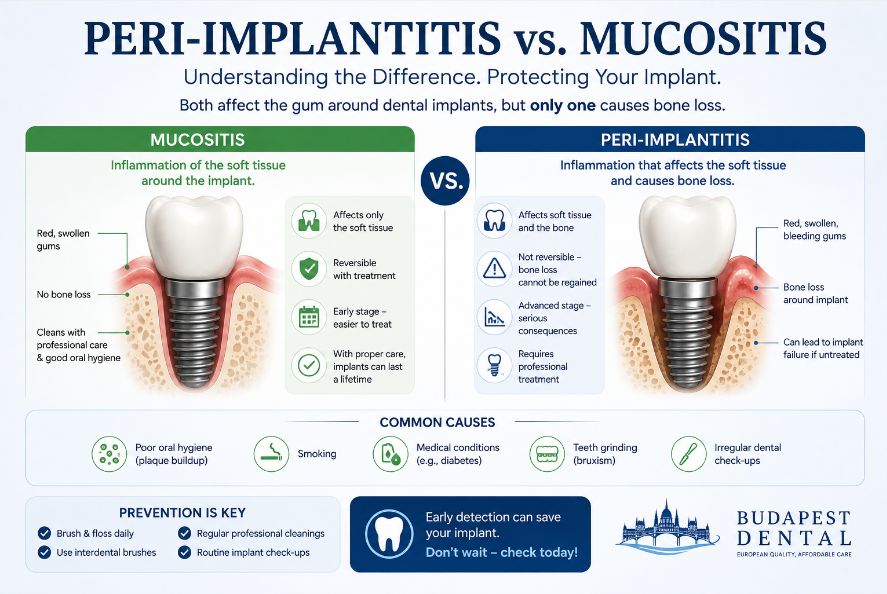
Dental implants are designed to be a long-term replacement for missing teeth, but they are not maintenance-free. Like natural teeth, implants can develop inflammation in the surrounding gums and supporting bone. The two main implant-related inflammatory conditions are peri-implant mucositis and peri-implantitis.
The difference is crucial. Peri-implant mucositis affects the soft gum tissue around an implant and is generally reversible when treated early. Peri-implantitis involves inflammation plus progressive loss of the supporting jawbone. Without treatment, it can threaten implant stability and may eventually lead to implant loss.
The good news is that many cases can be prevented or detected early through effective home cleaning, regular implant reviews, risk-factor management and prompt treatment of bleeding or inflammation.
Important: This article is for general UK patient education. If an implant bleeds, feels loose, develops swelling, pus, pain or a bad taste, arrange a dental examination. Do not try to clean beneath the gum with sharp instruments at home.
What Are Peri-Implant Diseases?
Peri-implant diseases are inflammatory conditions affecting the tissue surrounding a dental implant. They are usually associated with the build-up of bacterial plaque, also called biofilm, around the implant and restoration.
The term includes two distinct conditions:
-
Peri-implant mucositis: Inflammation limited to the soft tissue around the implant, without progressive loss of supporting bone.
-
Peri-implantitis: Inflammation around the implant combined with progressive loss of the supporting bone.pubmed.
An implant is not biologically identical to a natural tooth. Natural teeth are attached to bone through a periodontal ligament, while implants are directly integrated with bone. The soft-tissue seal around an implant is therefore different and can be more vulnerable when plaque accumulates or when the implant crown is difficult to clean.
Peri-implant inflammation is not always painful. This is why professional maintenance appointments remain important even when an implant feels comfortable and looks normal.
Peri-Implant Mucositis: The Early, Reversible Stage
Peri-implant mucositis is similar in some ways to gingivitis around natural teeth. It is an inflammatory reaction in the gum tissue around an implant, usually driven by bacterial plaque accumulation.
The main difference between mucositis and peri-implantitis is that mucositis does not involve progressive loss of supporting implant bone.
Typical clinical signs include:
-
Bleeding when the gum is gently probed by a dentist or hygienist
-
Bleeding while brushing or using interdental brushes
-
Redness around the implant crown
-
Swollen, puffy or tender gum tissue
-
Increased pocket depth compared with previous measurements
-
Mild discomfort during cleaning
-
Occasional unpleasant taste or breath changes
Mucositis can be easy to miss because some patients have no pain at all. Bleeding is often the earliest visible warning sign. If the gum around an implant bleeds, it should not be dismissed as normal.
The European Federation of Periodontology and UK guidance describe peri-implant mucositis as an inflammatory lesion around an implant without bone loss. It is often reversible when plaque is controlled and professional care is provided.
Peri-Implantitis: Inflammation With Bone Loss
Peri-implantitis is more serious. It is a plaque-associated disease affecting both the gum and the bone supporting an implant. The infection and inflammatory response can lead to progressive bone loss around the implant.
As bone support reduces, the implant may become increasingly difficult to maintain. In advanced cases, the implant can lose stability and may need to be removed.
Clinical signs of peri-implantitis can include:
- Bleeding on gentle probing
- Pus, also called suppuration
- Redness and swelling around the implant
- Deepening of the gum pocket around the implant
- Gum recession exposing metal components
- Bad breath or an unpleasant taste
- Discomfort, pain or pressure—although pain may be absent
- Bone loss visible on X-rays
- Implant mobility in advanced disease
Government oral-health guidance defines peri-implantitis as a plaque-associated disease characterised by inflammation of the implant mucosa and progressive loss of supporting bone. Diagnosis involves bleeding and/or suppuration on gentle probing, increased pocket depths compared with previous records and bone loss beyond expected early remodelling.
An implant should not normally feel loose. If it does, contact your implant dentist promptly. Mobility may indicate severe bone loss, a mechanical issue with the crown or abutment, or another complication that needs professional assessment.
Mucositis vs Peri-Implantitis: Key Differences
The distinction cannot be made by looking in a mirror alone. Your dentist needs to compare gum measurements, bleeding response and X-rays with earlier records. This is why baseline X-rays and periodontal measurements after implant restoration are valuable.
Why Do Dental Implants Become Inflamed?
The main cause of peri-implant disease is bacterial plaque biofilm. Plaque is a sticky film of bacteria that forms every day on teeth, implant crowns, bridges and gum margins.
If plaque is not removed effectively, it can trigger inflammation around the implant. The exact risk varies from person to person and depends on both home care and clinical factors.
Inadequate Daily Cleaning
Implant crowns and bridges need cleaning at the gumline and between teeth or implants. If plaque is repeatedly left around the implant, the gum can become inflamed.
This is especially challenging when:
- The crown shape is bulky or difficult to access
- An implant bridge has limited space underneath
- Interdental gaps are too tight or too wide for the wrong-sized brush
- The patient cannot comfortably reach the area
- Mobility, arthritis, eyesight or dexterity issues make brushing harder
- The implant is at the back of the mouth
- A removable implant denture is not cleaned thoroughly
A well-designed implant restoration should be both attractive and cleanable. If you cannot access the gumline or beneath a bridge, tell your dentist or hygienist. The solution may be a different interdental brush size, super floss, a water flosser as an additional aid, a redesigned restoration or a tailored maintenance plan.
Previous Gum Disease
A history of periodontitis is an important risk factor. The bacteria and inflammatory tendency associated with gum disease can also affect tissues around implants.
Any active gum disease should be stabilised before implants are placed. Periodontal treatment, consistent home care and ongoing supportive maintenance are particularly important for implant patients with a past history of bone loss around natural teeth.
UK government guidance identifies previous periodontitis, poor oral hygiene and lack of supportive care among risk factors for peri-implant disease.
Smoking and Vaping
Smoking affects gum blood flow, healing and immune response. It is associated with poorer outcomes for gum treatment and implant care. Nicotine-containing vaping may also impair healing and should not be considered risk-free around implant treatment.
Smoking can make inflammation less visually obvious because it may reduce gum bleeding, meaning disease can be harder to spot early. The absence of bleeding in a smoker is therefore not a guarantee of implant health.
Stopping smoking is one of the most valuable steps a patient can take to protect both natural teeth and implants.
Diabetes and General Health
Poorly controlled diabetes can impair healing and increase susceptibility to inflammatory disease. Other conditions or medicines that affect immunity, wound healing or bone metabolism may also influence implant risk.
This does not automatically prevent implant treatment. It means your dental team should understand your health, work with your GP or specialist where appropriate and ensure conditions are stable before and during implant care.
Implant Position and Restoration Design
Some risk factors are local rather than patient-related. Examples include:
- Implant placed in a position that makes cleaning difficult
- Deep implant placement
- A bulky crown or bridge contour trapping plaque
- Excess dental cement around an implant crown
- Poorly fitting restoration components
- Overload from biting forces, especially with tooth grinding
- Inadequate attached or keratinised gum tissue in selected cases
Excess cement is a recognised local risk indicator. It is one reason many implant dentists prefer screw-retained crowns where appropriate, because they can be retrieved more easily for maintenance without relying on cement.
Missed Maintenance Appointments
Implants require long-term review. Regular maintenance helps identify bleeding, pocket changes, plaque retention, early bone changes and mechanical problems before they become more serious.
Guidelines recommend a structured supportive peri-implant care programme after implant placement and loading, including periodic assessment of tissue health.
The recall interval is individual. A person with excellent hygiene, no gum-disease history and a single easy-to-clean implant may need a different schedule from someone with multiple implants, a history of periodontitis, smoking, diabetes or difficulty accessing a full-arch bridge.
Signs You Should Not Ignore
Peri-implant disease can be painless, so do not wait for severe pain before booking an appointment.
Contact your dentist or hygienist if you notice:
- Bleeding from the gum around an implant
- Red, swollen or tender gum tissue
- Pus or a pimple-like swelling near the implant
- A persistent bad taste or unpleasant smell
- Gum recession exposing more of the implant crown or abutment
- Food repeatedly catching around an implant
- A change in how the implant crown feels when biting
- A loose crown, bridge or screw
- Any feeling that the implant itself is moving
It is important to distinguish between a loose crown or abutment screw and a loose implant. Both need dental review, but they are different issues. A dentist can examine the implant and take X-rays to determine the cause.
How Is Peri-Implant Disease Diagnosed?
Your dentist, periodontist or hygienist will examine the implant and surrounding gum. Diagnosis may include:
- A review of symptoms and medical history
- Assessment of brushing and interdental-cleaning technique
- Checking plaque and calculus around the restoration
- Gentle probing around the implant to check for bleeding, pus and pocket depth
- Comparison with previous probing measurements
- Periapical X-rays or other imaging to assess bone levels
- Checking the crown, bridge, abutment and bite
- Reviewing whether the restoration can be cleaned effectively
Healthy implant tissues should show no redness, bleeding or pus on gentle probing, no increasing pocket depth compared with earlier records and no bone loss beyond early post-placement remodelling.
A professional assessment is essential because peri-implantitis can resemble other issues, such as a loose component, food packing, a cracked crown or inflammation arising from a neighbouring natural tooth.
How Is Peri-Implant Mucositis Treated?
The aim is to remove the bacterial biofilm and restore healthy, non-bleeding gum tissue.
Treatment commonly includes:
- Personalised oral-hygiene instruction
- Reviewing toothbrush technique
- Selecting the right size interdental brushes
- Professional removal of plaque and deposits around the implant
- Cleaning or modifying plaque-retentive crown or bridge contours
- Checking for excess cement or poorly fitting components
- Managing smoking, diabetes and other modifiable risks
- Treating gum disease elsewhere in the mouth
- Reassessment after a suitable healing interval
Professional mechanical plaque removal plus effective home cleaning are the central treatments. The evidence does not support relying on antiseptic gels, lasers, probiotics or antibiotics as substitutes for thorough plaque control and professional care.
Early mucositis treatment is important because controlling it helps reduce the risk of progression to peri-implantitis.
How Is Peri-Implantitis Treated?
Peri-implantitis needs a tailored approach because the disease severity, bone-loss pattern, implant position, restoration design and patient risk profile can vary widely.
Initial treatment usually includes:
- Oral-hygiene coaching and motivation
- Identifying and managing plaque-retentive factors
- Controlling smoking and improving diabetic control where relevant
- Cleaning above and below the gumline around the implant
- Treating periodontal disease around remaining natural teeth
- Checking whether the implant crown or bridge needs removal, modification or replacement for access
For advanced disease, non-surgical cleaning alone may not fully resolve the condition. Surgical treatment may be needed to gain access to the contaminated implant surface and reshape or regenerate surrounding bone where appropriate.
Potential surgical approaches include:
- Access-flap surgery to allow thorough cleaning
- Resective treatment to reshape bone in selected cases
- Regenerative treatment using graft materials and membranes where defects are suitable
- Soft-tissue grafting in selected cases
- Removal of the implant when disease is too advanced or the implant cannot be maintained
The current EFP guideline recommends non-surgical management as the initial approach, followed by individualised surgical treatment when necessary. It does not recommend routine adjunctive systemic antibiotics, local antimicrobials, laser therapy, photodynamic therapy or air-polishing as replacements for professional mechanical plaque removal.
Can Peri-Implantitis Be Cured?
Peri-implant mucositis can usually be resolved if detected early and plaque control improves.
Peri-implantitis is more complicated because it includes bone loss. Treatment can control inflammation, stabilise bone levels and improve long-term prognosis, but lost bone does not always grow back completely. The goal is to stop or slow disease progression, make the implant cleanable and preserve it where possible.
This is why the best strategy is prevention and early action. Do not wait until there is pain, pus or mobility.
Daily Implant Cleaning: A Practical Routine
Your dentist or hygienist should personalise your routine, but the following general principles apply.
Brush Twice Daily
Use a soft manual toothbrush or electric toothbrush twice a day with fluoride toothpaste. Angle the bristles gently towards the gumline around the implant crown.
Electric toothbrushes can be helpful for plaque removal, especially for patients with reduced manual dexterity. Use light pressure; scrubbing aggressively can irritate gums or wear restorative materials.
Clean Between Teeth and Implants Every Day
Interdental brushes are often the most effective option around implants, but size matters. A brush should fill the space gently without forcing it. Your hygienist can measure and recommend the correct size or sizes.
Depending on your restoration, alternatives may include:
- Implant-safe floss
- Super floss with a stiffened end for bridges
- Floss threaders
- Soft interdental picks
- Water flossers as an addition to – not necessarily a replacement for – mechanical brushing and interdental cleaning
For a fixed implant bridge, you may need to clean beneath the bridge every day. Ask your clinician to demonstrate this using a mirror, model or intraoral photograph.
Clean Removable Implant Dentures
If you have an implant-retained removable denture, remove it every night unless your clinician gives different advice. Clean the denture thoroughly and clean around the implant attachments, bars or locator components.
Never use abrasive household cleaners, bleach or boiling water unless the manufacturer and dentist have specifically advised it.
Check for Change
Once a week, look around your implants in good light. Check for redness, swelling, bleeding, food trapping, recession or new odour. This is not a substitute for professional checks, but it can help you recognise changes early.
Preventing Implant Loss: The Long-Term Plan
The prevention of peri-implant disease starts before the implant is ever placed. It continues through surgery, crown design and lifelong maintenance.
A strong prevention plan includes:
- Treating active gum disease before implant treatment
- Stopping smoking and reducing nicotine exposure
- Optimising diabetic control and general health
- Choosing an implant position and crown design that can be cleaned
- Removing excess cement and correcting poorly fitting components
- Receiving clear oral-hygiene instruction before the final crown is fitted
- Using a daily brushing and interdental-cleaning routine
- Attending individualised implant maintenance visits
- Seeking review quickly if bleeding, swelling, discharge or looseness develops
The British Society of Periodontology advises that preventing peri-implant disease requires infection control, patient instruction in personal oral hygiene and regular monitoring and reinforcement.
Questions to Ask at Your Implant Review
At routine visits, consider asking:
- Are my implant gums bleeding when checked?
- Are my probing depths stable compared with previous visits?
- Do my X-rays show stable bone around the implant?
- Is my crown or bridge design easy enough to clean?
- Which interdental brush size should I use?
- Do I need different cleaning tools for the back of my bridge?
- How often should I attend for supportive implant care?
- Are smoking, diabetes, clenching or gum disease affecting my risk?
- Is my implant crown screw-retained or cement-retained, and can it be removed if needed?
Final Advice
Dental implants can be a highly successful long-term treatment, but they need the same commitment to daily cleaning and professional maintenance as natural teeth – often more.
Bleeding around an implant is an early warning sign, not something to ignore. Peri-implant mucositis can often be reversed before bone loss occurs. Peri-implantitis involves supporting-bone loss and may require more complex treatment to protect the implant.
Brush twice a day, clean between implants and teeth daily, attend your personalised maintenance appointments and contact your dentist early if you notice bleeding, swelling, pus, a bad taste, gum recession or a loose implant restoration.
Peri-Implantitis and Mucositis FAQs
What is peri-implant mucositis?
Peri-implant mucositis is inflammation of the gum tissue around a dental implant. It commonly causes bleeding, redness and swelling, but it does not involve progressive loss of the bone supporting the implant. With early professional care and improved plaque control, it is usually reversible.
What is peri-implantitis?
Peri-implantitis is a more serious inflammatory disease around a dental implant. It involves inflamed gum tissue plus progressive loss of the supporting jawbone. If untreated, it can reduce implant stability and may eventually lead to implant loss.
What is the difference between mucositis and peri-implantitis?
Mucositis affects the soft gum tissue only and can usually be reversed. Peri-implantitis affects both the gums and the supporting bone, so it requires more intensive management and may involve surgical treatment in advanced cases.
Does bleeding around an implant mean peri-implantitis?
Not necessarily, but it should never be ignored. Bleeding may be an early sign of peri-implant mucositis, which can occur before bone loss develops. A dentist or hygienist needs to examine the implant, measure the gum pocket and compare X-rays with earlier records to rule out peri-implantitis.
Can peri-implantitis cause pain?
Yes, but many people have little or no pain in the early stages. Common warning signs can include bleeding, swelling, pus, bad taste, bad breath, gum recession, deeper pockets and bone loss seen on X-rays. Do not wait for pain before booking an implant review.
Can peri-implantitis be cured?
Peri-implant mucositis can often be resolved fully when treated early. Peri-implantitis can often be controlled and stabilised, but bone already lost may not completely grow back. Early treatment provides the best chance of protecting the implant.
Can peri-implantitis cause an implant to fall out?
Advanced untreated peri-implantitis can cause enough bone loss for an implant to become unstable and eventually fail. An implant that feels loose requires prompt professional assessment.
Why do implants become infected?
Peri-implant inflammation is mainly associated with bacterial plaque build-up around the implant. Risk can increase with poor oral hygiene, a history of gum disease, smoking, poorly controlled diabetes, difficult-to-clean crown or bridge designs and missed maintenance appointments.
Can smoking or vaping cause peri-implantitis?
Smoking is a recognised risk factor for peri-implant disease and can impair healing. Nicotine-containing vaping may also affect gum health and healing. Stopping smoking and reducing nicotine exposure can improve the long-term outlook for implants.
How do dentists diagnose peri-implantitis?
A dentist or hygienist checks for bleeding or pus when gently probing the gum, records pocket depths, assesses plaque and restoration design, and takes X-rays to identify bone loss around the implant. Diagnosis relies on comparing current findings with baseline records where available.
How is peri-implant mucositis treated?
Treatment usually involves professional plaque removal, improved home-cleaning techniques, correct interdental brush selection, correction of factors that trap plaque and review of smoking, diabetes and gum disease risk.
How is peri-implantitis treated?
Treatment starts with controlling plaque and risk factors, professional cleaning and ensuring that the implant crown or bridge can be cleaned properly. Where bone loss is more advanced, surgical treatment may be needed to access and clean the implant surface, reshape bone or use regenerative grafting techniques.
Do antibiotics cure peri-implantitis?
Not on their own. Antibiotics may be used in selected clinical situations, but they do not replace professional cleaning, control of bacterial biofilm, restoration modification or surgical treatment where needed. Routine use of antibiotics is not recommended as a substitute for mechanical plaque removal.
How often should implants be checked?
The right recall interval is individual. Patients with a history of gum disease, smoking, diabetes, multiple implants or difficult-to-clean restorations may require more frequent supportive care than lower-risk patients. Your implant dentist or hygienist should set a personalised review schedule.
What is the best way to clean around implants?
Brush twice daily with a soft toothbrush or electric toothbrush, clean between teeth and implants every day using the correct interdental brushes or flossing aids, and clean beneath fixed bridges where instructed. Your hygienist should demonstrate the most effective tools for your implant design.
Can a water flosser replace interdental brushes?
A water flosser may be a useful addition to your routine, particularly around implant bridges, but it does not automatically replace mechanical plaque removal with appropriately sized interdental brushes or floss. Ask your dental team which combination is best for your mouth.
When should I contact my implant dentist urgently?
Contact your implant dentist promptly if you have bleeding that does not settle, pus, swelling, pain, persistent bad taste, gum recession, a loose crown or bridge, or any feeling that the implant itself is moving.
Sources
- European Federation of Periodontology: Prevention and treatment of peri-implant diseases guideline
- British Dental Journal: Key guideline on peri-implant diseases
- UK Government: Delivering Better Oral Health—periodontal and peri-implant disease guidance
- Scottish Dental Clinical Effectiveness Programme: Treatment of peri-implantitis
- Scottish Dental Clinical Effectiveness Programme: Managing peri-implant disease risk