Summary
- Compare the complete treatment cost, not the advertised starting price. A cheap implant offer may exclude the abutment, final crown, scans or temporary teeth.
- Request an itemised treatment plan identifying each tooth or implant site, the reason for treatment, materials, quantities and prices. For full-arch work, confirm the implants, bridge design and number of replacement teeth.
- Check five common exclusions: preparatory treatment, bone grafting, implant components, temporary teeth, and diagnostics, anaesthesia or follow-up appointments.
- Treat remote quotes as preliminary unless the clinic clearly explains otherwise. An examination and appropriate imaging may change the plan; a CBCT scan is not necessary for every type of dental treatment.
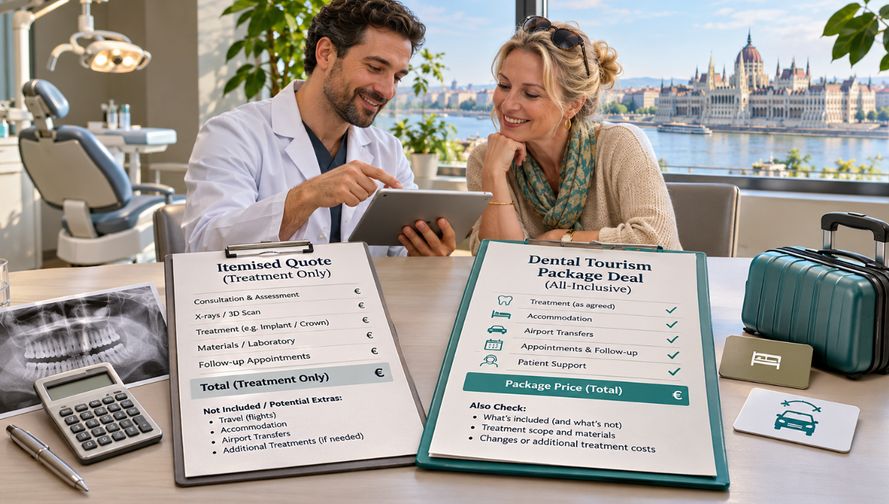
- Package deals are not automatically bad, and itemised quotes are not automatically safe. Clinical justification, clear exclusions and written approval for changes matter more than the format.
- Budapest’s EU setting provides a regulatory framework, not a guarantee of results, refunds or free repairs. Assess the individual clinic, treating dentist and contractual terms.
- Before booking, confirm the total price through to final teeth, the number of visits, aftercare arrangements and who pays if you need corrective treatment or another trip.
How to Compare Dental Quotes Abroad: Itemised Costs, Packages and Hidden Fees
A dental tourism quote should explain which teeth need treatment, why that treatment is recommended, what materials will be used and how much the complete process will cost. A package price can offer good value, but only when its clinical contents, exclusions and conditions are equally clear.
If you are comparing dental treatment in Budapest with options in Turkey, elsewhere in Europe or at home, the lowest headline price is only the starting point. The important comparison is the cost of reaching the same agreed result.
Saving money on implants, veneers or full-mouth restoration is an understandable priority. So is worrying that you could arrive overseas, sit in the dental chair and discover that your treatment now costs twice as much.
The best protection is not a particular destination or an impressive hotel package. It is a clinically justified, written treatment plan that you can understand before committing to irreversible work.
This guide explains how to separate a useful dental quotation from a persuasive advertisement—and what to request before booking your flight.
The Trap of “All-Inclusive” Dental Packages
An advertisement promising “Full Mouth for €4,000” leaves several important questions unanswered.
Does “full mouth” mean both jaws? Does the price cover crowns on existing teeth, removable dentures or fixed teeth supported by implants? Are the teeth supplied on your first visit temporary or final?
Without those details, you cannot compare the offer fairly with another clinic.
Every mouth needs a different plan
Two patients requesting a complete smile restoration may need very different treatment.
One may have healthy teeth suitable for limited cosmetic work. Another may need gum treatment, replacement of failing restorations or a staged implant procedure.
A flat-rate offer becomes risky when the advertised treatment is selected before the dentist establishes what the patient needs. The danger is not simply paying more: it is accepting unnecessary treatment because it fits the package.
A responsible clinician should explain which teeth can be preserved and why any extraction, crown or veneer is recommended.
“All-inclusive” may describe the trip, not the dentistry
Airport transfers, accommodation and an English-speaking coordinator can make treatment abroad easier. They do not establish what is included clinically.
A package might include a hotel while excluding the definitive bridge fitted after implant healing. Another might include implant placement but charge separately for the connectors and crowns.
Treat travel benefits and dental treatment as two separate lists. Both deserve clear terms.
Unspecified materials make comparisons unreliable
Descriptions such as “premium implants”, “German technology” or “high-quality porcelain” are not sufficiently precise.
An unnamed implant system is not automatically unsafe. However, without the manufacturer and system details, you cannot properly investigate the product, future component availability or maintenance arrangements.
The same applies to restorations. “White crowns” does not tell you whether the proposal uses metal-ceramic crowns, monolithic zirconia or another material.
The concern is not that every affordable package cuts corners. It is that vague wording makes shortcuts and substitutions harder to detect.
What a Transparent Tooth-by-Tooth Quote Looks Like: The Budapest Standard to Look For
In Hungary, a treatment plan is commonly called a kezelési terv. For an international patient, it should be supplied in clear English or another language the patient understands.
Budapest has clinics experienced in organising complex treatment for overseas visitors. Nevertheless, itemisation is a standard to demand from an individual clinic—not a guarantee attached to every Hungarian address.
Hungarian providers operate within national healthcare regulation and the wider EU framework. That framework supports information about treatment options, prices, provider authorisation and professional liability arrangements, but it does not make every treatment recommendation equally appropriate.
Start with the diagnosis
A useful quote connects a clinical finding with a proposed treatment.
“Six crowns” describes a saleable quantity. “Six crowns to restore these identified teeth, for these stated reasons” provides something you can discuss with another dentist.
Look for:
-
The teeth or implant sites involved.
-
The diagnosis or reason for treatment.
-
The proposed procedure at each site.
-
Reasonable alternatives.
-
The material or implant system.
-
The unit price, quantity and subtotal.
-
Any uncertain or conditional costs.
A long invoice is not enough. An unnecessary procedure does not become appropriate because it has its own line.
Understand the tooth numbering
European clinics commonly use two-digit FDI tooth numbers. US patients may be more familiar with a different numbering system.
Ask for a labelled chart and plain-English descriptions alongside the codes. You should not need to guess whether a price refers to an upper molar or a lower front tooth.
For example, a plan might identify a missing upper-right first molar, show its position on a diagram and list the implant, abutment and crown associated with that site.
Distinguish an estimate from a confirmed treatment plan
Photographs and existing dental records can help a clinic prepare a preliminary estimate. They cannot replace an appropriate clinical assessment.
Before definitive treatment, the dentist needs your medical history, an examination and relevant diagnostic information. The plan may change if the examination reveals disease or structural problems that were not apparent remotely.
A transparent estimate identifies those limitations in advance. It should explain what remains uncertain and which findings could affect the price.
Does every quote require a 3D CBCT scan?
No. A 3D CBCT scan is not automatically necessary for every veneer, crown or routine dental quotation.
CBCT produces three-dimensional images that can help assess bone and surrounding anatomy in implant planning. The dentist should justify the scan for your individual case, consider existing images and use the appropriate examination rather than ordering scans purely as a marketing feature.
For complex implant treatment, ask what imaging is needed before the plan can be confirmed. For cosmetic treatment, ask how tooth health, gums, bite and existing restorations will be assessed.
The principle is appropriate diagnostics—not the largest possible collection of scans.
Full-arch plans need more than a tooth list
An implant-supported full arch is not simply a series of separate crowns. Several implants may support one connected bridge.
The quote should therefore identify the implant positions and describe the restoration as a complete structure, including:
-
Whether treatment covers one arch or both.
-
The planned number of implants.
-
The number of replacement teeth in each bridge.
-
Whether the bridge is fixed or removable.
-
The temporary and final materials.
-
The conditions for providing fixed temporary teeth.
“Tooth-by-tooth” should mean traceable, understandable planning—not forcing every treatment into an unsuitable billing format.
Five Hidden Costs Left Off Cheap Quotes
An exclusion is not necessarily dishonest. The red flag is an exclusion that becomes apparent only after you have paid, travelled or started treatment.
Use this checklist when comparing proposals.
-
Preparatory treatment. Extractions, root canal treatment, replacement fillings and gum treatment may sit outside the headline price. Ask which teeth need preparation and whether those procedures are included, optional or subject to examination.
-
Bone grafting and sinus lifts. Some implant cases require additional procedures to provide suitable bone conditions. Request the proposed procedure, materials, associated fees and whether it changes the number of visits or healing schedule.
-
Implant components. The implant placed in the jaw, the abutment connecting it to the restoration and the visible crown are different components. An “implant price” may cover only the implant and its placement, not the complete replacement tooth.
-
Temporary teeth during healing. Establish whether you will receive a removable temporary denture, a fixed provisional bridge or another arrangement. Ask whether adjustments, repairs and replacement temporaries are included.
-
Diagnostics, anaesthesia and follow-up. Consultation fees, X-rays, CBCT scans, local anaesthesia, sedation and review appointments may be billed differently. Confirm what is included at each stage and whether sedation requires a separate assessment and fee.
For any uncertain item, request a written unit price or a sensible estimated range. “We will discuss it when you arrive” is not a useful budgeting answer when the clinic already knows the possibility exists.
Vague Package Deals vs. Budapest Tooth-by-Tooth Treatment Plans
The comparison below describes two quoting approaches. A package from any country can be transparent, and an itemised quote from Budapest still requires independent scrutiny.
| Comparison point | Vague Package Deals | Budapest Tooth-by-Tooth Treatment Plans |
|---|---|---|
| Pricing accuracy | Headline total without a clearly defined scope or clinical assumptions. | Procedures, quantities and assumptions are stated; preliminary estimates are distinguished from confirmed plans. |
| Implant brands | Descriptions such as “premium” without naming the manufacturer or system. | Manufacturer and system are identified; brands such as Straumann or Nobel Biocare are specified only when actually proposed. |
| Diagnostics | Treatment may be promoted before adequate assessment, without explaining its limitations. | Examination and appropriate imaging inform planning; unresolved findings are identified. |
| Hidden fees | Exclusions and charges for changes may be difficult to establish. | Inclusions, exclusions, conditional procedures and approval requirements are documented. |
| EU patient protections | Depend on the treatment country and provider, not the package format. A non-EU location is outside the EU cross-border healthcare framework. | Hungarian regulation applies within the EU setting; relevant patient rights and complaints routes can be checked. This does not guarantee outcomes or reimbursement. |
A recognisable implant brand may help with identification and future servicing. It cannot compensate for poor diagnosis, unsuitable treatment or inadequate maintenance.
Likewise, an EU location provides a regulatory context—not an automatic promise of easy refunds, free repairs or successful treatment.
A Worked Example: When the Lower Quote Costs More
Imagine receiving two quotes for one implant-supported replacement tooth.
The figures below are fictional and demonstrate quote comparison only. They are not Budapest market prices or treatment recommendations.
| Treatment item | Quote A: advertised package | Quote B: itemised proposal |
|---|---|---|
| Implant placement | €750 | €850 |
| Definitive abutment | Not stated | €250 |
| Final crown | Not stated | €450 |
| Diagnostic imaging | Not stated | €120 |
| Temporary replacement | Not stated | €180 |
| Stated total | €750 | €1,850 |
Quote A appears €1,100 cheaper. However, it does not establish the price of a finished replacement tooth.
Suppose the clinic later confirms €300 for the abutment, €500 for the crown, €150 for imaging and €250 for a temporary replacement. Its comparable total becomes €1,950.
Quote B is then €100 lower for those listed items.
This does not prove that packages are expensive. It shows why “not stated” must never be treated as “included” or “free”.
Neither example includes travel or any additional treatment that an individual patient might require. Those costs must be considered separately.
Compare the Treatment Before Comparing the Price
The most important difference between two quotes may be the proposed dentistry.
One clinic might recommend preserving teeth with targeted restorative treatment. Another might recommend extracting them and placing implants.
Those are different clinical strategies, not competing prices for the same service.
Veneers are not crowns
A veneer generally covers the front surface of a tooth. A crown covers the prepared tooth more extensively.
If a “veneer package” actually proposes crowns, ask the dentist to explain why. Request the restoration type for each tooth and an explanation of the expected tooth preparation.
Do not approve irreversible treatment based only on a smile photograph or a desired shade.
“Full mouth” needs a written definition
Ask whether the proposal covers the upper jaw, lower jaw or both.
Then establish how many teeth or bridge units will be restored, what supports them and which existing teeth will remain.
An offer for one arch with temporary acrylic teeth cannot be compared directly with a two-arch proposal including definitive restorations.
Ask what happens if the preferred plan is unsuitable
Immediate fixed teeth depend on clinical conditions. A clinic should explain the fallback arrangement if fixed temporary loading is not appropriate.
Ask whether that alternative changes the price, appearance, eating restrictions or length of stay.
A realistic contingency is more reassuring than an unconditional promise made before examination.
How to Audit Your Current Quotes
Email these three questions to each clinic before paying a substantial deposit or booking non-refundable travel.
1. “Please send a complete, itemised plan showing the treatment and reason for treatment at each tooth or implant site.”
Request tooth numbers, restoration types, materials, implant systems, quantities and prices.
Also ask whether the proposal is preliminary or confirmed, what assessment supports it and which findings could change it.
2. “What is the total cost from assessment to final teeth, and what could increase that total?”
Ask specifically about preparation, grafting, implant components, temporaries, diagnostics, anaesthesia and reviews.
Request confirmation that non-emergency changes will be explained, priced and agreed in writing before additional treatment begins.
3. “What happens if treatment changes, complications arise or I need help after returning home?”
Request the aftercare arrangements, warranty terms, complaints procedure and responsibility for return travel and corrective treatment.
Ask who provides urgent advice and whether any advertised home-country aftercare includes treatment or only an assessment.
Clear answers make meaningful comparison possible. Repeatedly evasive answers justify pausing the booking.
Check the Contract, Payment Schedule and Aftercare
Even a detailed clinical plan can leave financial uncertainty if the accompanying terms are vague.
Identify who is treating you
Establish the legal name of the healthcare provider and the identity of the treating dentist.
If a tourism agency or coordinator arranges the booking, clarify whether your treatment contract is with the clinic, the intermediary or separate organisations.
Request information about professional registration, provider authorisation and liability arrangements. Know which organisation will handle a clinical complaint.
Match payments to treatment stages
The quote should state the deposit, remaining instalments, payment currency and cancellation conditions.
For treatment involving more than one visit, ask what becomes payable at surgery and what is payable when the final restorations are fitted. Confirm how refunds are handled if you decide not to proceed after the examination.
Patients paying in pounds or dollars should also check exchange-rate arrangements and bank charges. A euro-denominated quote does not fix the eventual sterling or dollar cost unless that has been explicitly agreed.
Read the warranty exclusions
A warranty is a contractual promise with conditions. It is not insurance against every complication or a guarantee that an implant will last for life.
Check which components are covered, what maintenance is required and whether repairs must take place at the original clinic.
Most importantly, establish whether travel, accommodation, investigations and treatment by another dentist are excluded. A “free repair” can still involve substantial personal expense.
Budget for the whole treatment journey
Your practical budget should include:
-
All planned clinical stages.
-
Flights and accommodation for each visit.
-
Local transport and suitable insurance.
-
Time away from work.
-
Ongoing maintenance.
-
A contingency for changes or additional travel.
For UK, Irish, other European and US patients, funding and reimbursement rules differ. Do not assume that EU treatment automatically qualifies for reimbursement or that a health card pays for planned private dentistry.
Confirm any expected contribution with the relevant insurer or authority before relying on it.
Transparency Is the Real Value
A trustworthy dental tourism quote makes the treatment understandable before it makes the price attractive.
You should know what is being treated, why it is necessary, which materials will be used and what remains uncertain. You should also understand the cost of reaching the final result—not merely the cost of starting treatment.
Budapest is worth considering when a clinic combines appropriate diagnosis, conservative decision-making, clear documentation and practical aftercare. The strongest reason to choose it is the quality of the individual treatment proposal, not a general promise about the destination.
A clearly defined package can be reasonable. An itemised plan can still contain unnecessary treatment. The safest comparison examines both the clinical justification and the complete financial commitment.
Before booking, request a free, no-obligation preliminary review of your existing quote by a Budapest dental specialist. Send the complete proposal and available records through the platform’s secure enquiry channel, and ask for an explanation of missing items, treatment differences and questions requiring examination.
A remote second opinion can clarify your options. It cannot confirm a diagnosis or final price without the necessary clinical assessment.
Frequently Asked Questions
What should a dental tourism quote include?
A dental tourism quote should identify each tooth or implant site, explain the proposed treatment and list the materials, quantities and prices. It should also state what is excluded, how many visits are expected and whether the figures are preliminary or confirmed. For full-arch treatment, check the number of implants, the bridge material and whether both temporary and final teeth are included.
Are all-inclusive dental packages cheaper than itemised treatment plans?
Not necessarily. A package may offer good value, but only when its contents match the treatment you need. Compare the complete cost through to your final restorations, including diagnostics, preparatory work, implant components, temporary teeth and follow-up appointments. Hotel stays and transfers should be assessed separately from the clinical treatment.
Does a quoted dental implant price include the abutment and crown?
Not always. Some advertised prices cover only the implant placed in the jaw and the placement procedure. The abutment—the connector above the implant—and the final crown may cost extra. Ask for the total price of the completed replacement tooth, with each component clearly identified.
Can a dental clinic change my quote after I arrive?
Yes. An examination or appropriate imaging may reveal problems that were not visible in photographs or earlier records. A trustworthy clinic should explain this possibility before you travel, identify likely additional charges and obtain your informed agreement before carrying out additional non-emergency treatment. An unexplained increase or pressure to decide immediately is a reason to pause.
Is an itemised quote from Budapest automatically safer than a package from another country?
No. An itemised Budapest quote makes costs easier to check, but it does not prove that every proposed procedure is necessary. Compare the clinical reasoning, dentist’s credentials, specified materials, aftercare and written terms wherever the clinic is located. Hungary’s EU setting provides a regulatory framework, not a guarantee of successful treatment or free corrective care.
Sources
General Dental Council: Going abroad for dental treatment — Patient guidance on assessment, professional regulation, complications, guarantees and aftercare.
General Dental Council: Communicate effectively with patients — UK professional standards covering written plans, costs, changes and emergency arrangements. These standards are a useful comparison benchmark, not Hungarian law.
Your Europe: Information points for cross-border healthcare — EU information on provider registration, treatment prices, liability insurance and access to medical records.
Hungarian National Contact Point: Cross-border healthcare information — Information about the Hungarian healthcare system and the role of the National Contact Point.
Health Protection Agency: Guidance on the safe use of dental cone beam CT — Guidance on individual justification, previous imaging and avoiding unnecessary CBCT examinations.
European Commission: Toolbox for cross-border healthcare — Explanations of the cross-border healthcare framework and the conditions affecting patients’ funding rights.