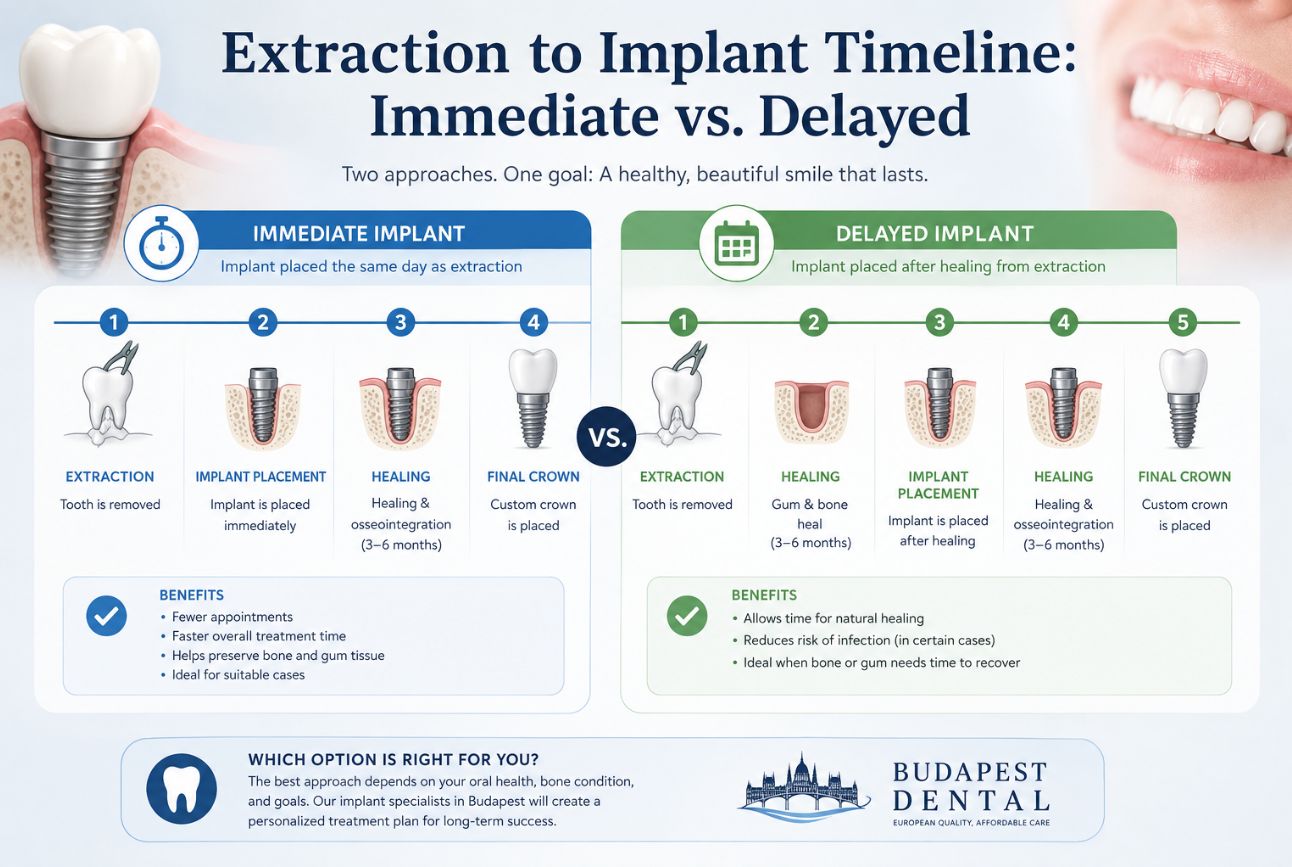
Immediate and delayed dental implants both work well; the right timeline depends on bone quality, infection, aesthetics and your overall treatment plan. Below is a patient-friendly guide to what “same-day implant” really means versus waiting 3–6 months after extraction.
Why Implant Timing Matters
When a tooth is removed, the socket is an active healing wound. The bone and gum around it remodel over weeks and months. An implant can be placed:
-
Immediately – at the same visit as the extraction (Type 1 placement).
-
Early – after initial soft-tissue healing, often 4–8 weeks.
-
Delayed – after fuller bone and gum healing, typically around 3–6 months.
Each option has advantages and disadvantages. The choice is based on:
-
Presence or absence of infection
-
How much bone is left around the tooth
-
Whether the socket walls are intact
-
Aesthetic demands (front teeth vs molars)
-
Whether a bone graft or sinus lift is needed
-
Your medical history and preferencespmc.
Key Terms: Placement vs Loading
People often mix two different ideas:
-
Placement timing – when the implant post is put into the jaw after extraction.
-
Loading timing – when a tooth (crown or bridge) is attached to the implant.
You can have:
-
Immediate placement + delayed loading
-
Immediate placement + immediate loading (same-day temporary tooth)
-
Early or delayed placement + delayed loading
Most UK patients still follow a delayed-loading protocol: the implant heals quietly for several months before the final crown is fitted.
Immediate Implant Placement (Same-Day)
What is an immediate implant?
An immediate implant is placed directly into a fresh extraction socket during the same appointment the tooth is removed, often within minutes.
Typical timing:
-
Day 0: Tooth extraction and implant placement in one visit
-
Weeks 1–12: Implant heals (osseointegration)
-
After 3–4 months: Final crown is fitted once healing and stability are confirmed
Who is a good candidate?
Immediate placement is usually reserved for carefully selected cases, for example:
-
Tooth without active, severe infection
-
Intact socket walls (especially the facial/buccal plate)
-
Adequate bone below and around the socket to hold the implant firmly
-
Stable bite with no excessive forces on the implant area
-
Good oral hygiene and non-smoking or low-risk smoking status
-
High aesthetic need, especially in upper front teeth, where preserving gum contour
If bone loss, infection or traumatic extraction has damaged the site, early or delayed placement is often safer.
Advantages of immediate placement
-
Fewer surgeries: Extraction and implant in one visit.
-
No long-term gap: Easier to keep the space filled with a temporary tooth, especially in the smile zone.
-
Helps preserve gum/bone architecture: The implant and any socket graft can support the ridge before major collapse.
-
Shorter calendar time: Many same-day implant protocols aim for about 3–4 months from extraction to final crown.
Limitations and risks
-
Higher technical demands: The surgeon must achieve strong primary stability in a healing socket.
-
Not suitable with active infection: Severe periapical infection or abscess usually calls for cleaning and healing first.
-
May need grafting at the same time: Thin facial bone often requires simultaneous bone grafting.
-
Aesthetics can be unpredictable if the facial bone is compromised.
-
Immediate loading (same-day tooth) adds further risk: Not every immediate implant should carry an immediately loaded crown.
Early Implant Placement (4–8 Weeks / 12–16 Weeks)
Many contemporary protocols use early placement, somewhere between immediate and fully delayed.
Common frameworks classify timing as:
-
Type 1 – Immediate: At extraction
-
Type 2 – Early (soft-tissue healing): 4–8 weeks
-
Type 3 – Early (partial bone healing): 12–16 weeks
-
Type 4 – Delayed: 4 months or more
Why wait a few weeks?
Waiting 4–8 or 12–16 weeks allows:
-
Gum tissue to close over and mature
-
Low-grade inflammation to settle
-
The clinician to see the final soft-tissue contour
-
Many infection risks to decrease
-
Enough bone to remain for predictable implant placement (if volume was good initially)
Early placement offers survival rates comparable to immediate placement (often in the 95–100% range) with fewer complications in many reviews.
For patients, it often means:
-
Extraction now
-
1–3 months of healing
-
Implant surgery once the site is healthier
-
3–4 months for implant integration
-
Final crown after radiographic and clinical confirmation
Delayed Implant Placement (3–6+ Months After Extraction)
What is a delayed implant?
Traditionally, implants were placed only after the socket had fully healed, often 3–6 months post-extraction. This delayed approach was considered the “gold standard” for many years.
Typical delayed timeline:
-
Day 0: Extraction (often with or without socket preservation graft)
-
3–6 months: Soft and hard tissue heal and remodel
-
Implant placement: Into a mature bone bed
-
A further 3–4 months: Implant integration (osseointegration)
-
Final crown fitting: Once the implant is stable and bone health is confirmed
When is delayed best?
Delayed placement is often chosen when:
-
There was significant infection or an abscess around the tooth
-
Bone loss is substantial and needs grafting first
-
A sinus lift or major bone augmentation is required
-
The ridge contour needs rebuilding over time
-
Medical or logistical factors mean a slower, staged approach is safer
Many clinicians prefer delayed placement for compromised sites, describing it as the most predictable route when bone and soft tissues are heavily affected.
Pros and cons of delayed placement
Advantages:
-
Fully healed socket gives a clearer view of available bone
-
Easier to plan implants from a stable ridge, especially after grafting
-
Lower risk in heavily infected or severely damaged sites
-
Bone and gum condition can be optimised first
Disadvantages:
-
Longer total treatment time (often 6–12 months from extraction to final crown).
-
The gap needs a temporary solution (denture, flipper, adhesive bridge).
-
Natural bone-remodelling may reduce ridge width and height unless socket preservation was used.
Osseointegration: The Second Waiting Period
Regardless of when the implant is placed, it must fuse with the jawbone. This biological process, osseointegration, generally takes:
-
About 3–4 months in standard cases
-
Up to 6 months if bone grafting or sinus lift was needed, or if bone quality is lower
Only once osseointegration is secure does your dentist attach the definitive crown or bridge. In delayed-loading protocols, you may wear a temporary tooth or denture while the implant heals underneath the gum.
Immediate vs Delayed Loading (Teeth on the Implant)
Two main loading strategies are used:
-
Immediate loading:
-
A temporary crown or bridge is attached within 48 hours to 1 week of implant placement.
-
Usually reserved for well-planned cases with strong initial stability and controlled bite forces.
-
Often used in full-arch or front-tooth cases, with careful occlusal design.
-
-
Delayed (conventional) loading:
-
The implant is left unloaded for 3–6 months.
-
A crown is fitted only after radiographic and clinical confirmation of osseointegration.
-
Considered safer in complex or grafted sites and for patients with risk factors.
-
Immediate placement does not automatically mean immediate loading. In many UK cases, even a same-day implant is left to integrate quietly before the permanent tooth is fitted.
Example: Typical Patient Timelines
Scenario 1: Healthy Premolar, No Infection – Immediate Implant
-
Week 0: Tooth removal + implant placed same visit, temporary tooth fitted.
-
Weeks 0–12: Healing and osseointegration.
-
Month 3–4: Final crown fitted.
Total: ~3–4 months.
Scenario 2: Moderate Infection, Good Bone – Early Implant
-
Week 0: Extraction, infection cleaned, simple socket preservation graft.
-
Weeks 0–8: Soft-tissue healing and infection resolution.
-
Week 8–12: Implant placement.
-
Months 3–6 post-implant: Osseointegration.
-
Month 6–7: Final crown fitted.
Total: ~6–7 months.
Scenario 3: Severe Bone Loss and Infection – Delayed Implant with Grafting
-
Week 0: Extraction; infection cleared; ridge-preservation or staged grafting.
-
Months 0–4: Socket and graft heal.
-
Month 4–6: Implant placed into rebuilt ridge.
-
Months 4–10: Implant healing (often 3–4+ months).
-
Month 8–12: Final crown fitted.
Total: ~8–12 months depending on graft complexity.
How Your Dentist Decides the Right Timeline
A UK implant dentist or oral surgeon will assess:
-
X‑rays/CBCT: Bone height, width, infection and neighbouring structures (sinus, nerve).
-
Gum health: Thickness, recession, aesthetic demands.
-
Tooth cause of removal: Trauma, fracture, chronic infection, gum disease.
-
Medical history: Smoking, diabetes, medications, immune status.
-
Your expectations: Speed vs safety, aesthetic priorities, budget.
British Dental Journal guidance emphasises restorative-driven planning: starting with the desired tooth position and smile result, then working backwards to decide when and where the implant should go.
The key message is that faster is not always better. Immediate implants can be excellent in the right hands and right cases; delayed implants can be safer in complex situations and still deliver long-term success.
Common Patient Questions
Can I always have a same-day implant?
No. Same-day placement requires healthy surrounding bone, no major infection, and enough structure to stabilise the implant. If these are missing, an early or delayed approach is often safer.
Will waiting 3–6 months make my implant less successful?
Not normally. Delayed implant placement has very high survival rates and remains the most common protocol globally, especially when infection or bone grafting is involved.
What happens to the gap while I wait?
Options include:
-
A small removable denture (“flipper”)
-
A temporary adhesive bridge bonded to neighbouring teeth
-
In some front-tooth immediate implant cases, a temporary crown on the implant itself
Your dentist will discuss which temporary solution is best for your situation.
Is a faster implant always more expensive?
Not necessarily, but immediate placement often requires more advanced planning, potential grafting and careful temporary restorations, which can increase cost. Extensive grafting and staged surgery for delayed implants can also be costly. The overall plan determines fees, not timing alone.
Will bone disappear if I wait?
Some bone resorption happens after every extraction, especially in the first 3–6 months. Socket preservation grafting can reduce this loss. Even with resorption, implants can often be placed successfully with or without additional grafting.
Takeaway for UK Patients
-
Immediate implants: Same-day extraction and implant, best when the site is clean and bone is strong.
-
Early implants: 4–16 weeks after extraction, balancing soft-tissue healing with preserved bone volume.
-
Delayed implants: 3–6+ months after extraction, usually chosen when infection, bone loss or grafting make a staged approach more predictable.
The “right” timeline is not universal; it is personal. A thorough consultation with your implant dentist – plus imaging and a full medical and dental history – is essential before deciding whether immediate or delayed placement is safest for you.
Extraction to Implant Timeline FAQs
How soon after tooth extraction can I have a dental implant?
A dental implant may be placed on the same day as extraction, after several weeks of soft-tissue healing, or after three to six months of bone healing. The right timeline depends on infection, bone volume, gum condition, the tooth’s location and whether the implant can achieve strong initial stability.
Can I get an implant on the same day as a tooth extraction?
Yes, but only in suitable cases. Same-day, or immediate, implant placement is usually considered when the extraction socket is clean, surrounding bone is intact and there is enough healthy bone to stabilise the implant securely. It is not automatically appropriate just because a patient wants a faster treatment timeline.
Does an immediate implant mean I leave with a tooth the same day?
Not always. Immediate placement means the implant post is inserted on the day of extraction. Immediate loading means a temporary tooth is attached soon after. A same-day implant may still be left beneath the gum to heal before a temporary or final crown is fitted.
Why would I need to wait three to six months for an implant?
Waiting allows the extraction socket, gum tissue and jawbone to heal. A delayed approach may be safer where there was significant infection, bone loss, a damaged socket wall, a need for bone grafting or insufficient bone to stabilise an implant immediately.
What is early implant placement?
Early implant placement sits between same-day and delayed placement. It is commonly performed after initial healing, often around four to eight weeks, or after partial bone healing at approximately 12 to 16 weeks. This can allow inflammation to settle while limiting the amount of natural bone shrinkage that occurs after extraction.
Will I lose jawbone if I wait for an implant?
Some natural bone remodelling occurs after every extraction, particularly during the first three to six months. Socket preservation or ridge-preservation grafting may help reduce this loss and maintain options for future implant placement.
Can I have an implant after an infected tooth is removed?
Often, yes. However, active or extensive infection may make immediate placement unsuitable. Your dentist may recommend extracting the tooth, cleaning the site, possibly using a bone graft and allowing a period of healing before implant placement. The safest option depends on the extent of infection and the condition of the remaining bone.
How long does an implant take to heal after it is placed?
Implant healing, known as osseointegration, often takes around three to four months in straightforward cases. It can take longer—sometimes up to six months or more—when grafting, sinus augmentation, lower-density bone or other clinical factors are involved.
Can I wear a temporary tooth while waiting for an implant?
Yes. Common temporary options include a removable partial denture or “flipper”, a resin-bonded adhesive bridge, or in selected cases a temporary implant crown. Your dentist will recommend an option that protects the space without putting harmful pressure on the healing site.
Is delayed implant placement less successful than immediate placement?
No. Delayed implant placement has a long record of predictable outcomes and may be the safer option in complex cases. Immediate placement can also be highly successful, but it requires careful case selection, advanced planning and adequate bone stability.
Will I need a bone graft before my implant?
Not everyone needs a graft. It may be recommended when the socket walls are thin or damaged, bone loss is already present, the ridge has narrowed after extraction, or the implant needs more support in the ideal position. A clinical examination and X-rays or CBCT scan help determine this.
Is implant placement painful?
Implant surgery is usually completed under local anaesthetic, so you should not feel pain during the procedure. Some swelling, bruising and tenderness can occur afterwards, particularly if bone grafting is also needed. Your dental team will provide individual pain-relief and aftercare advice.
Can smoking or vaping affect implant healing?
Yes. Smoking and vaping, particularly where nicotine is involved, can impair healing and increase the risk of implant complications. Stopping before treatment and remaining nicotine-free during healing gives the implant the best chance of integrating successfully.
How long is the full extraction-to-implant process?
A straightforward same-day placement pathway may take approximately three to four months before the final crown. A delayed pathway involving extraction, bone healing, implant placement and implant integration may take six to 12 months, particularly when bone grafting is required.
What should I ask at my implant consultation?
Ask whether immediate, early or delayed placement is safest for your case; whether you need a bone graft; how long healing is likely to take; what temporary tooth options are available; whether a CBCT scan is required; and what the complete treatment cost includes.
Sources
- Optimizing implant placement timing and loading protocols
- Timing of Dental Implant Placement: The Past, the Present, the Future
- British Dental Journal: Surgical guidelines for dental implant placement
- Dental Implants After Tooth Extraction: Timing Guide UK
- Immediate vs delayed dental implants: what is the difference?
- Tooth Extraction to Dental Implant Timeline