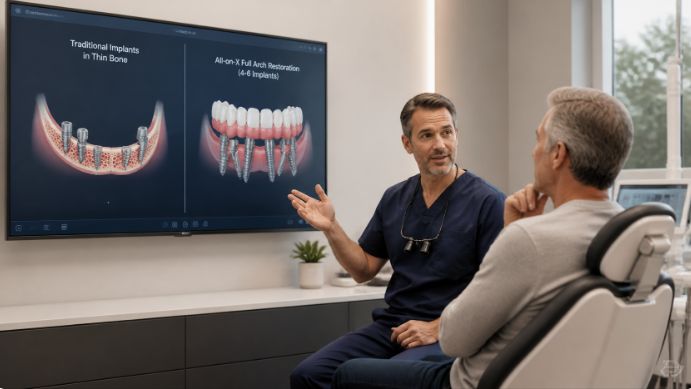
Basal implants, IHDE‑type systems and other immediate‑load implants all promise fast, fixed teeth on a reduced amount of bone, but for most full‑arch patients a carefully planned All‑on‑X fixed solution is usually more balanced, evidence‑based and maintainable in the long term. As a UK‑focused dental tourism reviewer, I’ll break down how these concepts overlap, where they differ, and why many clinicians prefer modern All‑on‑X over aggressive basal protocols, especially for international patients who need predictable results and safe follow‑up.
What Are Basal Implants?
Basal implants are special designs that anchor into the “basal” (cortical) bone of the jaw rather than relying mainly on the spongy alveolar bone used by conventional implants. They are often long, thin or disk‑shaped implants placed in different planes of bone with the goal of achieving high primary stability even when the jaw is severely resorbed.
Key points about basal implants:
-
Developed to treat advanced bone loss without bone grafting.
-
Typically combined with an immediate fixed bridge within 72 hours to splint the implants and distribute chewing forces.
-
Widely marketed by some dental tourism clinics as “implants for any bone” or “implants in 3–5 days, no bone graft, no sinus lift.”
While basal implantology can genuinely help certain complex cases, it is also controversial because of limited high‑quality long‑term data and the potential difficulty of revision if something fails.
Who or What Are IHDE Implants?
“IHDE implants” usually refers to systems created and promoted by Dr. Stefan Ihde, including basal and cortical designs like BOI, BCS and related immediate‑load concepts. These systems sit within the wider basal implantology family and are designed specifically for immediate loading with fixed prostheses.
Common characteristics of IHDE‑type implants:
-
Strong emphasis on immediate loading and splinting by a rigid bridge.
-
Use of screwable or disk‑style implants anchored in cortical bone, often in non‑standard directions.
-
Protocols that claim to treat almost any jaw with minimal or no bone grafting, even in smokers and patients with severe periodontitis or diabetes.
Supporters highlight speed and ability to treat “hopeless” cases, while critics point to revision challenges and the risk of over‑promising in very compromised mouths.
Immediate‑Load Implants: The Broader Concept
Immediate‑load implants aren’t a brand; they are a treatment protocol where implants are restored with a temporary or even definitive prosthesis within days or weeks of placement instead of waiting several months. This approach is used both in basal systems and in conventional implant designs (including All‑on‑4 and All‑on‑X) provided initial stability and case selection criteria are met.
Main features of immediate loading:
-
Functional loading shortly after surgery, often with a screw‑retained fixed bridge.
-
The prosthesis helps distribute forces across multiple implants, reducing overload on any single fixture.
-
Can dramatically shorten treatment time and give patients “teeth in a day” or within a few days, which is attractive for dental tourists.
The key difference is that in mainstream implantology, immediate‑load protocols are typically backed by structured clinical criteria and long‑term outcome data, whereas some aggressive basal marketing claims extend immediate loading to borderline situations with less robust evidence.
Common Features: Basal, IHDE and Immediate‑Load Systems
Despite branding differences, basal implants, IHDE designs and other immediate‑load concepts share several common elements.
Shared characteristics include:
-
Focus on speed – fixed prosthesis delivered within 72 hours to a few days, rather than months.
-
Reliance on primary mechanical stability rather than a long, undisturbed osseointegration phase.
-
Frequent use in atrophic jaws where bone height or width is reduced and traditional techniques might require bone grafting or sinus lifts.
-
Marketing as “no bone graft” or “implants for everyone” solutions, especially in the dental tourism sector.
-
Full‑arch fixed bridges that splint implants together and spread chewing forces.
For the right patient, these shared traits can be helpful; for the wrong patient or in the wrong hands, they can encourage over‑treatment and unrealistic expectations about what severely compromised jaws can support.
Evidence and Controversies Around Basal and IHDE Implants
Scientific literature has begun to evaluate basal and immediate‑load systems, but the evidence base is still smaller and more heterogeneous than for conventional implants and All‑on‑X‑type concepts.
Findings and concerns include:
-
Some studies report comparable short‑term survival between basal immediate‑load and endosseous immediate‑load implants in atrophic jaws.
-
Basal systems often avoid bone grafting and can succeed in medically complex patients, but success is highly technique‑sensitive.
-
Long‑term, if a basal implant fails or a bridge fractures, revision can be complex and may leave challenging defects for retreatment with standard implants.
-
Critics highlight the gap between aggressive marketing (“we treat everyone in 3 days, guaranteed”) and the relatively limited independent long‑term follow‑up compared with mainstream implant protocols.
For dental tourists, where follow‑up with the original surgeon may be limited, these potential downsides deserve careful consideration.
What Is All‑on‑X?
All‑on‑X is a full‑arch implant concept where a fixed bridge replaces all teeth in an upper or lower jaw using a strategic number of implants—often 4, 6 or occasionally more. The “X” simply stands for “the number you need,” so All‑on‑4, All‑on‑6 and similar variants all sit under the All‑on‑X umbrella.
Core principles:
-
4–6 implants placed in planned positions, often with angled posterior implants to maximise bone use and reduce grafting.
-
A fixed, screw‑retained full‑arch bridge that feels and functions like natural teeth and is not removed daily.
-
Ability to use immediate‑load protocols (“teeth in a day”) when primary stability and case selection are suitable.
-
A large and growing body of clinical research and global experience supporting its use.
This concept has become a flagship solution in many reputable dental tourism centres because it balances speed with strong evidence on long‑term function and maintenance.
Why All‑on‑X Is Often the Better Full‑Arch Choice
Compared with individual basal or IHDE implants scattered through compromised bone, a modern All‑on‑X solution usually offers a more predictable, maintainable and patient‑friendly path—especially for full‑arch dental tourists.
Key advantages:
-
Evidence‑Based and Widely AdoptedAll‑on‑X is based on standard endosseous implants with decades of accumulated data, modified by strategic angulation and prosthetic design. Many clinicians around the world are trained in these protocols, which means easier second opinions, maintenance and potential revisions in the UK if needed.
-
Fewer Implants, Less SurgeryInstead of 8–10 implants per arch or complex basal designs, All‑on‑X typically uses 4–6 implants, reducing surgical trauma and cost while still delivering a full fixed arch. This simpler approach is appealing for patients who want reliable results without highly exotic techniques.
-
Fixed, Stable and Natural‑FeelingAll‑on‑X bridges are fixed, do not move like dentures and provide strong chewing function, allowing you to enjoy a wide diet and confident speech. Aesthetics are highly customisable, helping restore facial support and a natural‑looking smile.
-
Immediate Function With Structured CriteriaAll‑on‑X can often be loaded immediately or within a short time frame, but only when bone quality, implant stability and bite forces are within accepted parameters. This more conservative, protocol‑driven approach tends to protect long‑term success rather than promising immediate loading “at any cost.”
-
Better Long‑Term Maintenance and RetrievabilityIf an implant fails or a prosthesis needs updating, All‑on‑X systems are generally easier to adjust, repair or remanufacture because they follow mainstream component designs and restorative principles. In contrast, some proprietary basal systems can be harder to service, especially if you move or switch dentists.
Basal / IHDE Implants vs All‑on‑X: Practical Comparison
For many UK patients, especially those planning overseas treatment but wanting local follow‑up, this maintainability and familiarity make All‑on‑X the safer bet.
Dental Tourism: Marketing Hype vs Reality
Basal and IHDE implant systems have become strongly associated with dental tourism, particularly in parts of Eastern Europe, India and North Africa, where clinics advertise “fixed teeth in 3 days, no matter how bad your jaw is.” While genuine success stories exist, it’s important to separate marketing slogans from clinical realities.
Common marketing angles:
-
“No bone grafting ever needed.”
-
“We can treat smokers and heavy periodontitis without extra risk.”
-
“Lifetime guarantee” on aggressive immediate‑load reconstructions.
Real‑world considerations:
-
Severely compromised jaws can still fail under extreme loading, regardless of implant design.
-
Hygiene access and long‑term maintenance are critical; if plaque control and biting forces are not well managed, any full‑arch system can fail.
-
Travelling back to the same clinic every time you need an adjustment or repair may be impractical once you’re back in the UK.
Reputable All‑on‑X providers—both abroad and in the UK—tend to be more cautious in their promises and more transparent about the need for follow‑up, hygiene and realistic expectations.
When Might Basal or IHDE Implants Still Make Sense?
Despite the controversies, basal and IHDE‑type implants are not automatically “bad”; they can be a valuable niche tool in specific situations.
They may be considered when:
-
Bone volume is so reduced that standard All‑on‑X techniques—even with angulation and zygomatic or pterygoid options—are not feasible or acceptable to the patient.
-
The patient cannot undergo more invasive grafting or complex hospital‑based procedures due to medical constraints.
-
An experienced surgeon with specific basal training can demonstrate a strong track record and offers realistic expectations and clear consent.
In such edge‑case scenarios, basal implants can sometimes offer a functional, fixed solution when the alternative might be only removable dentures. However, this should be framed as a carefully weighed compromise, not a magic shortcut.
How to Choose Safely as a UK Dental Tourist
If you are a UK patient comparing basal/IHDE systems with All‑on‑X offers at home and abroad, a structured decision‑making process will help.
Steps to take:
-
Get a thorough 3D assessment (CBCT scan) and at least one independent treatment plan in the UK for baseline comparison.
-
Ask each clinic which implant systems they use, and why they recommend basal vs conventional vs All‑on‑X in your specific case.
-
Check prosthetic design – is the bridge screw‑retained, retrievable, and cleanable? How will you maintain it in the UK?
-
Clarify guarantees and follow‑up – what happens if an implant fails or a bridge fractures a year later, and how much will remedial work cost?
-
Research the team’s training and publications – clinicians involved in All‑on‑X and evidence‑based immediate loading often share case series, lectures or scientific papers.
For most full‑arch cases with reasonable bone, a well‑planned All‑on‑X fixed solution with immediate or early loading offers a strong balance of speed, safety, maintainability and long‑term value, which is why many implant specialists increasingly favour it over more radical basal protocols.
Sources and Further Reading
Basal Implant vs Conventional Dental Implant – Dental Implant Europe:
https://dentalimplanteurope.com/2019/10/21/basal-implant-vs-conventional-dental-implant/
Basal vs Conventional Dental Implants: Differences & Cost – Rajkot Dentist:
https://www.rajkotdentist.com/basal-vs-conventional-dental-implants/
Immediate‑Loading Dental Implant in Basal Implantology – Anveli Dental:
https://anveli.dental/immediate-loading-dental-implant/
Implant Survival Between Endo‑Osseous Immediate‑Load and Basal Immediate‑Load Implants – Clinical Study (PMC):
https://pmc.ncbi.nlm.nih.gov/articles/PMC5717901/
Immediate Loading of Full‑Mouth Basal Implants – Case Report:
https://www.cureus.com/articles/277954-a-case-of-accelerated-rehabilitation-immediate-loading-of-full-mouth-basal-implants
Ihde Immediate Loading Info (Basal Implant Systems Overview):
https://www.scribd.com/presentation/100813104/Ihde-Immediate-Loading-Info-Ver2-En
Basal Dental Implants: Understanding the Controversies – BodyExpert:
https://www.bodyexpert.online/en/basal-implants-vs-conventional-implants
Basal Implants and Their Importance in Clinical Dentistry – Research Review:
https://rsdjournal.org/index.php/rsd/article/download/45835/36493/476881
ALL‑ON‑X Dental Implants – Concept and Benefits (Washington DC Implant Center):
https://www.implant-dentistry.com/all-on-x/
All‑on‑X vs Traditional Implants – Full‑Arch Comparison:
https://www.dentalcenteraz.com/blog/all-on-x-vs-traditional-implants-which-full-arch-option-is-right-for-you
All‑on‑X Benefits Explained – Spring St. Dental:
https://bastropdentistry.com/all-on-x-dental-implants-benefits/
Dental Implants: All‑on‑4, All‑on‑X & Single‑Tooth Options – Largo Dental Boutique:
https://largodentalboutique.com/blog/dental-implants-all-on-4-all-on-x-and-single-tooth-options-explained/
Everything You Need to Know About All‑on‑X Dental Implants – Harmony Smiles:
https://www.myharmonysmiles.com/blog/all-on-x-dental-implants-guide/
All‑on‑X Pros and Cons – Dean Dental Solutions:
https://deandentalsolutions.com/all-on-x-pros-cons/