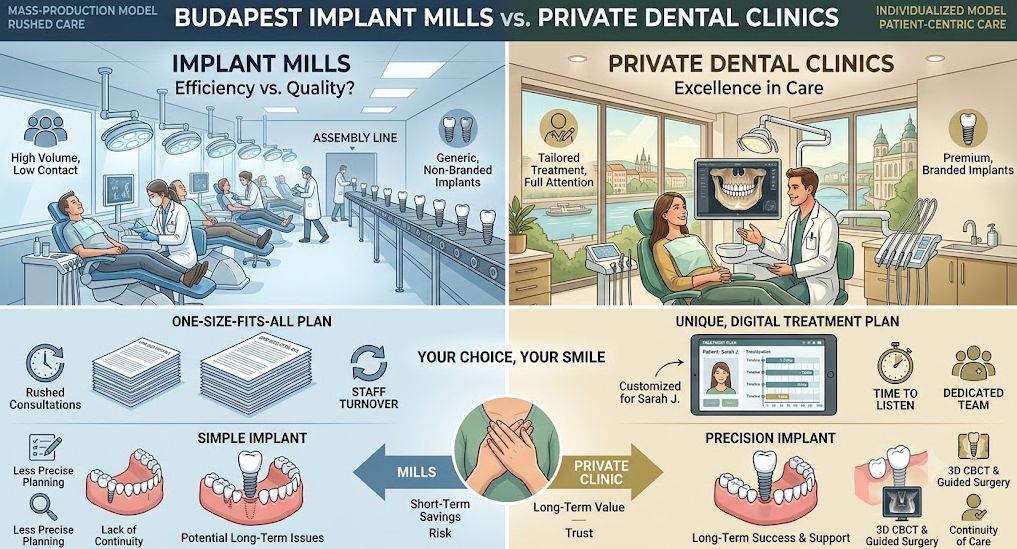
An “implant mill” is a high‑volume, tourism‑focused clinic that prioritises speed, sales and package turnover, while a genuine private family clinic treats both local patients and expats with slower, more personalised care and transparent surgeon‑led planning. An implant mill is more typical in Turkey, totally unknown in Budapest or Hungary.
This guide explains what an implant mill looks like, how to spot boutique Hungarian practices, and the specific red flags UK patients should watch for when choosing a clinic abroad.
What Is a Budapest “Implant Mill”?
An implant mill is not an official medical term; it’s a nickname for clinics whose business model revolves around placing large numbers of dental implants on foreign patients in as little time as possible.
These clinics typically rely on aggressive marketing, broker commissions and treatment packages, focusing more on volume and turnover than tailored planning or long‑term follow‑up.
Typical Features of an Implant Mill
Implant mills share several recognisable characteristics that UK patients can spot before booking.
-
High patient volume and rapid throughput
Large numbers of dental tourists scheduled into tightly packed timetables, with minimal consultation time per patient.townsvilledental+1 -
Commission‑driven sales teams
Non‑clinical “consultants” or sales reps push package deals, often paid commission per case.mydentalfly+2 -
Rotating dentists and surgeons
You may see different dentists at each visit, and the clinic avoids confirming exactly who will perform your surgery.linkedin+1 -
Package marketing over clinical detail
Heavy emphasis on “All‑on‑4 in X days,” “hotel + implants” or “Smile in a weekend” with little explanation of diagnostics, implant brands or long‑term maintenance.mezadentalcare+2
When speed, turnover and sales messaging dominate the clinic’s identity, you are likely looking at an implant mill rather than a small, private practice.
How Boutique Hungarian Clinics Work Differently
Boutique or family‑style clinics in Budapest tend to serve a mixed patient base: local Hungarians, expats living in Hungary, and some dental tourists from the UK, Ireland and Western Europe.
Their priorities lean towards continuity and long‑term reputation rather than maximising short‑term tourist volume, which shapes how they plan and deliver implant treatment.
Key Traits of a Private Family Clinic
A genuine private clinic usually shows several “green flags” that contrast sharply with implant mill behaviour.
-
Named lead dentist or surgeon
The clinic clearly identifies who will place your implants, with qualifications and experience profiles available.us-uk. -
Mixed patient base
Website and reviews mention local Hungarian patients and residents, not only foreign tourists. -
Individual treatment plans
Proposals are tailored to your bone condition, medical status and goals, rather than one‑size‑fits‑all packages. -
Emphasis on diagnostics and quality materials
Routine use of CBCT imaging, named implant brands (e.g. Straumann, Nobel Biocare) and transparent documentation.
These clinics generally view dental tourism as part of their work, not their sole revenue driver, which reduces pressure and overtreatment incentives.dentalclinichungary+2
Red Flag 1: Pressure Sales Tactics
One of the clearest warning signs of an implant mill is high‑pressure sales behaviour.
Examples include:
-
Limited‑time discounts (“book this week or lose the price”).
-
Pushing more implants or full‑arch packages than you initially requested.
-
Discouraging you from seeking a second opinion.
Ethical clinics abroad emphasise informed consent and give you time to decide; if you feel rushed or guilt‑tripped into booking, that is a strong red flag.
Red Flag 2: Refusal to Name Your Surgeon
A quality Budapest clinic should clearly tell you which dentist or oral surgeon will perform your implant surgery.
If staff insist “we have a team” but won’t specify who will operate, or they constantly change the name without explanation, it may indicate:
-
Heavy reliance on short‑term or visiting clinicians.
-
Lack of stable leadership.
-
Difficulty being accountable for outcomes.
Boutique and family clinics typically highlight their lead clinicians’ credentials, often tied to Semmelweis University or long‑term practice in Hungary.
Red Flag 3: Unknown Implant Brands and No Documentation
Implant mills sometimes use lower‑cost or obscure implant brands to keep package prices extremely low.
If the clinic cannot clearly name the manufacturer, model and country of origin of your implants, or does not provide written documentation, that’s a serious concern. Premium brands like Straumann, Nobel Biocare, MIS or similar should be named in your plan and invoice.
Red Flag 4: No CBCT or Proper Planning
Quality implant planning requires 3D imaging (CBCT) to assess bone volume, nerve positions and sinus anatomy.
If a clinic proposes multiple implants or full‑arch work based only on a quick panoramic X‑ray and a brief visual check, they are cutting corners. Boutique clinics and high‑quality centres in Budapest treat CBCT as standard for complex cases.
Red Flag 5: Ultra-Cheap Package Prices Far Below Market
Implant mills often lure patients with package prices dramatically lower than reputable Budapest clinics.
If you see “All‑on‑4” or multiple implants bundled with hotel and transfers at prices far below what independent guides list for Hungary in 2026, the clinic may be:
-
Using low‑quality materials.
-
Rushing surgery and follow‑up.
-
Cutting corners on diagnostics and hygiene.
Hungary can be 60–70% cheaper than UK private dentistry, but there is still a realistic floor on safe implant costs.
Red Flag 6: Broker-Heavy, Tourism-Led Marketing
Some implant mills rely on brokers and non‑clinical agencies who funnel UK patients in exchange for commission.
Signs include:
-
You book through a generic tourism site, not directly with the clinic.
-
The focus is on hotels, spa packages and sightseeing rather than surgeon profiles and outcomes.
-
Emails come from a “coordinator” who cannot answer clinical questions in detail.
Independent safety guides recommend booking directly with vetted clinics rather than via brokers to avoid commission‑driven overtreatment.
Green Flags: How Quality Budapest Clinics Present Themselves
To avoid implant mills, UK patients should look for positive indicators on clinic websites and in reviews.
-
Clear, named clinician pages with qualifications and experience.
-
Semmelweis University or comparable academic affiliations.
-
Long‑term Google and international platform reviews over many years, not just recent marketing bursts.
-
Transparent price lists with itemised costs, not only vague “package from…” offers.
-
Written treatment plans, warranties and aftercare instructions in English.
These “green flags” are common to both reputable big clinics and high‑quality boutique practices in Budapest.
How Boutique Family Clinics Communicate With UK Patients
Boutique clinics in Budapest usually adopt a slower, relationship‑driven communication style.
UK patients will often notice:
-
Longer initial video or email consultations, with time for questions.
-
Realistic explanations of risks, complication rates and maintenance.
-
Willingness to suggest conservative alternatives instead of pushing maximum implant numbers.
Independent implant safety resources emphasise that ethical care includes clear communication, alternatives and no pressure to accept aggressive treatment plans.
Why Implant Mills Are Riskier for UK Dental Tourists
The main risk in dental tourism usually lies in choosing the wrong clinic, not the wrong country.
Implant mills increase your chances of:
-
Overtreatment (more implants or surgeries than necessary).
-
Under‑planning and higher failure rates due to rushed diagnostics.
-
Poor documentation, making UK follow‑up harder and more expensive.
When things go wrong, UK dentists often face limited information about what was done abroad and which materials were used, complicating corrective work.
Practical Checklist for UK Patients Vetting Budapest Clinics
Before booking, UK patients can run through a simple checklist based on independent safety guides.
-
Surgeon identity – Do you know exactly who will place your implants and their background?
-
Imaging – Is CBCT part of the standard planning process for your case?
-
Implant brand – Are reputable, named implant systems used and documented?
-
Price realism – Are prices competitive but not suspiciously low compared with other Budapest clinics?
-
Written plan and warranty – Do you receive a detailed written plan, consent and warranty terms in English?
-
Reviews across platforms – Are there consistent reviews across Google, WhatClinic, Trustpilot, etc., over several years?
-
Clinic registration – Can you verify their EU medical registration and dentist licences?
If any of these points remain vague or unanswered, consider seeking a second opinion from another Budapest clinic before committing.
Practical Takeaway for UK Patients
Budapest remains one of the safest and best‑regulated destinations for dental implants in Europe, but clinic quality varies widely.
If you avoid implant mills – characterised by pressure sales, anonymous surgeons, ultra‑cheap packages and weak planning – and focus instead on clinics that treat local Hungarians and expats with clear diagnostics, named clinicians and realistic pricing, you can significantly reduce risk and improve long‑term outcomes.
FAQs: Budapest Implant Mills vs Private Family Clinics
1. What is a “Budapest implant mill” in dentistry?
An implant mill is a high‑volume clinic that focuses on placing as many implants as possible, often on short‑stay dental tourists, with strong package marketing, fast turnaround and sales‑driven consultations rather than slow, personalised planning.
2. How does a private family clinic in Budapest differ from an implant mill?
A private family clinic typically treats local Hungarians and expats as well as visitors, offers named dentists with long‑term patient relationships, and builds treatment plans around your health and budget rather than fixed “all‑in” packages and commission targets.
3. Why are implant mills riskier for UK dental tourists?
Implant mills may cut corners on diagnostics, use cheaper or poorly documented implant brands, and push more aggressive treatment than necessary. If problems arise later in the UK, your dentist may have limited information about what was done and which materials were used.
4. What are the biggest red flags that a clinic might be an implant mill?
Key warning signs include high‑pressure sales tactics, refusal to name the specific surgeon who will operate, ultra‑cheap “all‑on‑4” or implant packages far below typical Budapest prices, and very little detail on diagnostics, implant brands or long‑term follow‑up.
5. Why is it important to know who will place my implants?
Implant surgery outcomes depend heavily on the experience and training of the surgeon. A transparent clinic will tell you exactly who will operate, share their qualifications and case experience, and allow you to ask questions before you commit to treatment.
6. Should a Budapest clinic tell me which implant brand they use?
Yes. A reputable clinic will clearly name the implant system and manufacturer, explain why they chose it, and include this information in your plan and invoice. Vague answers or refusal to share brand details are a sign to dig deeper or seek another opinion.
7. Do quality clinics in Budapest always use CBCT imaging before implants?
For anything beyond the simplest case, good clinics treat 3D CBCT imaging as standard. It shows bone volume, nerve positions and sinus anatomy. If a clinic proposes multiple implants or full‑arch work without CBCT, that suggests rushed planning.
8. How can I tell if a clinic serves locals as well as tourists?
Look for Hungarian‑language pages, reviews from local residents, and long‑term patients mentioning routine check‑ups and follow‑up care. Clinics that only show foreign testimonials, hotel packages and “holiday dentistry” marketing may be more tourism‑driven.
9. Are very low implant prices always a bad sign?
Budapest is genuinely cheaper than UK private care, but there is still a realistic minimum cost for safe implant work. Prices far below what most reputable Hungarian clinics charge often mean savings are coming from cheaper materials, minimal diagnostics or rushed schedules.
10. What questions should I ask to avoid booking with an implant mill?
Ask who will place your implants, what imaging they’ll use, which implant brand they prefer and why, how many similar cases they treat each month, and what happens if problems arise later. A good clinic answers clearly and without pressure; an implant mill tends to deflect and push you to book quickly.
References
- General guide: choosing a clinic abroad and spotting red flags
How to Choose a Dental Clinic Abroad - Red flags for unsafe Hungarian dental clinics
Red Flags: Unsafe Dental Clinics in Hungary - Complications after Hungary dental tourism
Hungary Dental Tourism Complications Guide - Honest 2026 guide to implants abroad (brands and verification checklist)
Dental Implants Abroad: Complete Guide - Vetting clinics before going abroad
Dental Implants Abroad Safety Guide - Overview of dental implants in Budapest
Dental Implants in Budapest – Affordable & High-Quality Care - General Budapest medical tourism clinic listings
Top Clinics in Budapest for Medical Tourism