Full mouth restoration with bone loss is absolutely possible, but there is a big difference between “quick‑fix” solutions that look good for a short time and carefully planned, stable reconstructions that protect your jaw and investment for many years. For UK patients exploring dental tourism, the safest path is to understand which options truly rebuild structure and function, and which are essentially temporary compromises dressed up as full mouth makeovers.
Full mouth restoration (or full mouth reconstruction) is a tailored combination of treatments designed to rebuild all or most teeth in one or both jaws, restoring chewing, aesthetics and bite harmony. In patients with bone loss from gum disease, long‑term missing teeth or ill‑fitting dentures, it often involves managing the bone and gum architecture as much as the teeth themselves.
Typical components can include extractions, periodontal treatment, crowns and bridges, implants, grafting or gum reshaping, and in some cases orthodontics or bite correction. For dental tourists, many clinics package these into “full mouth restoration” offers that range from basic prosthetic facelifts to advanced fixed implant solutions.
How Bone Loss Changes Your Options
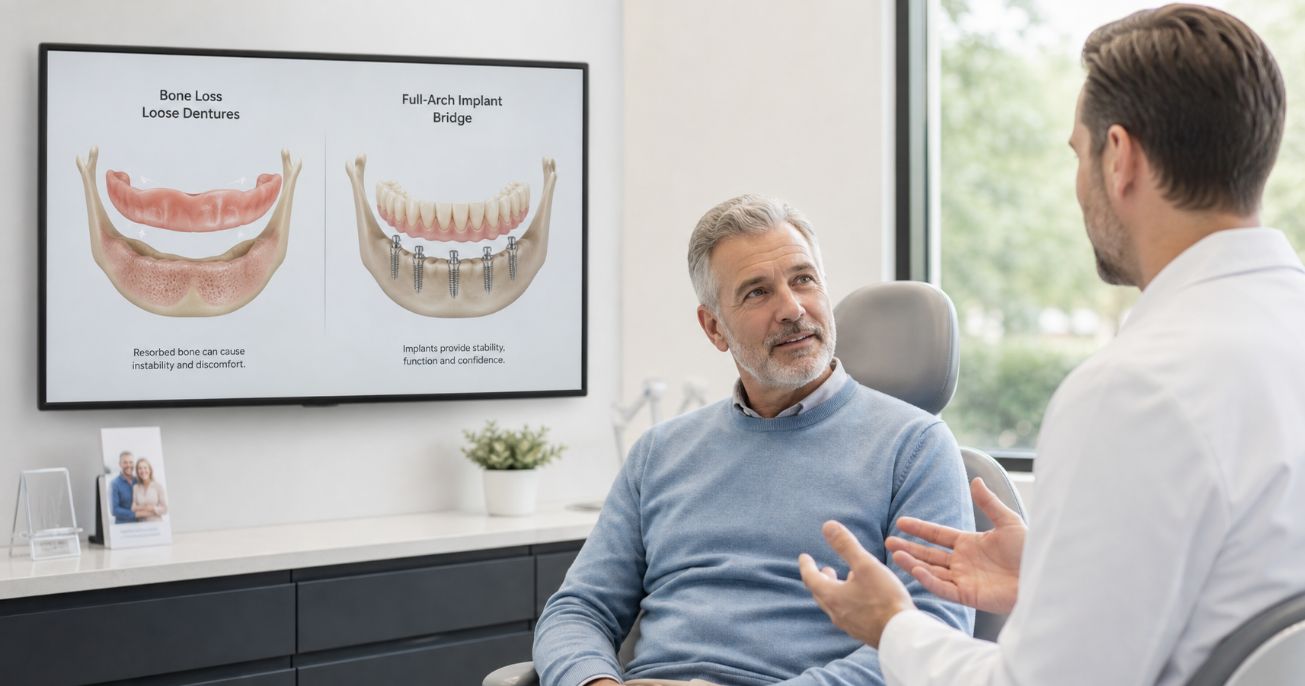
When you lose teeth, the surrounding jawbone gradually resorbs because it no longer receives stimulation from tooth roots. Long‑term periodontitis accelerates this process, leaving ridges that are thin, low and often uneven.
Bone loss affects:
-
Where and how many implants can be placed safely.
-
Whether bone grafting, sinus lifts or graft‑less techniques are needed.
-
The choice between removable dentures, implant‑retained over‑dentures and fully fixed bridges.
In severe cases, the loss of both bone and soft tissue also affects facial support, lip position and smile aesthetics, so the restoration must rebuild not just teeth but also the “framework” behind your smile.
Main Restoration Pathways With Bone Loss
Broadly, full mouth restoration with bone loss falls into three categories.
-
Conventional removable dentures – acrylic prostheses resting on the gums, sometimes with a palate in the upper jaw.
-
Implant‑assisted solutions – from two‑implant over‑dentures to All‑on‑X fixed bridges, with or without grafting.
-
Hybrid or “quick makeover” options – crowns and veneers on compromised teeth, or minimal‑support bridges that improve appearance but don’t fully address structural issues.
Within each category, there are safer, longer‑lasting versions and more fragile, short‑term compromises; understanding the difference is crucial when you are spending thousands and travelling abroad.
Temporary or Short‑Term Options
Temporary choices can still have a role, especially as interim steps, but they are not true long‑term solutions in the presence of significant bone loss.
Common temporary or limited‑lifespan options:
-
Conventional full dentures resting on thin ridges, which often feel loose, reduce chewing force and may accelerate further bone resorption over time.
-
Partial dentures that clip onto remaining compromised teeth, which may overload those teeth and require frequent adjustments as bone changes.
-
Cosmetic “wrap‑around” crowns and bridges on mobile teeth affected by advanced periodontitis; they can look good briefly, but the underlying bone loss and looseness continue.
-
Non‑reinforced acrylic full‑arch bridges on too few or poorly placed implants, susceptible to fracture or loosening under bite forces.
These approaches may be appropriate as stepping stones—post‑extraction healing or budget‑bridging phases—but framing them as permanent full mouth restoration can be misleading.
Safe, Long‑Term Solutions With Implants
For most patients with significant bone loss, the most stable, long‑term path involves implants supporting fixed or well‑retained prostheses.
Key long‑term strategies:
-
Full‑arch fixed implant bridges (All‑on‑X concepts) 4–6 implants placed strategically (often angled posteriorly) support a screw‑retained full‑arch bridge, providing strong function, aesthetics and easy maintenance. With correct planning, these can often be done without extensive grafting, even with moderate bone loss.
-
Implant‑retained over‑dentures2–4 implants with locator attachments or a bar dramatically improve denture stability and chewing compared with conventional dentures, while being more affordable than full fixed bridges.
-
Graft or graft‑less advanced protocolsIn severe bone loss, options include bone grafts, sinus lifts, or graft‑less techniques such as zygomatic or pterygoid implants, all aiming to anchor implants in stable bone and restore a full arch.
These solutions are designed for longevity and allow for controlled loading of implants, maintenance access, and predictable biomechanics.
Bone Grafting vs Graft‑less Approaches
When bone is insufficient, you and your dentist must decide whether to rebuild it or work around it.
Bone grafting and regeneration
-
Techniques like sinus lifts, ridge augmentation and guided bone regeneration add volume where needed.
-
They extend treatment time (often 6–12 months) and cost, but can allow more ideal implant placement and prosthetic design.
-
High‑quality grafting is common in advanced full‑mouth cases in both the UK and top international centres.
Graft‑less solutions
-
Use existing dense bone in alternative sites—tilted posterior implants, zygomatic implants to the cheekbone, pterygoid implants in the back of the upper jaw.
-
Shorten treatment time and avoid donor sites but require very experienced surgeons and meticulous planning.
For dental tourists, graft‑less approaches can be attractive because they compress treatment into fewer trips; however, they must be balanced against complexity, surgeon skill and long‑term follow‑up needs.
Immediate Load vs Staged Load in Bone Loss
Many full‑mouth implant systems promise “teeth in a day” or immediate loading, which can be safe when properly indicated.
Evidence shows:
-
Immediate loading can succeed even in compromised jaws when enough implants are placed, primary stability is high and the bridge design carefully distributes forces.
-
Case reports describe successful immediate loading of full‑mouth implants in patients with severe periodontal damage, using rigid splinting and controlled occlusion.
-
However, pushing immediate loading where stability is borderline or prostheses are under‑engineered raises the risk of early failure or complications.
A safe approach treats immediate loading as a protocol with strict criteria, not a marketing slogan guaranteed for every patient.
How Long Do Full‑Arch Solutions Last?
Longevity depends on design, execution, maintenance and patient habits.
-
Well‑planned implant‑supported full‑arch bridges can function for many years, with high survival rates reported in long‑term follow‑ups when patients adhere to hygiene and recall schedules.
-
Acrylic or composite bridges may need resurfacing or replacement over time; metal‑ceramic or high‑end zirconia frameworks offer greater strength but demand precise planning.
-
Conventional dentures often require relining or remaking every 5–8 years as bone continues to resorb.
From a cost‑per‑year perspective, stable implant solutions often prove more economical over the long term than a series of short‑lived prosthetic “patches.”
Dental Tourism: Safe vs Risky “Full Mouth” Offers
Many international clinics in Turkey, Hungary, Mexico and other hubs advertise full mouth restorations at a fraction of UK prices. Some offer excellent, evidence‑based care; others cut corners with rushed timelines, limited diagnostics and one‑size‑fits‑all prosthetics.
Red flags for temporary or risky work:
-
Very short stays (e.g. 3–4 days) for extraction of all teeth, placement of many implants and “final” bridges in one go.
-
Lack of 3D imaging (CBCT) and comprehensive periodontal evaluation before extractions and implants.
-
Over‑promising (“no bone? no problem” for everyone) without clear explanation of bone quality, risks and alternatives.
-
No structured plan for long‑term maintenance or clear guidance on what happens if something fails once you’re back in the UK.
By contrast, safer full‑arch programs—both abroad and in the UK—emphasise staged treatment when needed, realistic healing times, and transparent follow‑up protocols.
Balancing Budget, Safety and Expectations
For many UK patients, cost is the reason to look abroad, but value is more than the lowest price tag.
Ways to balance your priorities:
-
Consider implant‑retained over‑dentures as a step up from conventional dentures at a lower cost than fully fixed bridges.
-
Look at phased treatment: e.g. stabilise one jaw with implants first, then restore the other when budget allows.
-
Compare detailed treatment plans from a UK provider and one or two overseas clinics, including number and type of implants, grafting, prosthetic materials and aftercare.
-
Ask explicitly whether a proposed solution is expected to be definitive, medium‑term or temporary, and what maintenance or eventual replacement will cost.
This clarity prevents disappointment and helps you choose a plan that fits your financial reality and long‑term goals.
Practical Steps Before You Travel
If you are seriously considering full mouth restoration with bone loss as a dental tourist, a little groundwork goes a long way.
Practical checklist:
-
Get a full assessment at home, including CBCT if possible, and keep copies of scans and reports.
-
Shortlist clinics with clear experience in full‑arch and bone‑loss cases, not just cosmetic dentistry.
-
Ask for case photos, success data and references from patients with similar bone loss patterns.
-
Clarify how many visits will be needed, how long you will wear provisional prostheses, and how final bridges will be delivered.
-
Plan maintenance: decide which dentist in the UK will handle hygiene, checks and small repairs once the work is done.
The aim is to treat your mouth like a long‑term investment, not a once‑off cosmetic purchase.
Safe and Lasting vs Temporary: The Bottom Line
When bone loss is part of the picture, safe and lasting full mouth restoration usually means:
-
Working with implants anchored in stable bone (with grafts or graft‑less techniques as needed).
-
Using prosthetic designs that are retrievable, repairable and cleanable.
-
Respecting healing timelines and evidence‑based criteria for immediate loading.
-
Building a realistic maintenance plan with regular review and professional cleaning.
Temporary solutions – basic dentures, cosmetic quick fixes on failing teeth, or under‑engineered implant work – can have a role as interim phases, but they should be presented honestly as such, not as definitive answers.
Sources and Further Reading
Full‑Mouth Rehabilitation With Immediate Loading Basal Implants – Case report in severe periodontal bone loss:
https://pmc.ncbi.nlm.nih.gov/articles/PMC6563623/
Full Mouth Rehabilitation With Implant‑Supported Prostheses for Severe Periodontitis – Case report and bone management:
https://pubmed.ncbi.nlm.nih.gov/21339901/
Functional and Aesthetical Full‑Mouth Rehabilitation – Conservative and minimally invasive principles:
https://pmc.ncbi.nlm.nih.gov/articles/PMC10682251/
Best Clinics for Bone Grafting and Full Mouth Restoration – Medical Tourism Magazine overview:
https://www.magazine.medicaltourism.com/article/best-clinics-for-bone-grafting-and-full-mouth-restoration
Full Mouth Restoration Without Bone Grafting – Graft‑less approaches and zygomatic implants:
https://www.magazine.medicaltourism.com/article/full-mouth-restoration-without-bone-grafting–is-it-possible
Full Mouth Restoration Turkey 2026 – Costs and treatment options for UK patients:
https://www.mydentalfly.com/guides/full-mouth-restoration-turkey
Top Dental Tourism Destinations for Full Mouth Rehabilitation – LBR Dental Implants:
https://lbrdentalimplants.com/oral-health/top-dental-tourism-destinations-for-full-mouth-rehabilitation/
Affordable Full Mouth Reconstruction – Cost & Options (veneers, crowns, implants):
https://www.andepol.com/blogs/full-mouth-reconstruction
Full Mouth Dental Implants Abroad – Guide for dental tourists:
https://dentaltourismassociation.com/full-mouth-dental-implants/