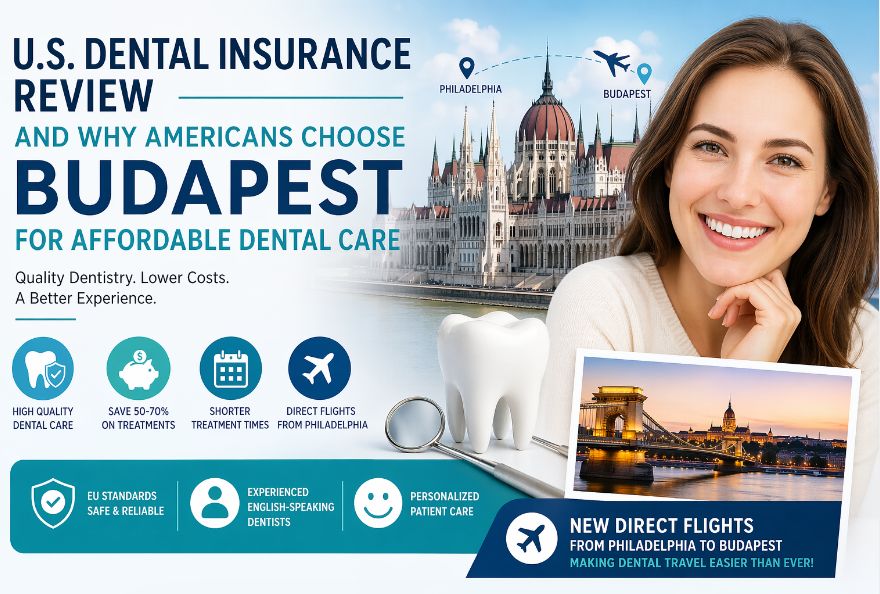
The United States has one of the most complex and often misunderstood dental insurance systems in the developed world. While many Americans assume that dental coverage works like general health insurance, the reality is quite different. As someone who closely observes global dental tourism trends, it becomes clear that the structure and limitations of U.S. dental insurance are a major factor driving patients to seek care abroad, particularly in destinations like Budapest, Hungary.
This review explores the strengths and weaknesses of leading U.S. dental insurance providers, highlights the systemic issues that frustrate patients, and explains why Budapest has emerged as one of the most attractive alternatives, especially with new direct flight connections from Philadelphia.
Overview of the U.S. Dental Insurance Landscape
Dental insurance in the U.S. typically operates on a benefits model rather than a true insurance model. Most plans emphasize prevention, offering full or partial coverage for cleanings and basic exams, while placing strict limits on more complex procedures such as crowns, implants, and orthodontics.
Unlike healthcare insurance, dental plans usually include annual maximums, waiting periods, and significant out-of-pocket costs. These structural elements shape patient behavior in ways that increasingly push them to consider international options.
The major players in the U.S. dental insurance market include companies like Delta Dental, Cigna, MetLife, Aetna, and Humana. Each offers a range of plans, but all operate within the same general framework.
Delta Dental: Market Leader with Predictable Limitations
Delta Dental is the largest dental insurance provider in the United States, covering tens of millions of Americans. Its network is extensive, and patients often appreciate the ease of finding in-network providers.
However, Delta Dental’s plans typically include annual maximums ranging from $1,000 to $2,000. While this may sound reasonable, it quickly becomes insufficient when patients require procedures such as implants, which can cost several thousand dollars per tooth in the U.S. Additionally, reimbursement rates are often low, leaving patients responsible for a significant portion of costs.
Another common issue is the “least expensive alternative treatment” clause. This allows the insurer to cover only the cheapest viable option, even if a more durable or aesthetically pleasing solution is recommended by the dentist. For example, a removable partial denture may be covered instead of a dental implant.
Cigna Dental: Flexibility with Trade-Offs
Cigna offers both PPO and DHMO plans, giving patients some flexibility in choosing providers. PPO plans allow out-of-network care but at higher costs, while DHMO plans require strict adherence to a network.
Cigna’s strength lies in its preventive care coverage and relatively transparent pricing structures. However, like most U.S. dental insurers, it imposes waiting periods for major procedures, often ranging from 6 to 12 months. This delay can be problematic for patients with urgent needs.
Cigna also follows the industry standard of annual maximums, which means that patients undergoing complex treatments often exceed their benefits quickly. Once the cap is reached, all additional costs must be paid out-of-pocket.
MetLife Dental: Employer-Focused Coverage
MetLife is widely used through employer-sponsored plans. It offers broad network access and competitive preventive care coverage.
One advantage of MetLife is its negotiated fee schedules, which can reduce costs even after insurance benefits are exhausted. However, these discounts are often modest when compared to international price differences.
MetLife’s plans also include waiting periods and annual maximums, and coverage for implants is frequently limited or excluded. For patients needing full-mouth rehabilitation, these plans provide only partial financial relief.
Aetna Dental: Integration with Health Plans
Aetna integrates dental coverage with broader health insurance offerings, which can be convenient for patients managing multiple policies.
Aetna’s dental plans are generally straightforward, with good preventive care coverage. However, like its competitors, it restricts major procedures through annual caps and waiting periods. Orthodontic coverage, when available, is often limited to children and capped at relatively low lifetime maximums.
Patients frequently report that Aetna’s reimbursement levels for major procedures are insufficient, leading to significant out-of-pocket expenses.
Humana Dental: Accessible but Limited
Humana offers a range of affordable dental plans, making it a popular choice for individuals without employer-sponsored coverage.
Humana’s plans are accessible and easy to enroll in, but they come with notable limitations. Lower-tier plans often exclude major procedures entirely or impose long waiting periods. Even higher-tier plans maintain relatively low annual maximums.
For patients seeking advanced restorative work, Humana plans typically cover only a fraction of the total cost, making them less effective for comprehensive treatment needs.
Common Strengths Across U.S. Dental Insurance
Despite their limitations, U.S. dental insurance plans do offer some consistent advantages. Preventive care is usually well covered, encouraging regular check-ups and early detection of dental issues. Networks are generally large, providing convenient access to local dentists.
Additionally, negotiated rates between insurers and providers can reduce costs compared to paying entirely out-of-pocket. For routine care, these systems function reasonably well.
However, the strengths tend to diminish as treatment complexity increases.
Systemic Weaknesses That Impact Patients
The most significant issue with U.S. dental insurance is the annual maximum. Unlike medical insurance, which may cover catastrophic expenses, dental insurance caps its contributions at relatively low levels. This creates a ceiling that patients quickly hit when undergoing serious procedures.
Waiting periods further complicate access to care. Patients who need immediate treatment may be forced to delay or pay full costs upfront. Coverage exclusions for implants, cosmetic procedures, and advanced restorative work also limit the usefulness of these plans.
Administrative complexity adds another layer of frustration. Patients must navigate pre-authorizations, claim denials, and varying coverage rules, often without clear guidance.
Why Dental Insurance Limitations Drive Patients Abroad
The structural limitations of U.S. dental insurance create a gap between what patients need and what their coverage provides. When faced with high out-of-pocket costs, long waiting periods, and restricted treatment options, many patients begin to explore alternatives outside the United States. Dental tourism emerges as a practical solution, offering high-quality care at significantly lower prices, often without the bureaucratic hurdles associated with insurance. Procedures such as implants, crowns, and full-mouth restorations can cost 50 to 70 percent less abroad, even after accounting for travel expenses. Patients are also attracted by shorter treatment timelines, personalized care, and the ability to combine medical treatment with travel. These factors collectively explain why destinations like Budapest have become increasingly popular among American patients.
Budapest, Hungary: A Leading Dental Tourism Destination
Budapest has established itself as one of Europe’s premier dental tourism hubs. The city combines advanced dental expertise with competitive pricing, making it particularly appealing to international patients.
Hungarian dentists are highly trained, often with international experience and certifications. Clinics in Budapest are equipped with modern technology and adhere to strict European Union standards.
Cost savings are substantial. A dental implant in the U.S. can cost between $3,000 and $5,000, while the same procedure in Budapest may range from $800 to $1,500. These differences are significant enough to justify international travel for many patients.
The Impact of New Direct Flights from Philadelphia
The introduction of direct flights from Philadelphia to Budapest represents a meaningful development for dental tourism. Easier access reduces travel time and logistical complexity, making Hungary more accessible to patients on the U.S. East Coast.
Shorter travel times also make it more feasible for patients to complete multi-stage treatments. For example, implant procedures often require two visits spaced several months apart. Direct flights simplify this process and reduce overall travel fatigue.
This improved connectivity is likely to increase the flow of American patients to Budapest, further strengthening its position as a global dental tourism destination.
Patient Experience in Budapest
Patients traveling to Budapest for dental care often report a markedly different experience compared to the U.S. system. Clinics typically provide comprehensive consultations, transparent pricing, and detailed treatment plans.
Many clinics offer package services that include airport transfers, accommodation assistance, and multilingual support. This level of service helps reduce the stress associated with traveling for medical care.
Treatment timelines are also more efficient. Without the constraints of insurance approvals and waiting periods, patients can begin and complete procedures more quickly.
Quality and Safety Considerations
Quality is a primary concern for patients considering dental tourism. Budapest addresses this through rigorous standards and a strong reputation for excellence in dentistry.
Clinics often use internationally recognized implant systems and materials. Many dentists participate in ongoing education and training, ensuring that they remain up to date with the latest techniques.
Patients are encouraged to research clinics thoroughly, verify credentials, and review patient testimonials. When done carefully, dental tourism in Budapest can offer outcomes comparable to or even exceeding those in the U.S.
Financial Perspective: A Clear Comparison
From a financial standpoint, the contrast between U.S. dental insurance and dental tourism is striking. In the U.S., a patient with insurance may still pay thousands of dollars out-of-pocket for major procedures. In Budapest, the total cost including travel can still be lower than the uninsured portion in the U.S.
This economic reality is a key driver of dental tourism. For many patients, the decision is not simply about saving money but about accessing treatments that would otherwise be unaffordable.
The Future of Dental Tourism
Dental tourism is expected to continue growing as patients become more informed and global travel becomes more accessible. Advances in digital communication allow patients to consult with international clinics before traveling, further reducing uncertainty.
The combination of high costs and limited insurance coverage in the U.S. suggests that outbound dental travel will remain a strong trend. Budapest, with its established reputation and improved connectivity, is well positioned to benefit from this shift.
Final Thoughts
U.S. dental insurance provides value for preventive care but falls short when it comes to comprehensive treatment. Annual maximums, waiting periods, and coverage limitations create barriers that many patients find difficult to overcome.
As a result, dental tourism has evolved from a niche option into a mainstream consideration. Budapest stands out as a leading destination, offering high-quality care, significant cost savings, and an increasingly convenient travel experience.
For patients willing to look beyond their local options, the combination of modern dentistry and international accessibility presents a compelling alternative to the constraints of the U.S. system.