In the landscape of American employee benefits, few names carry as much weight as MetLife. As of 2026, MetLife remains one of the most prolific dental insurance providers in the United States, offering a massive “Preferred Dentist Program” (PPO) that covers millions of lives.
For the average American family, MetLife is a household staple. It is the insurance policy that covers the routine checkups, the childhood sealants, and the occasional cavity. But for the patient facing a “dental crossroads”—where a single tooth loss spirals into a need for implants, or a aging bridge requires a full-arch restoration — MetLife, like many US carriers, reveals a structural ceiling.
In this expert review, we will analyze the MetLife Dental ecosystem, the specific mechanics of their 2026 plans, and why a growing number of MetLife members are using their “out-of-network” flexibility to book a direct flight from Philadelphia to Budapest.
1. The MetLife Network: Strength in Numbers
MetLife’s primary advantage is its sheer scale. Their Preferred Dentist Program (PDP Plus) is one of the largest PPO networks in the country.
-
Negotiated Fees: MetLife’s “Negotiated Fee” structure is particularly aggressive. In-network dentists agree to accept fees that are typically 35% to 50% lower than average community charges. For basic care, this makes MetLife incredibly cost-effective.
-
The Premier vs. PPO Dynamic: Similar to Delta, MetLife offers tiers of providers. While “In-Network” offers the deepest discounts, MetLife’s “Out-of-Network” (OON) policies are often more robust than smaller competitors, allowing patients to seek specialists—even those across the Atlantic—without being completely disqualified from reimbursement.
2. The 2026 Benefit Analysis: What’s New?
MetLife has introduced several 2026 updates to stay competitive in a post-pandemic healthcare market.
Enhanced Preventative Focus
MetLife has expanded its “SpotLite on Oral Health” program. For 2026, many High-Option plans now include a third annual cleaning for patients with specific medical triggers, such as pregnancy or diabetes. This recognizes the systemic link between oral health and overall wellness.
Teledentistry and Smart Scans
MetLife has leaned heavily into AI-driven diagnostics. Members now have access to “Smart Scan” tools via the MetLife mobile app, allowing them to take photos of their teeth for a preliminary AI assessment before ever stepping into an office.
3. The Structural Ceiling: Why $1,500 Isn’t Enough
Despite these innovations, MetLife members still face the “Annual Maximum” problem. Most MetLife DPPO plans feature an annual limit between $1,500 and $2,000.
The Math of a Major Procedure
Consider a standard 2026 restorative scenario for a patient in a major US city:
-
Surgical Extraction: $450
-
Bone Graft: $600
-
Titanium Implant: $2,500
-
Abutment and Zirconia Crown: $2,000
-
Total Cost: $5,550
If you have a $1,500 MetLife cap, your insurance will likely cover the extraction and the graft, and then “zero out.” You are left with a $4,000+ bill for a single tooth. If you need three teeth replaced, your insurance becomes a drop in the bucket.
4. The Budapest Bridge: Expanding Your “Network”
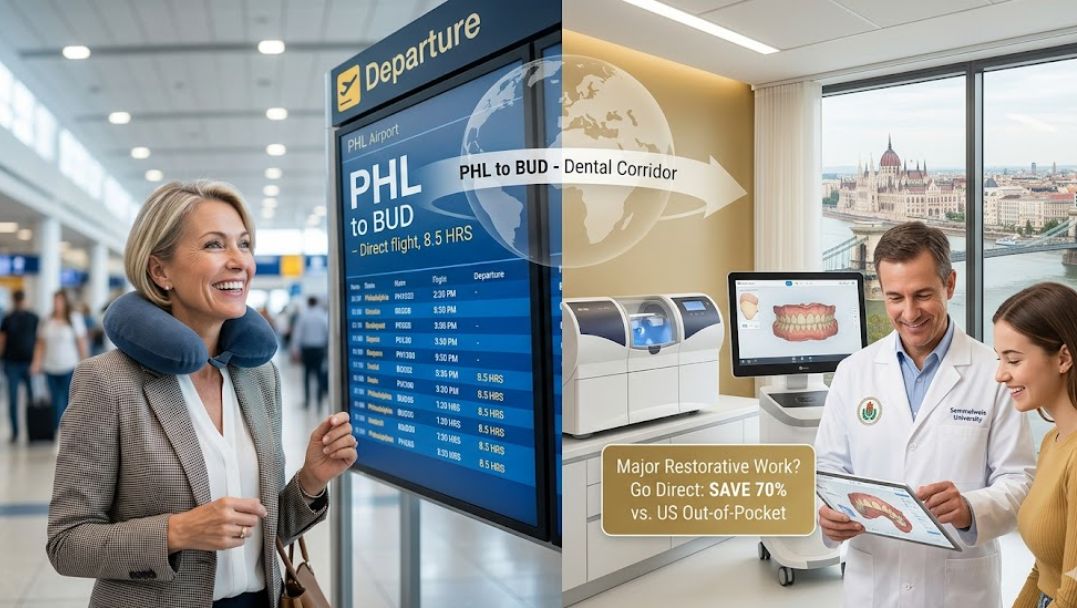
This financial gap is driving the “Philadelphia-Budapest Corridor.” With the 2026 launch of daily direct flights from Philadelphia International Airport (PHL) to Budapest (BUD), the logistical barriers to European dental care have vanished for East Coast residents.
Why Budapest is the Logical Choice for MetLife Members
Budapest has spent decades as the “Dental Capital of Europe.” For a MetLife member, the value proposition is simple: The total cost of the procedure in Budapest, including airfare and a week in a luxury hotel, is often less than the “Patient Responsibility” portion of a US dental bill.
| Procedure | US Cost (with MetLife) | Budapest Cost (Out-of-Pocket) |
| Dental Implant (Complete) | $5,550 ($4,050 after cap) | $1,150 |
| Zirconia Crown | $1,800 ($900 after cap) | $450 |
| All-on-4 (Full Arch) | $30,000+ | $8,500 |
5. Quality Assurance: Semmelweis Standards
One of the most common questions from MetLife members is: “Will the quality be the same?” In Budapest, the answer is found in Semmelweis University. Hungarian dental education is world-renowned, and the city’s top clinics—such as those catering to the “Direct PHL Flight” demographic—are ISO 9001 certified. These clinics utilize the same Swiss and German implant systems (Straumann, Nobel Biocare) that a high-end US prosthodontist would use, but at a fraction of the cost due to lower overhead and subsidized medical education.
6. Utilizing MetLife Benefits for Overseas Treatment
Can you use MetLife in Budapest? The answer is: Technically, yes.
-
Out-of-Network Reimbursement: Most MetLife PPO plans allow for “Out-of-Network” claims. While you must pay the Budapest clinic upfront, you can submit your itemized English-language invoice (which top Budapest clinics provide as standard) to MetLife for reimbursement at OON rates.
-
The Diagnostic Strategy: Use your MetLife “In-Network” benefits for your initial 3D CT scans and cleanings in the US. Get your diagnosis at home, then send the digital files to Budapest for a “Second Opinion” and a quote.
-
HSA/FSA Synergy: Because the IRS recognizes dental work in Hungary as a qualified medical expense, you can use your Health Savings Account to pay for the treatment tax-free, even if MetLife only covers a portion.
7. The Experience: Recovery in the City of Spas
A major draw for the Philadelphia-based patient is the recovery phase. Instead of driving home through I-95 traffic after a procedure, patients in Budapest recover in the world-famous Széchenyi Thermal Baths. The combination of high-end clinical care and a “vacation” atmosphere reduces the cortisol levels associated with dental work, often leading to better healing outcomes.
8. Final Verdict: The 2026 Strategy
MetLife Dental is a premier product for preventative health. It is an essential tool for maintaining your natural teeth and catching issues early.
However, if you have already crossed the threshold into “Major Restorative” territory, you must look beyond the limitations of the $1,500 cap. The new direct flight from Philadelphia has changed the map. By combining the preventative power of MetLife at home with the restorative expertise of Budapest abroad, US patients finally have a way to beat the high cost of American dentistry without sacrificing quality.
Our Recommendation: Use MetLife for your checkups, but for your dental implants, use your passport. Budapest is no longer a world away—it’s just one direct flight from Philly.