For over 60 years, Delta Dental has reigned as the undisputed heavyweight of the American dental insurance market. With a network that encompasses nearly 150,000 dentists and coverage for over 80 million members, it is the default choice for most HR departments and individual shoppers alike.
However, for the modern patient facing significant restorative needs – dental implants, full-mouth reconstructions, or complex bridge work – Delta Dental presents a fascinating paradox. While it is excellent for preventing minor issues from becoming major ones, it often leaves patients financially stranded when the “major work” actually begins.
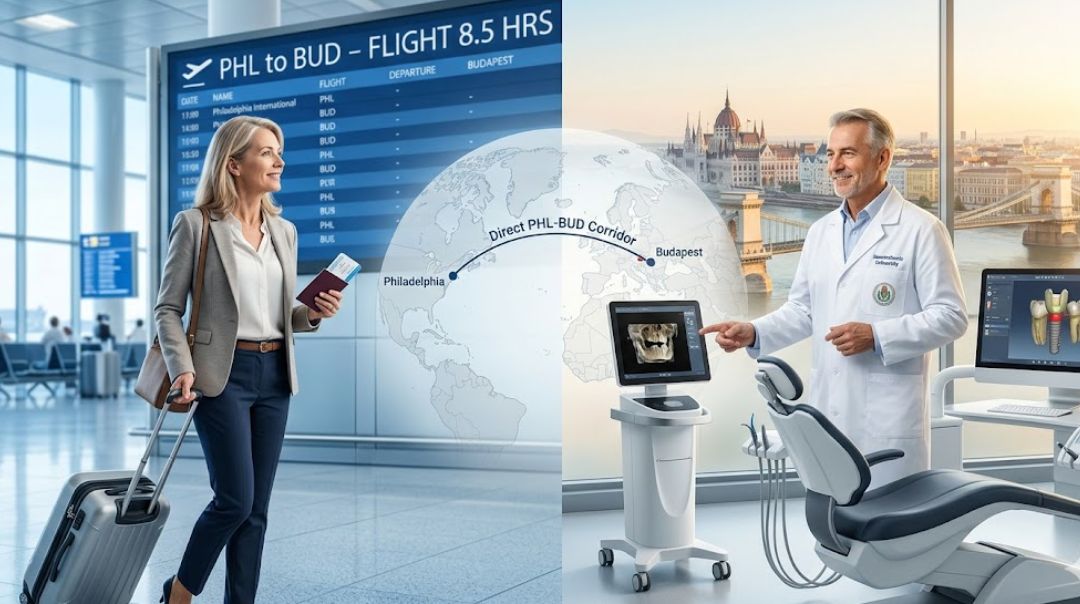
In this review, we will dissect the Delta Dental ecosystem, explore the structural limitations of US dental insurance, and explain why a new direct flight path from Philadelphia to Budapest is becoming the most popular “coverage expansion” for savvy American patients.
1. Understanding the Delta Dental Ecosystem: PPO vs. Premier
Delta Dental operates unlike most other insurers because of its two-tiered provider network. Understanding the difference between Delta Dental PPO and Delta Dental Premier is critical for any US patient.
The PPO Tier
The PPO (Preferred Provider Organization) is the standard model. You visit a dentist who has agreed to a specific fee schedule. You pay your coinsurance (usually 20% for fillings, 50% for crowns), and the insurer covers the rest.
The Premier Tier
This is Delta’s unique “safety net.” The Premier network is significantly larger than the PPO network. While the out-of-pocket costs are slightly higher than the PPO tier, they are still “contractually limited.” This is Delta’s greatest strength: the sheer probability that your favorite neighborhood dentist is “in-network” is higher with Delta than with Cigna or Aetna.
2. The “Math of Failure”: The Annual Maximum Trap
The primary criticism of Delta Dental—and indeed the entire US dental insurance industry—is the Annual Maximum Benefit.
In 1970, the average annual maximum for a dental plan was approximately $1,000. In 2026, the average annual maximum for a Delta Dental PPO plan is still approximately $1,500 to $2,000.
If we adjust for inflation, a 1970 limit of $1,000 should be worth nearly $8,000 today. Because insurance caps have not kept pace with the cost of medical technology, dental insurance in the US has shifted from being “insurance” to being a “pre-paid maintenance plan.”
The Breaking Point
Consider a patient in Philadelphia who needs two dental implants and a sinus lift.
-
Total Cost in the US: ~$9,000
-
Delta Dental PPO Coverage: 50% (after a 6-12 month waiting period).
-
The Catch: The plan stops paying once it reaches the $1,500 cap.
-
Patient Responsibility: $7,500.
This $7,500 “gap” is precisely why the American East Coast is looking toward Central Europe for relief.
3. The Budapest Bridge: A New Era for US Dental Patients
For decades, European patients from the UK, Germany, and Scandinavia have treated Budapest, Hungary, as their primary dental hub. Now, the American East Coast is catching on, facilitated by the expansion of direct flight routes from major hubs like Philadelphia (PHL).
Why Budapest is the “Dental Capital of the World”
Budapest has more dentists per capita than almost any other city on earth. However, for a US patient, the appeal isn’t just the quantity—it’s the specialized focus on Restorative Dental Tourism.
While your local Philadelphia dentist might place 20 implants a year, a lead surgeon at a top Budapest clinic likely places 500 to 1,000. This volume creates a level of clinical expertise and technological investment that is difficult to find in standard US family practices.
4. Quality Comparison: US Standards vs. Hungarian Standards
A common hesitation for Delta Dental members is the fear of “offshore” quality. However, the regulatory environment in Hungary is exceptionally rigorous.
-
Education: Hungarian dentists graduate from world-renowned institutions like Semmelweis University. The curriculum is so prestigious that it attracts thousands of international students from the US and Canada who then take their boards back home.
-
Technology: Because Budapest clinics serve an international clientele, they often invest in technology faster than US suburban offices. It is standard to find 3D Cone Beam CT (CBCT), CAD/CAM digital milling, and laser dentistry all under one roof.
-
Materials: Leading Budapest clinics use the exact same hardware as US specialists—Straumann (Switzerland) or Nobel Biocare (Sweden) implants. The difference is that the Hungarian clinic buys these components at European medical rates and passes the savings to the patient.
5. The Financial Logic of the “Dental Vacation”
Let’s look at the logistics of a patient utilizing the new direct flight from Philadelphia to Budapest.
The Flight
A direct flight from PHL to BUD takes roughly 8.5 to 9 hours. For a patient in the Northeast, this is marginally longer than a flight to Seattle but significantly more productive.
The Cost-Benefit Matrix (2026 Estimates)
| Procedure | US Average (Delta PPO) | Budapest Average (Out-of-Pocket) |
| Zirconia Crown | $1,600 ($800 after cap) | $450 |
| Dental Implant (Full) | $4,500 ($3,500 after cap) | $1,200 |
| All-on-4 (Full Arch) | $28,000 ($26,500 after cap) | $9,500 |
For any patient requiring more than $4,000 worth of work, the “Budapest Option” pays for the flight, a 4-star hotel, and the treatment itself, while still leaving thousands of dollars in the patient’s bank account.
6. How to Use Delta Dental and Budapest Together
Smart patients do not cancel their Delta Dental insurance. Instead, they use it strategically alongside their overseas treatment.
-
Use Delta for Diagnostics: Get your initial X-rays, cleanings, and consultations done at home using your Delta Dental PPO benefits.
-
Request a Digital Copy: Ask your US dentist for your digital 360-degree CT scan. You can email this to a Budapest clinic for a remote preliminary quote.
-
Save the “Major” Category: Use your insurance for the small stuff (fillings, cleanings) and save your “Dental Budget” for the high-ticket items in Budapest where your dollar goes 300% further.
-
HSA/FSA Compatibility: Most Americans don’t realize that Health Savings Accounts (HSA) and Flexible Spending Accounts (FSA) can often be used for legitimate medical and dental expenses abroad, even if your Delta insurance doesn’t directly pay the Hungarian clinic.
7. The Experience: Recovery in the City of Spas
One element the US dental experience cannot replicate is the recovery environment. Budapest is known as the “City of Spas” due to its natural thermal springs.
Post-operative recovery in the US usually involves a drive through traffic and a pharmacy stop. In Budapest, patients spend their recovery days visiting the Széchenyi or Gellért thermal baths. The mineral-rich waters and relaxed atmosphere significantly reduce the stress associated with major dental surgery, turning a medical necessity into a holistic wellness experience.
8. Final Verdict: Is Delta Dental Enough?
Delta Dental is an excellent tool for the “average” American year—the year where you need two cleanings and perhaps a small filling. It is a reliable, widely-accepted safety net.
However, if you are a patient facing a “catastrophic dental year”—one involving multiple extractions, implants, or bone grafting—Delta Dental is mathematically insufficient. The $1,500 annual limit is a relic of a bygone era.
With the new accessibility of direct flights from Philadelphia, Budapest has effectively become the “Northeast’s Dental Annex.” It offers a way to bypass the limitations of US insurance and access world-class, European-standard care at prices that the American market simply cannot match.
The Expert Recommendation: Keep your Delta Dental plan for the preventative basics, but for anything that requires a “Specialist,” book a flight to Budapest. Your smile—and your retirement account—will thank you.